Monday, June 10, 2024

Batman in the 1960s Issue 24: November/ December 1963


The Caped Crusader in the 1960s
by Jack Seabrook
& Peter Enfantino


Moldoff
Batman #159

"The Great Clayface-Joker Feud"
Story by Bill Finger
Art by Sheldon Moldoff & Charles Paris

"The Boyhood of Bruce Wayne Jr."
Story by Bill Finger
Art by Sheldon Moldoff & Charles Paris

Kathy Kane's niece, Betty (a/k/a Batgirl), is visiting her aunt (a/k/a Batwoman) and she and Robin swoon over the prospect of working together again. Suddenly, a radio news bulletin alerts Batman that Clayface has escaped from prison! The next night, Clayface, in the form of a giant eagle, tries to rob the gate receipts from the Architect's Exposition (surely a source of huge profits). Batman and Robin try to stop him, but the villain manages to escape after revealing that his powers no longer last 24 hours and now start to wear out after five hours.

Batman and Robin surmise that Clayface managed to hide some of the magic pool liquid that facilitates his transformation and then used it to create a synthetic equivalent that had less staying power. In an underworld hangout, hoodlums agree that Clayface is the top criminal in the country, but the Joker bursts in and calls Clayface a "'blundering third-rater.'" The next night, Batwoman is being crowned "Queen of Space" as the greatest space rocket is christened after her, when the Joker appears and steals the crown from her head. Batgirl confronts the Joker and is nearly knocked off a high spot to her doom when Robin rushes to her aid. The Joker transforms into a winged sphinx and flies away; it turns out he was Clayface impersonating the Joker!

The next day, Commissioner Gordon tells Batman that he received a tip that Clayface plans to steal a gold idol from the Gotham Museum. The Dynamic Duo rush there and find not Clayface but the Joker! After some silliness with various Joker costumes, the Clown Prince escapes out a window with the idol. Clayface reads about the Joker's antics and sees a TV news report stating that a rajah will give Batman the King of Diamonds, a fabulous gem. The next night, the Joker shows up to steal the jewel but Clayface also appears and knocks out Batman and the Joker before carrying them off in the guise of a gorilla.

Clayface takes Batman and the Joker to his hideout and ties them up, whereupon the Joker suggests that they team up. Clayface unties the Joker before unmasking Batman, but the top half of Bruce Wayne's face is obscured by clay. The Joker knocks out Clayface and we learn that he's really Batman, disguised as the Joker, and Batman is really the Batman robot. The Joker has been in jail since the night he tried to steal the idol, having been captured  by Batwoman and Batgirl, who were flying by the museum on Whirlybats. Clayface is put behind bars, but vows to cause more mayhem when he gets out.

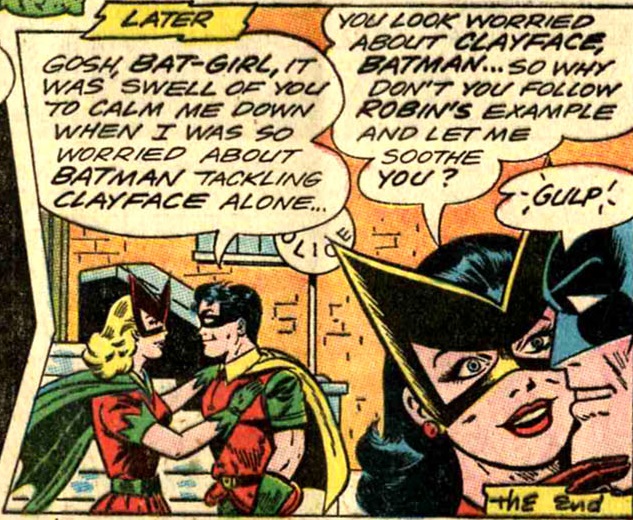
Forget about the complicated plot and "The Great Clayface-Joker Feud"! What I liked best about this double-length (16-page) story were the goofy romance-comic panels between Robin and Batgirl and between Batman and Batwoman! When Betty and Robin see each other, they both sigh at the prospect of working together again.


Robin saves Batgirl and she swoons; Batwoman tries the same move on Batman and he gives the reader a look that says, "Oh, brother!"


In the last panel, Robin and Batgirl look ready to make out, but when Batwoman offers to soothe Batman, all he can say is "'Gulp!'" This stuff is hilarious!

Having finished the dusting and sweeping, Alfred sits down to type out another imaginary tale of Batman and Robin's future: "The Boyhood of Bruce Wayne Jr." Bruce Wayne/Batman marries Kathy Kane/Batwoman and, a year later, Kathy gives birth to Bruce Jr. As the lad grows, Uncle Dick trains him in gymnastics and Dad plays some baseball with sonny. Junior shows promise as a future crimefighter when he helps Batman and Robin solve the mysterious disappearance of the Green Owl Gang; he remarks that they must be magicians, so Batman, Robin, and Batwoman follow them and discover that it really is all done with mirrors.

One day, Bruce Jr. is trying to impress some other guys and blurts out that his Dad is Batman. Fortunately, Batman is within earshot, and convinces the boys that the mere thought is ludicrous; he also teaches them a lesson about how every boy's father is important. Eventually, Bruce Jr. would grow up to be the new Robin to Dick's new Batman!

In this issue's letters column, Kenneth S. Sanders of Los Angeles complains that characters like Bat-Girl and Batwoman are taking too much interest away from the main characters. The editor replies that the majority of readers disagree, but he also reassures Kenneth that there will still be stories about outer space villains. As Robin would say, "sigh."-Jack

Peter-I liked both these stories. The first has a way-too-complicated expository at the climax, one of those "Okay, so here's what really happened..." panels that can force a reader to think. Who wants to think? I can't stand the Alfred imaginary tales, but "The Boyhood of Bruce Wayne, Jr." wasn't bad at all. I wonder if the average 8-year-old reader realized that Batman had to have sex to father a kid. I'm surprised the CCA didn't step in. 


Moldoff
Detective Comics #321

"The Terrible Trio!"
Story by Dave Wood
Art by Sheldon Moldoff & Charles Paris

Lock up your daughters! "The Terrible Trio!" are back in town. Yes, the Fox (land heists), the Shark (by sea), and the Vulture (by air) have escaped Gotham Pen and have three money-making schemes in mind. First, the Vulture has a flock of pigeons illegally smuggled into Gotham Airport, where an inside man opens the cage and lets them fly free. Batman and Robin, at the airport following up a clue, hop on their Whirly-Bats and give chase to the filthy fowl. 

Their flight leads them right into the hideout of the Vulture, where the boys witness the criminal untie diamonds from around the birds' talons. They also overhear the loony villain tell his feathered friends that it's the Shark's turn the following day to pull off his end of the heists, with the Fox carrying out a "human cargo" operation as the grand finale. Alas, the Dynamic Duo make a little too much noise while sneaking up on the Vulture and he sics a pair of eagles on the heroes. The Vulture gets away in a missile and the boys are left wondering why they constantly let the bad guys escape in the first act.

The next day, Batman and Robin head out to sea on the Bat-Boat to smoke out the Shark. They spy a cargo ship dumping copious amounts of fish over the side and porpoises grabbing at the snacks. Just then, the Shark Sub emerges from the deeps and the Trio hop onto the surface, accepting the fish bounty spit at them by their trained porpoises. Once again, the Caped Crusaders muck up the Trio's plans and once again the bad guys escape. Back on the Bat-Boat, Batman and Robin examine the fish they've captured and discover that each one has a counterfeit bill plate inside its guts (yecccch!). 

Back at the Bat-Cave, it's brainstorming time as the boys try to out-fox the Fox and his "human cargo" operation. Robin shows that, every now and then, his seventh-grade education pays off when he opines that perhaps the Fox intends to provide a getaway service to escaped criminals. "Holy cow," exclaims the World's Greatest Detective in a roundabout compliment, "That's the most obvious solution!" Later that night, Batwoman answers a call for help from the police; hardened criminal Archie Craig has jumped the wall at Gotham Pen. Craig heads to middle man, Mouthy, for a way out of Gotham, and Mouthy sends him down into a deserted subway station. Batwoman catches a glimpse of Craig heading down the stairs and follows him, arriving in the bowels of the station just in time to watch the con hop into a giant mole machine with the Fox. The gizmo gears up and digs its way into the Earth.

The vehicle pops up on the surface at a secluded hideout, where the remaining two-thirds of the Trio await. Shortly after their arrival, Robin shows up and Batman removes his Archie Craig disguise; the two engage in battle with the three nature freaks. Yet again, Gotham's favorite heroes are defeated; this time they are loaded into missiles and blasted off into space. Through their utility belts (which for some reason were not perceived to be a threat!), the boys communicate and Batman explains that the manual controls for the missiles have been shut off. It's surely curtains for our heroes. Not so fast, screeches Batwoman, as she throws a net over the Trio and turns the manual controls lever to "On." Bats and Robin are saved and Kathy giggles and confesses that it's a good thing she didn't know that Archie Craig was really Batman or she wouldn't have bothered following. "Huh, yeah right! Since when did you not want part of the limelight?" chortles the Dark Knight.

Another inane but perfectly enjoyable adventure from Dave Wood. I thought it was interesting that we never saw The Terrible Trio unmasked, not even for a moment. These guys are all very serious about their work. But then you could tell that from their elaborate plans. Shoving steel plates down fish gullets has got to take a bit of time and that mole machine must have cost a pretty penny. I love how the Fox is trusting of "Archie Craig," even if the guy never gave him any dough (Mouthy says "Sure, sure!" when "Archie" says he's good for it). They're thieves but trusting thieves. The Trio first appeared in Detective #253 (March 1958) and would see a few different variations on their roster (and costuming) throughout the following decades.-Peter

Jack-I was surprised when Robin said that the Whirly-Bats were in the Batmobile's trunk. They sure don't make cars like they used to! I don't think one of the Whirly-Bat blades would fit in my trunk. I was happy to see Batwoman again; more and more, she and Bat-Girl light up otherwise dull stories. And thank goodness that the Terrible Trio included a handy "manual missile control" switch that was clearly labeled! That was a close one.


Moldoff
Batman #160

"The Mystery of Madcap Island"
Story by Bill Finger
Art by Sheldon Moldoff & Charles Paris

"The Alien Boss of Gotham City"
Story by Dave Wood
Art by Sheldon Moldoff & Charles Paris

Gangster Ed Kiley has loot stolen by the Green Hood Gang! Following a clue, Batman and Robin travel to Madcap Island, "'where eccentric rich people have those crazy summer homes,'" according to Robin. The island is a Moldoff explosion of giant wackiness. The rich folks seem to build their houses to represent their businesses, and it's not just houses--Benson, of Benson Binoculars, drives up in a car shaped like a giant pair of binoculars.

Jason Reid, dishware manufacturer, had a different idea, though, and built his big house in the shape of Batman's head and torso. The Dynamic Duo manage to escape being knocked off of a cliff by the spray from a giant water pistol. Hearing a shot from Bart's Soda Shop, they discover that Bart (dressed like a soda jerk) ducked when Kiley fired at him after Bart discovered Kiley hiding, possibly in search of a giant milkshake.

Batman and Robin find Kiley, dead and lying on the cuckoo of a giant cuckoo clock and chase a masked man whom they assume is his killer. The man escapes but, when Batman finds Kiley's gun, he gets a bright idea. That night, Bart visits Reid, Kiley's boss, and admits that he shot and killed Kiley. Batman and Robin burst in and capture Bart; Reid escapes and Batman chases him on top of the big Batman house. Reid tries to escape in a big flying cup and saucer, but Batman bounces on some patio furniture and leaps up to catch Reid.

What this all has to do with the Green Hood Gang is anyone's guess. "The Mystery of Madcap Island" is Bill Finger's gift to Sheldon Moldoff, allowing him to go wild and draw any big, zany item he can think of. The early '60s were such a fun time--the super-wealthy actually all lived together during the summer on an island, where they built big houses shaped like soda shops, flew around in cups and saucers, and drove binocular mobiles. Nowadays they just buy social media companies and spend their time sending out angry messages.

When Batman and Robin encounter a gang robbing a bank truck, they are surprised to discover that the leader is "The Alien Boss of Gotham City," a green-skinned, bald fellow named Lido whose spaceship crash-landed and who decided to take over a local gang. It turns out that the alien isn't an alien at all, but rather a human gang boss who found the abandoned spaceship and decided to pretend to be an alien. Batman concludes that the alien abandoned the ship before it ever crashed.

The alien's striped sleeves resemble those of Amazo, from Justice League comics, and Dave Wood allows readers  to have their alien cake and eat it, too, by writing most of the story as if the alien is real and then revealing that he's just another crook in the end. One question: why bother? Wasn't it a lot of work to come up with the alien costume, not to mention all of the alien gadgets? And if the mob boss could invent this stuff and convince everyone he was from Planet Claire, why was he so easy to capture?-Jack

Peter-"Madcap Island" is dopey fun, from its outlandish architecture to its amazing lawn furniture (with springs that can launch a man sixty feet in the air!). How is it that eccentric millionaire Bruce Wayne doesn't own a pad on Madcap Island? "Alien Boss" is the pits in both script and art departments. It's hard to believe the Moldoff/Paris team that did a semi-decent job on the first story are the same guys who doodled out the stick figures for the second. It's bad enough we get so many alien stories; now we get faux-alien stories. 

I love reading the letters pages; the readers are always so perceptive. "Why don't you have a story where the Penguin steals a spaceship and flies to Mars where he plans to destroy Earth with a laser beam?" writes little Jackie Seabrook from the Garden State, and editor Jack Schiff answers along the lines of "Well, Jackie, we have just such an adventure lined up in the March issue of Brave and the Bold!" Makes you wonder if the 8-year-olds were really writing those LOCs.


Moldoff
Detective Comics #322

"The Bizarre Batman Genie"
Story by Dave Wood
Art by Sheldon Moldoff & Charles Paris

Batman and Robin are summoned to the Gotham Museum, where they are told the building was broken into but, bizarrely, barely pilfered. The only artifact stolen was the "relatively worthless" Larko Lamp. Batman explains to all those listening (including the museum's curator, who already knows the legend) that, in ancient times, a sorcerer named Larko invented a lamp that made anyone his slave when sprinkled with some sort of fairy dust. The powder trapped its victim within the lamp, a slave to its owner.

Shortly thereafter, Gordon is given a tip that some of the dust was stolen from an excavation site and is, as we speak, on its way to Gotham in the clutches of evil genius, Aristo! The Caped Crusaders head Aristo off at the airport, but the semi-magician gets the drop on the boys and tosses the magic powder at Batman. Bats disappears and Robin is left to ponder his own future in crimefighting.

At the requisite villain barn outside of Gotham, Aristo maps out his plan to his two pea-brained assistants. He now holds Batman captive within the lamp and the Dark Knight must follow Aristo's orders three times without fail. First up, Aristo orders the Giant-Sized Batman to "plunder the Gotham Mint." "The Bizarre Batman Genie" heads down to the Mint, unable to disobey. He pulls the roof off and empties the building of its contents. Once the Genie is back in the lamp, Aristo has a look at his booty (well, I mean, he has a look at the ill-gotten gains). But Robin was two steps ahead of Aristo and had Bat-Girl go down to the local produce market and buy forty tons of mint so that the Genie-Batman would be thrown off his game. Aristo is not pleased.

Wish number two forces Bat-Genie to become bodyguard to the Aristo gang as they rob the Diamond Exchange. As the getaway truck speeds out of Gotham, Robin hops in the back (under the veil of Bat-Girl's Estee Lauder hairspray smoke bomb!) and attempts to take control of the truck. He manages to grab the lamp just as the truck moves over a bridge. The swaying motion causes Robin to lose his grip and he and the lamp tumble into the river. Aristo and his gang find the lamp and attempt to summon Bat-Genie. Batman--the man, the legend, the regular-sized superhero--steps out of the bushes and decks Aristo, with Robin dispatching the moronic henchmen. When Aristo begs to know why Batman didn't come out of the lamp, Robin laughs and tells the criminal that the third wish was already utilized.... by Robin himself, when he summoned the genie to save him from drowning. The Dynamic Duo have a laugh on Aristo's behalf and take the goons away.

Most of these 1960s fantasy Batman adventures are a load of fun, but some, like "The Bizarre Batman Genie," are just too outlandish and ridiculous for my tastes. The cast just seems to absorb every fantastical event that comes their way with a sigh and a rolling up of the sleeves. Wouldn't it have been easier for Robin to just empty the Mint rather than take the time to locate tons of mint plants? And how did he have time to set up the ruse? Poor Bat-Girl is relegated to standing around and only participating when one of her fancy cosmetics can come in handy. Chanel No. 5 fire extinguisher. Dior laughing gas. L'Occitane facial masks. This hobby might get expensive! 

I often wonder if, decades later, Nightwing and a so-much-darker version of our happy-go-lucky Bat-Guy sat around chugging Guinness and reliving past cases. 

Batman: Hard to forget the time you died at dawn, little buddy.
Robin: How about the time Bane broke your back?
Batman: No, no, no, what about the time the Joker dumped that guy in the shark tank?
Robin: Yeah, but none of that compares to the time you turned into a giant genie and tore the roof off the Gotham Mint!
Batman (raises his stein): To the good times!-Peter

Jack-To the good times, indeed! This is silly but fun. As I read it, I was struck by how quickly things happen in the stories of this era. Page one is always a splash page previewing a big event that will occur later in the story. By page six, Batman has turned into a genie and Bat-Girl has shown up. And by page 13, which is only half a page, it's all wrapped up. DC writers were efficient plotters.


Next Week...
Bernie Krigstein Brings to Mind
EC Comics in "The Hypnotist!"

Monday, June 3, 2024

Journey Into Strange Tales Issue 113: Marvel/Atlas Horror and Science Fiction Comics!


The Marvel/Atlas 
Horror Comics
Part 98
February 1956 Part III
by Peter Enfantino
and Jack Seabrook


Strange Tales #43
Cover by Russ Heath

"The Man Who Lived Twice!" (a: Tony DiPreta) ★
"I Saved Mankind!" (a: John Forte) ★1/2
"Behind the Mask!" (a: Bob Brown & Joe Giella (?)) ★
"The Mysterious Machine!" (a: Larry Woromay & Steve Kirkel) ★★
"The Unbelievable Man!" (a: Bob Forgione & Jack Abel) ★

Hal Walters lies dying on the operating table, but when an odd twist of fate grants him a reprieve, he becomes "The Man Who Lived Twice!" Well, kinda. Time is suspended and Hal gets to live one year per second on the clock. But he only has five seconds till he dies. How does he know this? Don't ask me. But Hal uses his time wisely. He plants pear trees along Main Street, shuts down nuclear reactors that are about to go Defcon-4, talks John Lennon out of going to that gallery, etc. When his five years are up and Hal has made everything right in the world, he accepts his fate. The script for "The Man Who Lived Twice!" asks the reader to suspend disbelief several times over its five-page span, but so do most other Atlas post-code fantasy tales. It's the dreadful art that really sinks this strip. Hard to believe this is the same DiPreta I raved about during the pre-code era; gone are the odd angles and eerie character depictions, replaced by stiff cardboard cut-outs. 

Lester Harmon awakens one night during a violent storm and hears a strange sound emanating from the woods. He goes out to investigate and stumbles across a group of aliens dumping vats of liquid into the town's reservoir. Knowing that aliens + good intentions don't mix, Lester fires a warning shot and the aliens grab their barrels and hoof it back to their UFO. Lester calls the White House and explains that if there's one spaceship, there might be two. Without hesitation, the Air Force is scrambled and all the UFOs are sent packing. Lester shrugs and exclaims "I Saved Mankind!" on national TV while the space visitors, who were actually dumping an elixir that would eradicate disease from Earth, head back to Planet X--Third From the Right. Like "The Man Who Lived Twice," any brief interlude of wit in "I Saved Mankind!" is buried in the muck of the heavily-inked, mediocre artwork.

This issue's theme of "Awful Art" continues with "Behind the Mask," about Joe Fenton, a carnival clown who desperately wants to adopt a kid with his wife. Because of his work schedule (!), the adoption agency turns the couple down, but a miracle arrives when Joe is walking home through a field and literally stumbles over an abandoned baby. The Fentons agree to keep the kid and tell all their friends they've finally been granted that adoption. 

Joe's happiness comes to a screeching halt when he overhears the baby speaking into a strange object and informing his C.O. that the way is nearly clear for the big Earth invasion. Yes! Joe Fenton's new son is actually Ogu, emissary from another world! Joe can't decide whether to keep quiet or to call the White House, like Lester Harmon did. In the end, that unhappy option is eliminated when he overhears Ogu telling his contact that Earth is a splendid place to live and should not be invaded. And oh, by the way, can Ogu stay? I'm not sure I understand the decision not to invade a planet you were already geared up for because the inhabitants are swell people, but if the order had been to go ahead and invade, then we wouldn't have been "blessed" with the saccharine-saturated finale. Yecccccch.

Frederick Harper has been working on a machine that can "convert" things (don't ask questions), but the darn thing doesn't want to do what it's supposed to do. Fed up after years of marriage to a worm, wife Louella pushes "The Mysterious Machine!" over and the gizmo spits out a diamond. Fred explains that the gem had previously been a simple rock. Louella takes the diamond to a jeweler and the man confirms its value, handing the amazed woman a cool grand in a quick sale. Louella heads home and tells her spineless husband to get cracking. 

Fred pumps out diamond after diamond and Louella poshes up her surroundings exponentially. Then, one day, Fred tells his wife he won't do it anymore, that man was not meant to tamper with the laws of nature and all that. He's going to change all the diamonds back to rocks. Louella enters the machine to retrieve her bounty and the converter switches on. Once the cycle is complete, Louella exits the contraption a loving wife who only wants to cuddle and make sandwiches for her hubby. I found "The Mysterious Machine!" to be enjoyable, despite some red flags (why does Fred suddenly decide it's not natural to turn rocks into gems after he's crafted millions of dollars' worth?) and the Woromay/Kirkel art sure looks like Howard Nostrand in spots. [Looks like bargain-basement Jack Davis to me!--Jack]

Someone is breaking into the lab of famed electronics expert, Professor Bryce, and stealing equipment. When Bryce stays after hours one night to try to catch the culprit, a man in fancy garb materializes and explains he's from the 18th century and came to the present via time machine to borrow elaborate devices in order to invent electric lights! Bryce refuses to let the man bring back any of his equipment and, moments after the man heads back to his own time, the lights go out across the world!

"The Unbelievable Man!" is another of those really contrived, headache-inducing time travel yarns that makes no sense no matter how many times you read it. Sure, I get that the lights go out, but why would the professor have a breaker box and fuses for lights that don't exist in the first place? And this guy is such a genius that he invented a time machine, but he has to cheat in order to become father of the light bulb!-Peter


Strange Tales of the Unusual #2
Cover by Sol Brodsky & Carl Burgos

"He Waits in the Dark Alley" (a: Bill Everett) ★★
"Man Afraid" (a: Joe Orlando) ★1/2
"The Man Without a Heart" (a: Robert Q. Sale) ★
"Those Who Plan" (a: John Forte) ★
"Lost on the Wrong World" (a: Art Peddy & Bernard Baily(?)) ★

A skid row bum sleeps in alleys and regrets his life choices, remembering that his father once told him that if he wished hard enough, his dreams would come true. Ha! Yeah, right. Suddenly, the wino stumbles over a newspaper and, picking it up, notices that it has tomorrow's date.

Thinking back to that timely quote issued by his father, the vagrant decides this is a message from Heaven, his one big chance. Skimming the headlines, he comes across an item about a millionaire being assaulted in front of his office building. Picturing the huge reward the mogul will pay out, our hero hurries over to the building in order to interrupt the violent incident. He sees the tycoon and a car slowing down with a gun barrel pointed at its target. The bum wrestles the rich man to the ground and... is summarily arrested for assault. Just then, a policeman pokes the bum with his nightstick and he realizes he's back in his alley. It was all a dream! Then he sees the same newspaper lying on the ground and decides to mind his own business.

Wow! Never saw that big twist coming! "He Waits in the Dark Alley" starts out interestingly enough, with our protagonist mulling his fate ("If only I could get a break--get lots of money! But that would take some special kind of miracle! Me, I just get lower and lower as the years go by!"), but quickly becomes the same old "peek into the future" nonsense. The story can't be completely ignored, however, since it features some atmospheric Bill Everett artwork.

"Man Afraid" is a mediocre alien espionage thriller about a guy who suddenly becomes convinced that the people around him are aliens. It's only in the end that he discovers he can pick the outer space visitors out of a crowd because he's one of them! Another cliched plot device covered. Artist Joe Orlando still seems to be developing that eerie style he perfected once he became the chief architect of the DC mystery titles.

Pulp hack Carl Wessler earns his easiest twenty bucks when he rewrites Dickens' A Christmas Carol as "The Man Without a Heart." Seriously, we've called out swipes and cliches numerous times here, but this has to be one of the most egregious examples set down on paper. Were there no copies of the Dickens holiday classic circulating in America in 1956?

The doldrums continue with "Those Who Plan," wherein a poor schmuck overhears two dogs talking about world domination and then tries to convince the authorities of the plot. He's first shown the precinct door and then, eventually, loaded into a wagon by those nice young men in their clean white coats.

And... let's add a cherry on top with the confusing "Lost on the Wrong World." Mean-spirited Harvey Watts visits his optician in order to get new eyeglasses, but when the specs are fitted, Harvey sees his face on everyone around him. After a long, convoluted, and unfunny series of events, Harvey becomes disgusted with mankind and takes a rocket ship to Mars, where he lives happily ever after. Five cliched and lazily-written tales in one issue. I believe this is why slabbed comics were invented.-Peter


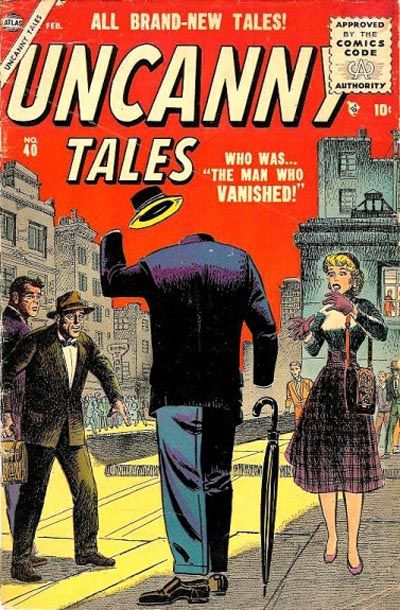
Uncanny Tales #40
Cover by Carl Burgos

"The Night the Sphinx Spoke!" (a: Dick Ayers) ★
"There Is No Escape" (a: Ross Andru) ★1/2
"A Day to Remember" (a: John Severin) ★★1/2
"The Man Who Vanished!" (a: John Forte) ★★
"A Man's Best Friend" (a: Ed Winiarski) ★★
"Trapped in the Labyrinth!" (a: Doug Wildey) ★★1/2

Archaeologists have discovered a secret chamber in the sphinx, so a crook named Vince cooks up a scheme to trick superstitious local workmen into handing over the jewels they find in the chamber. Vince wires the sphinx for sound and "The Night the Sphinx Spoke!" follows. It tells the workmen to hand over the jewels to Pharaoh, who is actually Vince's cohort, Jerry, in costume. The handoff goes as planned, but when Vince returns to Cairo to meet up with Jerry, he is arrested and thrown in the clink with Jerry, who says that he was arrested that morning for stealing a pharaoh costume from the museum. But if the sphinx wasn't Jerry, who was it?

Raise your hand if you didn't see that ending coming. You are officially banned from reading Atlas comics. You'll thank me. Dick Ayers turns in some awful art here and this issue is notable for including six stories rather than the usual five; none exceed four pages.

Chased down a dark alley by androids, a man fears that "There is No Escape"! He makes his way to a secret meeting of humans and tells them that androids are a menace. The humans are skeptical, but the man insists. He leaves and is again trailed until he succeeds in reaching a safe house, where he climbs into a tub and pushes a button to turn himself off. A small group of humans and androids enter and agree that the man, a robot, needs to be controlled so that it doesn't ruin the peace between humans and androids.

The only plus about this four-pager is that Ross Andru tried a bit harder with his panels than Dick Ayers did in the story before it. Otherwise, it makes little sense and just takes up space.

Rupert leaves for work in the morning but can't remember what the thing was that he was supposed to remember today. Neither can his wife, Thelma. On his way to work, Rupert finds a wallet on the sidewalk. Inside it is a note promising a reward to the person who brings it to 236 Elm Drive.

Rupert takes a bus to Elm Drive and approaches the house, the roof of which resembles a rocket ship. He enters and is welcomed by Martians, who reveal that the reward is a free trip to Mars! Rupert tries to decline but is told that the Martian king wants to see a real, live Earthling. Unfortunately for the Martians, a short-circuit in the ship's wiring prevents it from taking off and Rupert escapes out a window. Back at home, he and Thelma suddenly recall that today is April Fool's Day! They have a laugh about the Martians but, on Mars, the king is not laughing.

John Severin single-handedly saves the day for this issue of Uncanny Tales with three pages of delightful art. Carl Wessler's script for "A Day to Remember" is silly, but at least we get more Severin. I felt sympathy for Rupert, since I have trouble remembering things all the time.

A painter named Ogden pays a visit to his friend, a doctor named Don Keller, who is experimenting on animals by injecting a serum into them to try to make growths disappear. He's puzzled by the fact that the entire animal disappears for a short time!

Don tells Ogden that his artwork is primitive, like ancient cave paintings. When Don leaves the room to fix coffee for them both, Ogden accidentally injects himself with the serum and becomes "The Man Who Vanished!" He finds himself back in caveman times, hunting a mastodon. When he and the other cavemen return to their cave after the hunt, Og (Ogden's caveman name) begins to sketch pictures on the wall, telling the story of the hunt. He awakens back in Don's house and he and Don sit down to coffee and argue about whether his art is primitive or modern.

I'm a bit taken aback by this story, which actually has some thought behind it. I wonder how many readers in 1956 were familiar with terms like primitive or modern art. John Forte does his usual, adequate job illustrating the tale, but I gave this one a two-star rating because it made me think, at least a little bit, which is not something that often happens when I read Atlas comics.

Harvey thinks that Bruce is just a big, lazy hound, but when a spaceship from Jupiter lands in Harvey's back yard and Bruce is kidnapped as an example of an Earth creature, "A Man's Best Friend" soon proves his worth! Bruce is taken back to Jupiter, where he unwittingly helps the emperor squelch a rebellion. The grateful emperor cancels the planned invasion of Earth and sends Bruce home, where Harvey tells him that he's useless, but he loves him anyway.

We've seen versions of this story before, where a dog saves the planet from alien invaders and the humans never know it. Ed Winiarski is not my favorite Atlas artist, but I like the costumes of the folks on Jupiter--the hooded rebels look like villains from a Golden Age comic.

Wilson and Holt love puzzles so much that they try to come up with games that the other can't solve. Wilson takes Holt to see Massam Farrah, an Indian mystic, who hypnotizes Holt. Holt finds himself in a world so surreal that he can't escape; he admits defeat and Farrah tells him that he was "Trapped in the Labyrinth!" of his own mind.

For an issue that seems to be comprised of short stories from the scrap heap, Uncanny Tales #40 has two tales that are worth a look. The first was "The Man Who Vanished!" and the second is this one. I'm reproducing the last two pages here because they look like something Ditko might have drawn for Dr. Strange a decade later.-Jack


Next Week...
Two of the Rogues
in One Story!

Thursday, May 30, 2024

The Hitchcock Project-Mink by Irwin Gielgud and Gwen Bagni [1.36]

by Jack Seabrook

A woman's misguided desire for a quick path to status leads to trouble in "Mink," an original teleplay by Irwin Gielgud and Gwen Bagni. In the opening scene, Paula Hudson walks into a store and asks a furrier to appraise her mink stole; she claims it was a gift from her husband and says that she needs to know its value for insurance purposes. The furrier, Leslie Ronalds, consults with his tailor in a back room and they agree that the item brought in by Mrs. Hudson is the $1800 crystal mink stole that they made for a customer named Mrs. Wilson and that was stolen from her two weeks ago. Ronalds calls Mrs. Wilson and tells her to bring the police, while he stalls for time.

Mrs. Hudson begins to get nervous and her story seems fishy as she tells Ronalds that her husband bought her the stole at an out-of-town furrier, she has no receipt, and there is no label on the stole. Paula is clearly lying, something she is not very good at, and the men in the store know it. Realizing that her story is not holding up, she rushes out of the store and the tailor follows her across the street to the Claremont (a hotel?), where he telephones Ronalds and describes the women he sees by the furs they wear: "the crystal mink ... met a full-length royal pastel."

Vinton Hayworth as Sgt. Delaney
In the powder room at the Claremont, a scene unfolds that seems like something out of another era as Lois, a friend of Paula's, praises the stole, commenting that "'I felt so sorry for you when you were wearing that little cloth thing.'" Clearly, a mink stole or coat equals status among women in the world of 1956. Lois adds, "'A good mink does more for a woman than a psychiatrist,'" suggesting that possession of a fur contributes to a woman's sense of self-worth and improves her mental health. Paula and Lois agree that wearing mink affects how people react to a woman.

Ruth Hussey as Paula Hudson
Two other women enter the powder room and sit next to Paula, in front of the mirror. The woman next to Paula admires the fur and then reveals that she is police Sergeant Bradford and that the woman sitting next to her is Mrs. Wilson, whose pilfered stole may be on Paula's shoulders. When the lining of the stole does not match Mrs. Wilson's description, Sgt. Bradford takes Paula to police headquarters, where she meets another male authority figure, Sgt. Delaney, the third man to appear in the episode, none of whom believe her story of how she got the mink.

Vivi Janiss as Sgt. Bradford
Paula soon admits that she bought the stole herself and lied when she said that it was a gift from her husband. Not only does Paula wear the fur to impress others and improve her sense of self-worth, she also felt the need to say that it was a gift from her husband. Paula tells Sgt. Delaney that her hairdresser told her about a woman who had a stole for sale and Delaney asks about her husband, whom Paula says is out of town, in Henderson, Nevada, near the gambling mecca of Las Vegas. At first, the viewer wonders if Delaney is casting aspersions on Mr. Hudson's character by pressing Paula to admit that he stays at a hotel in Las Vegas, but it turns out that, according to the sergeant, the mink was stolen last weekend in Las Vegas, despite the furrier in the first scene having said that it was stolen two weeks ago.

Desperate to provide evidence to back up her story, Paula offers to take Sgt. Delaney to see the woman who sold her the mink, and the trio of Paula, Delaney, and Sgt. Bradford go to an apartment, where they meet an attractive young woman who identifies herself as Dolores Dawn. At first, she says she recognizes Paula as the woman who was looking at the apartment across the hall from hers; she speaks in a breathy voice like that of Marilyn Monroe and explains that she works at a local store modeling clothes. She denies having sold the stole to Paula and now claims that she never saw her before. She also denies knowing Lucille, the woman at the beauty parlor whom Paula claims told her about Dolores and the stole.

Sheila Bromley as Lois
Paula grows increasingly frantic, revealing that she paid $400 for the mink and insisting that she bought it from Dolores. A trip to the beauty parlor yields more of the same when Lucille, the hairdresser, fails to support Paula's story. It's clear that she is being gaslighted and that there are two separate worlds operating here: that of the men, like Sgt. Delaney, Mr. Ronalds, and the tailor, all of whom think that Paula is lying and treat her paternalistically, seeming somewhat amused by her predicament, and that of the women, who meet and make deals among themselves in powder rooms, beauty parlors, and apartments.

Anthony Eustrel as
Leslie Ronalds
The truth begins to emerge after Paula and the two sergeants leave the beauty parlor. Lucille telephones Dolores, who is no longer putting on her breathy, innocent act; in fact, she is smoking a cigarette and tells Lucille that, for the benefit of the police, she "'acted all girlish and innocent.'" This scene presents a question to the viewer: who is in charge here, the men, seemingly representing authority, or the women, who have no trouble manipulating the men? Dolores hands the phone to Charlie, presumably the boyfriend she referred to in the earlier scene, but he is not shown on camera; the reason why will become apparent later in the show.

Back at Paula's house, the sergeants take her written statement and she asks if she can call her husband. She goes up to the bedroom to use the telephone in private and, while she is gone, Sgt. Bradford admires the mink stole, while Sgt. Delaney looks on, amused, and asks, "'What's mink got for you women, anyway?'" Paula comes back downstairs and says that the telephone circuits were busy, so she could not reach her husband. She tells the police to leave and they do, with Sgt. Delaney admitting that they can't prove that the stole is not hers.

Paul Burns as the tailor
Later, a man rings the doorbell and, when Paula opens the door, he claims to be Mr. Jonas from the Indemnity Insurance Company. He offers to pay her $600 for the stole in order to avoid paying Mrs. Wilson the $2000 for which she insured it. Paula refuses, saying that she wants to keep the stole, and he suggests that she unknowingly bought a stolen item. When she again refuses, Jonas admits that his real name is Charlie Harper (the unseen Charlie from the prior scene at Dolores's apartment) and that he stole the mink and needs to return it to avoid being sent to prison. Incredibly, he offers to steal a full-length mink coat from someone else and give it to Paula in place of the stole; he tells her a sob story about needing the money to take care of his sick child. This story is not credible, since he also admits that stealing minks is something he's done before, but usually he ships them out of state to avoid the situation he now faces.

Eugenia Paul as Dolores Dawn
The telephone rings and Paula rushes to answer it, hoping that the caller is her husband. She tells Harper to leave but, when she answers the phone, she is told that her husband still can't be reached and when she goes back to the front room, she sees an empty hanger swinging in the closet; Charlie has stolen the mink and run out the door. Resolved to her fate, she telephones Sgt. Delaney.
Later, the sergeant arrives at Paula's house and finds that she has packed a bag and is ready to be taken to prison. She asks if she can wait for her husband to call, so Delaney comes in and sits down. Paula blames her friends for what happened, explaining that they did not think her husband was a success because she didn't own a mink. Delaney surprises her by revealing that the police arrested Charlie at Mrs. Wilson's home when he tried to return the pilfered stole. Harper confirmed all of the details of Paula's story and cleared her.

Veda Ann Borg as Lucille
The telephone rings and Paula finally speaks to her husband, telling him nothing of her experience and urging him to drive home from Nevada, which suggests that the events of the show took place in California, which is within driving distance of Las Vegas. As Delaney is about to leave, Paula asks him for an apology, and he tells her that she is the only person who will ever know for certain if she bought the mink stole with the awareness that it had been stolen. The episode ends with a close-up of Paula's face as she is uncertain how to take his statement. Does she wonder if it's true? Based on her behavior in the fur shop in the show's initial scene, Paula must have suspected that there was something fishy about the purchase of the stole, but she convinced herself that she had done nothing wrong.

James McCallion as Charlie Harper
"Mink" is a well-crafted episode, a time capsule from an era when relations between men and women were very different than they are today and the popularity of fur coats and stoles among women was common knowledge among television viewers. The characters' behavior is foreign to today's eyes and the events could no longer take place, at least not as they are presented.

"Mink" was directed by Robert Stevenson (1905-1986), a British director who came to Hollywood in the 1940s. He directed movies from 1932 to 1976, including King Solomon's Mines (1937) and the 1943 Jane Eyre with Orson Welles. While working in TV from 1952 to 1982, he directed seven episodes of Alfred Hitchcock Presents, including "And So Died Riabouchinska." He was best known for his work for Walt Disney, directing 19 Disney films, including Mary Poppins (1964), as well as many Disney TV episodes in the 1960s and 1970s. Stevenson later told interviewer Patrick McGilligan that his television work in the '50s led him to be noticed by Disney, and he went on to direct Disney's best live-action films.

Mary Jackson as Mrs. Wilson
Gwen Bagni (1913-2001), who co-wrote the teleplay, wrote for radio in the 1940s and 1950s, then wrote a handful of films and many TV episodes between 1950 and 1987. She wrote with three husbands in sequence: first, John Bagni, who died in 1954; then, Irwin Gielgud, whom she married in 1955 and who died in 1961; and finally, Paul Dubov, whom she married in 1963 and who died in 1979. She did not remarry after Dubov's death, but she kept writing for TV. She and Gielgud contributed two teleplays to Alfred Hitchcock Presents (see "Never Again") and her papers are housed at UCLA.

Her co-writer and husband at the time, Irwin Gielgud (1919-1961), does not have as long a list of credits as Gwen Bagni, having written four screenplays between 1949 and 1956 and having co-written teleplays with his wife from 1956 to 1961.

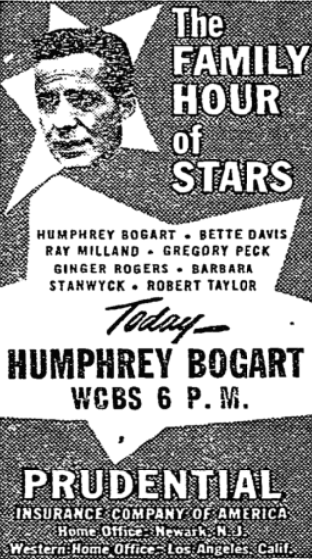
John and Gwen Bagni wrote a radio play called "Mink Gloves" that aired on December 5, 1948, on The Prudential Family Hour of Stars. The show starred Humphrey Bogart as a down-on-his-luck fight manager who sits in a bar and tells the story of how he saved the career of Johnny Richards, "the greatest middleweight in the racket," and wrecked his own career in the process. Nick buys Johnny's girlfriend, Georgia, a mink coat to get her to talk Johnny out of throwing a fight; the gloves of the title are boxing gloves. The show is lost but the script is in Gwen Bagni's papers at UCLA. (Thanks to Maxwell Zupke at UCLA Special Collections for providing a copy of this rare radio script.) "Mink Gloves" has nothing to do with the TV show "Mink" that aired on Alfred Hitchcock Presents; Bagni wrote the original teleplay with Irwin Gielgud, whom she married in 1955, the year after John Bagni died.

Ruth Hussey (1911-2005), who plays Paula Hudson, was a stage actress and model who appeared in films from 1937 to 1970 and on TV from 1951 to 1973. She has a star on the Hollywood Walk of Fame. This was her only episode in the Hitchcock series.

Vinton Hayworth (1906-1970) plays Sgt. Delaney; he started on radio in the 1920s, moved into movies in the 1930s, and then began a long TV career in the 1940s. He was the president of AFTRA from 1951 to 1954 and the uncle of both Rita Hayworth and Ginger Rogers. He was a semi-regular on I Dream of Jeannie from 1968 to 1970 and he may be seen in four episodes of Alfred Hitchcock Presents, including "Night of the Execution."

Vivi Janiss (1911-1988) plays Sgt. Bradford. Born Vivian Jacobsen, she was married first to Bob Cummings and later to John Larch. She was on TV from 1949 to 1979 and appeared in a few films; she was on The Twilight Zone twice, Alfred Hitchcock Presents twice (see "You Got to Have Luck"), and she was the voice of Daisy Duck for Disney.

In smaller roles:
  • Sheila Bromley (1911-2003) as Lois, Paula's friend in the powder room; she was on screen from 1930 to 1975 and she was also known as Sheila Le Gay and Sheila Manners. She was in two other episodes of the Hitchcock series, including "The Evil of Adelaide Winters."
  • Anthony Eustrel (1902-1979) as Leslie Ronalds the furrier; he was on screen from 1936 to 1972 and appeared on Batman. This was his only role on Alfred Hitchcock Presents.
  • Paul Burns (1881-1967) as the tailor; he made a career out of bit parts that were often uncredited and he was on screen from 1930 to his death. He was seen on The Twilight Zone and in two other episodes of Alfred Hitchcock Presents, including a small part in "The Blessington Method."
  • Eugenia Paul (1935-2010) as Dolores Dawn, the model; born Eugenia Popoff, she was a dancer turned actress who appeared on screen from 1954 to 1959, when she retired after marrying Pep Boys heir Robert Strauss. She was also seen in "Alibi Me."
  • Veda Ann Borg (1915-1973) as Lucille, the hairdresser; she was a model-turned-actress who was on screen from 1936 to 1963. She appeared in Mildred Pierce (1945) and this was her only role on the Hitchcock TV show.
  • James McCallion (1918-1991) as Charlie Harper, the thief; he was on screen from 1931 to 1976 and appeared in Kiss Me Deadly (1955). He was on The Twilight Zone, The Outer Limits, and Night Gallery, and he also appeared on Alfred Hitchcock Presents in "The Hands of Mr. Ottermole."
  • Mary Jackson (1910-2005) as Mrs. Wilson, whose fur was stolen; she was on screen from 1951 to 1997 and appeared on The Twilight Zone and The Outer Limits. This was her only role on the Hitchcock TV show.
"Mink" aired on CBS on Sunday, June 3, 1956. Watch the episode online here or buy the DVD here. Read the GenreSnaps review here.

Sources:

Bagni, John, and Gwen Bagni. “Mink Gloves.” The Prudential Family Hour of Stars, CBS, 5 Dec. 1948.

Grams, Martin, and Patrik Wikstrom. The Alfred Hitchcock Presents Companion. OTR Pub., 2001.


IBDB, www.ibdb.com.

IMDb, www.imdb.com.

"Mink." Alfred Hitchcock Presents, season 1, episode 36, CBS, 3 June 1956.


Wikipedia, www.wikipedia.org.


Listen to Al Sjoerdsma discuss "Mink" here!

Listen to Annie and Kathryn discuss "Mink" here!

In two weeks: "Lonely Place," starring Teresa Wright, Pat Buttram, and Bruce Dern!