Monday, July 12, 2021

The Warren Report Issue 63: May 1975


The Critical Guide to
the Warren Illustrated Magazines
1964-1983
by Uncle Jack
& Cousin Peter


Kelly
Creepy #71

"Room For One More" ★
Story by Doug Moench
Art by Luis Bermejo

"But When She Was Bad" ★1/2
Story by Gerry Boudreau
Art by Luis Bermejo

"His Name Is John!" ★1/2
Story by Budd Lewis
Art by Luis Bermejo

"The Song of Alanbane" ★★★
Story by Gerry Boudreau
Art by Luis Bermejo

"The Minotaur" ★★1/2
Story by Nathaniel Hawthorne
Adapted by Rich Margopoulos
Art by Luis Bermejo

Okay, so pay attention cuz I'm only going to try to explain this once (how I wish I didn't have to 'splain it at all!): Mrs. Lomax has murdered Mr. Lomax and is intent on running away with his best friend, Augie. Well, that's what she thinks! Mr. Lomax caught on to the Mrs.'s scheme months before she planned on poisoning him cuz Augie is still Mr. Lomax's buddy, not Mrs. Lomax's bed buddy! But anyway, Mrs. Lomax goes to the Farrow Funeral Parlor and orders up a coffin for Mr. Lomax, flirting with the handsome Mr. Farrow (whose wife died months before... kinda... sorta) in the process. 

While Mr. Farrow is readying Mr. Lomax for embalming, Lomax sits up in his coffin and explains what's going on. The "poison" his wife has been giving him is actually a super-secret formula that gives the user symptoms of death. He holds a gun on Farrow and tells him to give him some more of the potion and bury him; Augie will dig him up later. But Mr. Farrow actually has something else going on in the back room; he's keeping Mrs. Farrow's body company with the corpses of several other unwary visitors, all propped up in a dining area. In a very short amount of time, he adds Lomax, Augie, and Mrs. Lomax to the guest list.

Farrow wears a "death mask" to make his wife's corpse more comfortable with her present state. After dispatching Mrs. Lomax and Augie, Farrow is called to the showroom by a customer. Unfortunately, the dimwit forgets to take off his scary mask and the customer screams in fear. This brings the local police, who break in just in time to see Farrow berating and emptying a pistol into his wife's moldering corpse.

"But When She Was Bad"
I've never been near a rotting corpse, so I have no idea if it smells as bad as Doug Moench's script for "Room For One More" but, I gotta tell you... this is some gawdawful crap. There seem to be two or three contrived and confusing parallel story lines and no resolution to any of those threads. Farrow's obsession is inane, as is his random selection of victims. How the hell could the smell not warrant a visit from the cops? If you're going to try to convince a mortician to go along with your scheme, do you threaten him with death? If it was me, I'd be very nice to the guy who's going to be putting you into the ground for later exhuming. And what's the story with Augie and Mr. Lomax? Are they really really close friends? I'd add that the final panel makes no sense, but then I've just wasted hundreds of words describing an entire story that makes no sense. 

"His Name Is John"
After surviving a terrible car crash in which her parents are both killed, Julie begins hearing voices in her head. Those voices tell her to do terrible things like bash her puppy's head in. Who are these voices? Is it mental erosion due to Julie's concussion? Is there a sinister force at work? Good luck if you think you'll find out anything about what's going on. If I was Luis Bermejo, I'da been on the phone to Jim Warren. "If you're going to dedicate an entire issue to my art, could you at least give me something literate to illustrate?" Neither "Room for One More" nor "But When She Was Bad" makes a lick of sense. To add inanity to inanity, "But When She Was Bad" either ends on a cliffhanger or the last page wasn't printed. It literally ends mid-scene. The big secret the voices keep prodding Julie about throughout the second half of the tale really isn't that much of a secret, is it?

In "His Name Is John," a priest is beamed up into a spaceship by an alien who claims he is God. The creature is about to destroy Earth because it hasn't become the paradise it envisioned. Can the father talk this God into giving us another chance? Some will cry "pretension," some "heresy," but I just found "His Name Is John!" to be a wall-to-wall bore. So many other writers have tried to put a spin on "the creator." If you want to present your "vision" to the world, I'd advise you not to be so talky about it. That seems to be the main problem with Warren science fiction.

There seems to be no defense for the demon Alanbane, a huge "dark knight" equipped with a sword that can seemingly cut a swath through any army. In the end, only love and a fetching naked lass can defeat this hellspawn. In direct contrast to "His Name Is John!" is "The Song of Alanbane," light on text and a feast for the eyes. Boudreau manages to pull off a feat not usually successful in funny books: story as poem. Bermejo's Alanbane is an imposing figure, no doubt, but if Gerry's rhymes come off as pretension, the entire presentation is dust. Thankfully, Boudreau hits the bullseye; RE Howard would be proud. Easily the best thing in this issue.

Every year, fourteen young Grecians are sent to Crete to be sacrifices for King Minos's Minotaur. Prince Theseus vows to put an end to this bloodshed, so he volunteers to be one of the fourteen in the latest export. With the help of Minos's daughter (who believes her father to be kind but a bit loony in the head), Theseus confronts and slays "The Minotaur"! Not a bad adaptation at all, "The Minotaur" is an exciting bit of mythological adventure, tantamount to a newly discovered Harryhausen film. The art is a bit sparse but it'll do. Overall, I'm not sure the artistic talents of Luis Bermejo merit a full issue of his work.-Peter

Jack-I had the same thought when I finished reading this issue. He seems to be a mid-level Warren artist--not as good as Wrightson or Sutton but not as bad as Fraccio/Tallarico, either. I like "The Minotaur" best of the stories this time out, though the story (based on Hawthorne, based on Greek mythology) is better than the art, which is a bit bland.

Next came "The Story of Alanbane," where the art is decent and the story good enough. I was not as impressed by the rhymes as you were and I thought it unusual that the naked girl is as un-sexy as she is, which is not what we're used to from Warren. "Room for One More" has its enjoyable sections, but the whole thing ends up a complete mess. "But When She was Bad" is junky pop-psychology and "His Name Is John!" is twelve endless pages of religious babble and ancient astronauts. If Warren is going to spend an entire issue on one mediocre artist, they'll need to improve the writing.


Torres
Vampirella #42

"The Mountain of Skulls"★★1/2
Story by Flaxman Loew & Gerry Boudreau
Art by Jose Gonzalez

"Around the Corner...Just Beyond Eternity!"★★
Story by Gerry Boudreau
Art by Luis Garcia Mozos

"Laugh, Clown, Laugh!"★1/2
Story by Shelly Leferman
Art by Ramon Torrents

"Straw on the Wind"★
Story by Budd Lewis
Art by Rafael Auraleon

"The Whitfield Contract"★★1/2
Story & Art by Fernando Fernandez

After the airplane Vampi and Pendy are on is drawn down to a crash landing by a mysterious force, she turns into a bat to survey the desert island on which they've landed. Pendragon and the rest of the survivors are captured by beautiful women, who lead them to their village and put them in a cage. The women behead obese, loudmouthed Clarence Swinger, while Vampi flags down a paddleboat whose two owners are looking for El Dorado.

Vampi leads the men to the crash site, but they are more interested in scavenging the wreckage for valuables until the native women happen by and kill their guide. One of the fortune-hunters machine-guns the native women after his partner knocks out Vampi; the nasty duo march through the jungle until they find the womens' village, which features "The Mountain of Skulls," which happen to be plated in gold. Waking up to the realization that she hasn't had her blood substitute in a while, Vampi gets hungry and feasts on one of the men from the paddleboat. His partners make a run for it. Vampi and Pendy restack the golden skulls and, after a sisterly (?) kiss between Vampirella and the leader of the native women, our heroes are free to leave. The remaining fortune-hunter is killed by a giant snake.

I am so happy to see Jose Gonzalez back as the artist for this strip that I can excuse some of the problems with the script. Why are Vampi and Pendy on a plane? Where are they going? Where are they coming from? How did everyone survive the plane crash? Who are the random extra people that come and go from the group of plane survivors and the group on the paddleboat? Why is Vampi always running out of blood substitute? Has she ever heard of foam packaging? Where did the giant snake come from?

Is there life after death? "Around the Corner...Just Beyond Eternity!" Doing research for an article on immortality, a man revisits a decaying house that he had first visited when he was an RAF flyer in the First World War. He was shot down over Germany and taken to the house, where an old woman took him in but then revealed his presence to angry villagers, though she insisted on keeping him there until the army came. The young man was aided by a beautiful young woman, who helped him to escape but who also offered him a place next to her in the small lake outside. Returning years later, he saw the young woman in a portrait and learned that she had died before he was brought there. Did his resemblance to her late brother call her back from beyond the grave to help him?

In spite of Luis Garcia Mozos's very scratchy art, which looks unfinished but which I suspect is supposed to look atmospheric, I enjoyed this story. The ghostly turn it took at the end made up for the unfocused storytelling at the beginning, and it all made a kind of sense by the last page. I guess I was in a mood for a Gothic romance.

Droopy, the sad-faced clown, is the hit of the circus! He never socializes or removes his makeup, so reporters begin to clamor for a picture of him as he really looks. One reporter succeeds in snapping a photo and it show that Droopy is really a fanged ogre. No one believes it until a Senator investigates and Droopy is forced to reveal himself. Now everyone hates Droopy! To save the circus, he must allow himself to be displayed among the freaks, where patrons can mock him.

"Laugh, Clown, Laugh" is written by Shelly Leferman who, as far as I can tell, had a career as a letterer for comics. Was he (she?) the one who made all of the spelling errors in the Warren mags? In any case, this eight-pager is not at all original or well-written, but I like the crisp, clean artwork by Ramon Torrents, though the comic credits it to Esteban Maroto. Too bad such nice art is wasted on a depressing tale like this.

Pantha returns to the strip club (where she was not a stripper) but is fired for taking two days off. Another strip club owner invites her to work at his joint but, when she arrives, she meets the head stripper, a woman who goes by the name of Cleopatra and who has a pet leopard named Antony. Cleo kisses Pantha and Pantha reacts badly, so when Cleo tries to sic Antony on Pantha, our "heroine" turns into a panther and rips Cleo to shreds. Pantha flees to an opium den but, when one of the druggies tries to have sex with her, a man named Jack Kimble, who is searching for his daughter, rescues her and takes her home with him.

Kimble is kind to Pantha, so she insists that he sleep with her, which he does. He then counsels her to leave the nasty city and she tells him that one more "Straw on the Wind" will break her spirit. He walks off and is robbed and killed by a man who has his eye on Pantha through her apartment window.

Budd Lewis's script is, in a word, dreadful. I knew we were in trouble when Pantha angrily calls Cleo a "female fag," but it gets worse--in the opium den, Pantha gets high and has a memory of her father getting a little too friendly. That memory then is confused with a druggie trying to rape her as she wakes up. One would think she might have had enough of men for awhile, but the first guy who is kind to her finds Pantha insisting that he hop in bed with her. I like Auraleon's art (except for the guys with the giant, bald foreheads), but this story is the dregs and surely in the running for worst of '75. And from the winner of Best Warren Writer for the year, Budd Lewis!

John Gamble, paid assassin, has killed Peter Whitfield, and the Syndicate asks him to attend the funeral. He feels some guilt over murdering his friend and decides to retire, but when he goes to the funeral, the Syndicate men say that's not allowed. Whitfield's wife Jill, with whom Gamble once had an affair, knows her husband was murdered and is working on identifying his killer.

Two days later, Gamble is assigned a new victim: Dr. Hackett, who was paid by the Syndicate to certify that Whitfield died a natural death. The doctor has figured out that Whitfield was killed by someone with a tremendous mental power and Gamble decides not to kill him. Gamble calls Jill Whitfield to apologize and she reveals that she knows he killed her on orders from Modesto of the Syndicate. The next day, Gamble visits the Syndicate and explains that he comes from another planet and has special mind powers that he uses to kill cleanly. He plans to return to his home planet but promises to come back some day and kill Modesto.

Fernandez's stories don't look like those of anyone else, and this one has a lot of plot and is interesting until he flubs the ending. There was no need to have Gamble be an alien from another planet. Perhaps the writer/artist felt that he had to add a supernatural element to make it fit in a Warren horror mag. Who knows? But for most of its 12 pages, it's probably the most cogent story in this underwhelming issue.-Jack

Peter-Even more slapdash than usual, Flaxman Butterworth's script is a sinkhole of stupidity and lukewarm Moench-esque prose (The last screams of the moribund intermingled with the dolorous wails of the living creating a nightmare of cacophony). What is it that brings the plane down in the first place? Am I supposed to be so intoxicated by the half-nekkid jungle girls that I'll completely forget the pilot's exclamation of  "Something's drawing us down!?" And what's with the fact that every Amazonian looks exactly alike? I thought, at first, we'd get some power-mad scientist who's created a race of sexy androids to guard his Fort Knox of skulls but, alas, that old trope was not trotted out. Why is it that sometimes Vampi is a helpless femme and other times a savage beast? And where is she getting that endless supply of fake blood (that, inevitably, is destroyed every issue)?  Only the vicious beheading and some sexy lesbian titillation save "The Mountain of Skulls" from being unsalvageable dreck. Lots of fat-hating as well!

There's a line in "Around the Corner..." that perfectly sums up my feelings about the tale: My mind swirled in confusion. A thought that has nagged at me while reading some of these Warren stories popped up yet again here: do these writers begin with an outline or are they just winging it through the entire process? Nothing about "Around the Corner..." cries out "natural progression." I've always thought Luis Garcia's art well-done but a bit "fuzzy." The fuzz is starting to grow to epic proportions. 

Inside cover

"Laugh, Clown, Laugh!" is equally perplexing. Yeah, I know that the Senate once blamed funny books for rape, sadism, juvenile delinquency, and high gas prices, but the Droopy witch hunt is ludicrous beyond belief. And how was it that Droopy was hiding those fangs? Though Esteban Maroto was credited on the splash, this is actually a Ramon Torrents production. The chore continues with "Straw on the Wind," the rebooted Pantha, which replaces the execrable "Dracula" series. Based on this first new chapter, the act might be tantamount to replacing old kitty litter with... old kitty litter. Awful dialogue ("Get away from me, you female fag!") and a ponderous storyline that seems to go absolutely nowhere. The highlight here would have to be Pantha's story about fishing a beloved cap out of a toilet with a comb. I hated hated hated this junk.

"The Whitfield Contract" starts promisingly enough. I'm a men's adventure paperback fanatic, so a hit man story falls well within my enjoyment parameters. Then, of course, the damn thing descends into mediocrity and lunacy. I literally laughed out loud when the coroner told Gamble that he'd guessed the real cause of death for Whitfield was "a certain form of electrical energy transferred from a powerful outside source... a superior brain!" I know we've been forced to wade through some bad issues but Vampirella #42 might be the worst collection of pretentious and half-baked crap yet. To add insult to injury, the 1974 Warren Awards are announced and, as usual, the grand prize goes to more pretentious prattle, Budd Lewis's "Excerpts From Year Five." Laughably, the story is so important that Warren doesn't even list the title correctly!


Next Week...
More vampiric hijinx!

Monday, July 5, 2021

Batman in the 1980s Issue 31: July 1982


The Dark Knight in the 1980s
by Jack Seabrook &
Peter Enfantino


Andru & Giordano
Batman #349

"Blood Sport"
Story by Gerry Conway
Art by Gene Colan & Alfredo Alcala

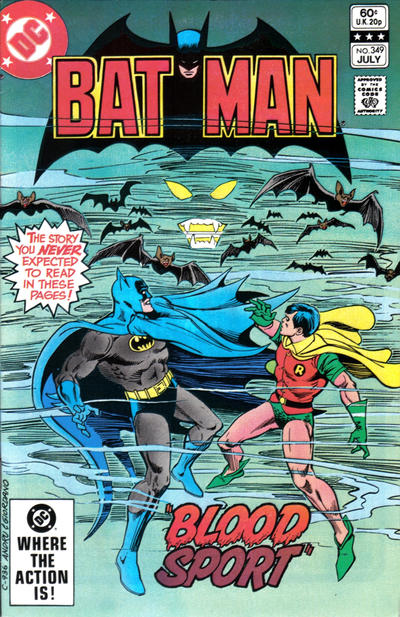
Killing time in L.A. waiting for his application to the Academy of Crime to be approved, Batman calls Stately Wayne Manor after 10 p.m. and is surprised when no one answers. Little does he know that Robin is tied to a chair in Dala's spooky mansion. Meanwhile, Alfred is in Boston, hiring Christopher Cross (a/k/a the Human Target) to impersonate Bruce Wayne. Alfred claims Bruce's life is in danger, but he really wants to trick Vicki Vale into thinking Bruce and Bats are different people.

In Gotham City, Commissioner Gordon sits at home in his bathrobe until Babs shows up with Jason Bard in tow. On the 11 o'clock news, they see an announcement that the new commissioner plans to institute mandatory retirement after 20 years on the force. Gordon gets fired up and agrees to work with Bard to investigate the recent mayoral election. Back in Dala's mansion, Robin knocks over a lamp and sets fire to a rug, bringing Dala and a spooky monk on the double--and they both have fangs! Dala puts the bite on Robin before he knocks her out and he finds two corpses in another room, tied upside down to beams and with bite marks on their throats.

Robin fights off the monk, escapes from the mansion, and collapses in the middle of the road, where a priest happens to drive by and pick him up. The priest takes the Boy Wonder to the hospital and thinks that he recognizes the mark of the Vampiri!

Peter: First things first: Gene Colan and Alfredo Alcala working together on a Batman strip? Be still my beating heart. Colan was untouched when it came to noir art and Alcala (for my money) was one of the three best horror artists of the 1970s (along with Wrightson and Sutton), and their excellence shines through in just about every panel here. Ironically, the only scene I didn't care for was the lone appearance of Batman himself, which looked a little clunky. As for the story, which is a spotlight on the supporting cast despite the misleading cover illo, I love when the writers introduce supernatural possibilities to the Bat-stories, since the Dark Knight's gloomy atmosphere meshes with those scary elements so well. Of course, this all could be explained away as "blood disease" next issue but, as it stands, the Best Story of the Year award is "Blood Sport"'s to lose. The Monk and Dala are rebooted characters who appeared in slightly different form in Detective #31; Gerry was obviously going the Roy Thomas route of sifting through old issues for inspiration. That always seems to bring about good stuff.

Jack: I don't like Alcala's inks on Colan's pencils at all. The panels look muddy. Here and there I can see a glimpse of the old Colan but, overall, the art in this story is a mess. Not as big a mess as the story, though! Conway uses his Marvel training to make us read one issue after another by keeping multiple story threads going, but none of them is particularly interesting. Batman and the Academy of Crime are given short shrift, the subplot with Alfred hiring the Human Target is just stupid, and Commissioner Gordon being revived to fight early retirement seems silly. That leaves the main story thread, with Robin in the spooky mansion. Maybe Dick Giordano brought in Alcala to amp up the story's horror elements, but Colan was the best vampire artist of the '70s and didn't need the help.

"The Man, The Bullet, The Cat,
Part Two"
Story by Bruce Jones
Art by Trevor Von Eeden & Larry Mahlstedt

Candidate Dan Brown is shot but he's not dead, so when he is taken to the hospital, his wife blames Catwoman for failing to protect him. Brown wins the election and insists on making an acceptance speech, so Catwoman develops a protective bubble for him to stand under. On the night of the speech, the bubble fills with poison gas and Catwoman tricks Simmons into admitting he's to blame. He then throws Mrs. Brown under the bus but, when she makes a run for it, she suffers a bad fall and is left paralyzed.

Peter: The reveal, that Simmons and Mrs. Brown were the hidden villains, was too obvious, and I would question whether an emergency trapdoor that can leave someone with a broken spine is a really good idea, but the Von Eeden art is so stylish and sets itself apart from the usual meh art of the backups that I can still enjoy the series. Still, this is not Bruce Jones's finest work.

Jack: Once again, the backup story outshines the lead story, something that I can be sure will not happen in Detective Comics or The Brave and the Bold. I agree that von Eeden's art is the highlight; some of the panels and layouts recall those of Walt Simonson from the mid-'70s Batman.


Andru & Giordano
Detective Comics #516

"Academy of Crime, Part Two:
Final Exams!"
Story by Gerry Conway & Paul Kupperberg
Art by Don Newton & Frank Chiaramonte

Matches Malone, a/k/a Bruce Wayne, a/k/a The Dark Knight, has infiltrated Hollywood's "Academy of Crime," an elite school for criminals. There, hoods are taught how to ventilate, stab, and immolate their foes. But somehow, the Headmaster is onto the Dark Knight's presence and sends his goons after our hero. Obviously, these toughs get an "F," since they are all dispatched without much of a fight. That leaves the Headmaster himself, who discovers that not even a flamethrower is effective against Gotham's most famous vigilante.

In our "meanwhiles" this issue, Vicki Vale has pressure applied to her by her editor (who is under Boss Thorne's thumb) to give up her candid shots revealing the true identity of Batman, and Commissioner Gordon becomes one-half of a PI team (the other half being Jason Bard), hell-bent on uncovering dirt on mayor Hamilton Hall, the man who took Gordon's job. And Boss Thorne might be going slightly mad, since he's seeing Hugo Strange everywhere he looks.

Peter:
Once you get past the ludicrous plot device of a school for wayward murderers, you're left with little but mediocre fight scenes and humdrum sub-plot interludes. The Gordon angle is an interesting one, but then we all know how that has to end since he becomes commissioner again one day. The Vicki soap opera is going on too long and we know that nothing will come of that, either. As I recall, the "Is Boss Thorne just overworked or is he really seeing Hugo?" storyline will actually pay off in a few months' time.  Oddly, Gerry never lets on how the Headmaster gets wise to Bats being one of his pupils. The only bright side to this disposable adventure is, as usual, the art, which continues to dazzle.

Jack: I'm not loving the Ross Andru pencils on the covers this month, though Dick Giordano manages to tone down his excessive tendencies. I do love the art, though, and much prefer it to that in Batman. All of these continuing stories and subplots require a lot of recaps, which tend to eat up pages. After all of the subplots were dutifully advanced, the wrap-up was pretty good. But what was that panel where Matches went to a music club? Was that supposed to be DC's idea of 1982 punk rock or new wave?


"Sleep While the Serpent Smiles!"
Story by Cary Burkett
Art by Jose Delbo & Joe Giella

Still reeling from the bite delivered last issue by Lady Viper, Batgirl passes out in a seedy alley and is discovered by a group of homeless people who live in the "undercity" below Gotham. With their help, the Dark Knight-ette overcomes the poison in her system and makes a speedy recovery, only to discover that she's become half-snake! Meanwhile, Lady Viper is slithering through the city, pulling off antiquity heists. The Queen of the Serpents is heading for an inevitable battle with Bat-SnakeGirl!

Peter: This has to be one of the most unashamedly stupid arcs I've ever read and yet the damn thing is like Cheetos. I can't stop ingesting it, possibly because Burkett dispenses with anything related to reality and just throws in the kitchen sink. This is perfectly demonstrated by the batshit-crazy final panel for "Sleep While the Serpent Smiles," where Babs discovers that fabulous behind of hers has been replaced by ugly green scales! Keep this going for another ten issues, Cary. Please don't get back to Babs's love life or Jerry the mechanic and his underground Batgirlcycle ramp. I'm begging you.

Jack: The art is better than usual, which makes me wonder if Giella and Delbo had help here and there from an uncredited third artist. Burkett is taking the snake lady a bit further than I expected and that last panel is just nuts. With Robin battling vampires and Batgirl turning into a giant snake, things are pretty kooky this month at DC!


Aparo
The Brave and the Bold #188

"A Grave as Wide as the World!
Part One: A Moon for Madmen!"
Story by Robert Kanigher
Art by Jim Aparo

As Batman stands in a grave in Gotham Cemetery, about to be crushed by a big rock thrown by Nazis, along comes Thorn, whose flying barbs distract the baddies. Flash back to several nights before, when a man dressed as Adolf Hitler visited a dying Nazi to learn a long-held secret that will threaten all democratic countries! The next day, Bruce Wayne got nowhere trying to make friends with a group of poor kids, but when Batman showed up in his cool car they were off for a ride that ended with them cleaning up a polluted lake.

On the way back to Gotham, Batman hears a radio news bulletin about the death of the Nazi and recalls that the man stole a canister of deadly poison gas that was never found. Batman promises the kids to protect the world from this very dangerous form of pollution. After deducing that David Phillips, a hospital orderly, must have disguised himself as Hitler in order to learn the dying Nazi's secret, Batman saves Rose Forrest from a flock of insane birds but, after she goes to sleep, she awakens and transforms into the crimefighter known as Thorn! The Caped Crusader learns that the birds were infected with the deadly poison gas and that Rose's father's body was one of many stolen from their graves the night before. Batman visits the grave, looking for clues, and is attacked by Nazis. After he and Thorn defeat them, Batman heads off alone on the trail of David Phillips. To be continued!

Peter: Bob Kanigher's six-page prologue about ecology and rehabilitating wasted youth is hilarious, but what's even more funny is the fact that Batman doesn't even require his Batmobile-riding moppets to wear seat belts! These borderline-gang kids go from uttering idiocies like "Who's the dude?" and "Take your scrubbin' brush somewhere else, turkey!" to cleaning up lakes and commenting on the adults they have to deal with in this big, troubled world:

Kid #1: "You promised us the world--not a bad dream!"
Kid #2: "You adults are big--with promises!"
Kid #3: "Batman will find it!"
Kid #4: "He'd better--before the clock runs down!"

Written as if by someone who never actually heard a kid on the streets of 1983 talk, it's tantamount to the cliche of a millionaire being asked how much a jug of milk costs. Sounds phony. The lengthy lecture and Thorn's origin recap leave precious little space to devote to a story. But that may be a good thing, based on what we got. Full of coincidences (Bats just happens to pick up Rosie, who happens to be the Thorn) and silliness (if you're a part-time Hitler youth and you want to keep things on the q.t., would you take a pic wearing your death's-head ring?), the first part of "A Grave as Wide as the World!" is one great big yawn. As with most of these B&B guest stars, I had no idea who Rose and Thorn were and Bog Bob gives me no reason to seek out any other adventures by the "duo."

Jack: I vaguely remember them from early 1970s issues of Lois Lane that my father would buy for my sister to read. I didn't read those "girly" comics, so I don't know much about this heroine. What troubled me about this issue, beyond the cliches and convoluted plot, was the unusually mediocre art by Aparo. In places, it reminded me of the work of Irv Novick. Now, Novick is fine, but he's no Aparo. Maybe Jim wasn't inspired by Kanigher's story and phoned these pages in.

"Gladiator's Gauntlet!"
Story by Cary Burkett
Art by Dan Spiegle

Nemesis is trapped in Kingston's mansion and must run the "Gladiator's Gauntlet!" He knocks out a couple of guards and is watched the whole time by the other members of the Council on closed-circuit TV. Avoiding falling to his death through a hole in the floor and being impaled on spikes, Nemesis comes face to face with a quartet of gladiators, who attack with knife, hook, bullwhip, and martial arts. Council member Leonard Maddok intervenes when he fears Nemesis will be defeated and Kingston will become head of the Council. But does Nemesis need his help? After beating the fearsome foursome, he feels around for an opening in a wall, unaware that it's rigged to blow up.

Peter: Despite the fact that this chapter is wall-to-wall action, it feels so tame. The fight scenes are so badly choreographed, you can't really tell what is going on. And do we really have to be reminded, every time Nemesis fires his rifle, that the bullets are harmless "Stunno-pellets?" You would never hear the Punisher brag about that.

Jack: After a not-awful story last issue, we're back to the dregs this time out. These stories are so boring and badly drawn that I find myself checking the little numbers on the bottom right of each page to see how much more I have to endure. Hang in there. It's nearly over.


Aparo
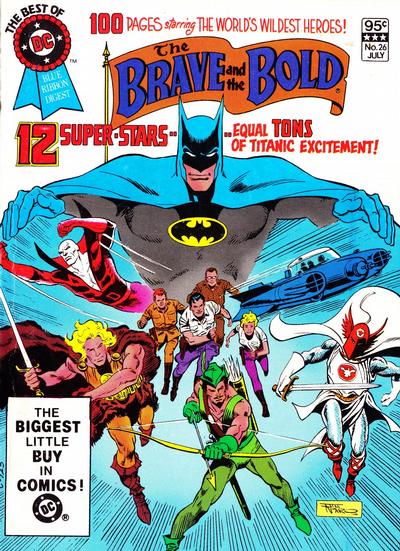
The Best of DC #26

"You Can't Hide from a Deadman!"
Story by Bob Haney
Art by Neal Adams
(Reprinted from The Brave and the Bold #86, November 1969)

"Three Arrows Against Doom!"
Story by Bob Haney
Art by Russ Heath
(Reprinted from The Brave and the Bold #9, January 1957))

"Menace of the Mirage People!"
Story by Robert Kanigher
Art by Ross Andru & Mike Esposito
(Reprinted from The Brave and the Bold #38, November 1961)

"Threat of the Ice King"
Story by Bob Haney
Art by Joe Kubert
(Reprinted from The Brave and the Bold #18, July 1958)

"The Sword in the Lake!"
Story by Robert Kanigher
Art by Irv Novick
(Reprinted from The Brave and the Bold #31, January 1959)

"The Secret Beneath the Earth"
Story by Ed Herron
Art by Bruno Premiani
(Reprinted from Brave and the Bold #31, September 1960)

Jack: After a sharp cover by Aparo and a three-page "fact file" that introduces the main characters in this all-reprint issue, we're treated to 23 pages of gorgeous Neal Adams art from 1969! This was Deadman's second appearance in The Brave and the Bold and his first since his original run ended in Strange Adventures. Batman announces at one point that he has based his career on "surprise and fear," pre-dating the 1970 arrival of the Spanish Inquisition on Monty Python and suggesting an influence I had never before suspected. Also, the whole business with the Sensei and the snowy mountains made me think the creator of Marvel's Iron Fist may have read Deadman at some point before coming up with his kung fu hero.

The back cover!
Russ Heath's work on "Three Arrows Against Doom!" is pleasant and Haney's story is fun. "Menace of the Mirage People," from 1961, is not very interesting, though it's from the period where Andru and Esposito's art was easier to take than it would become later. "Threat of the Ice King" features 13 pages of classic Kubert art which, paired with the Adams story, makes this digest worth every penny of the dollar cover price. "The Sword in the Lake!" is fourteen pages of above-average Novick art and a story that demonstrates why the Silent Knight did not become a big hit. Finally, 25 pages of Cave Carson in "The Secret Beneath the Earth" just feels like filler to me, despite a giant lava monster and a giant magnetic monster, both of which made me think of Kirby.

Peter: It's great to have Neal Adams back with us but I couldn't make heads or tails of Bob Haney's script for "You Can't Hide..." (the mid-story expository from the Sensei was like nails on a chalkboard), and after a bit I gave up and just stared in awe at new (to me) Neal. "You Can't Hide..." is the only Bats-starring vehicle this issue and the most recent of the reprints. One of my all-time favorite DC war and Atlas horror artists, Russ Heath, adds an almost Joe Maneely-esque sheen to the historical setting of "Three Arrows Against Doom!" Until I did some research, I had no idea that Robin Hood was one of DC's first regular characters, introduced way back in New Adventure Comics #23 (January 1938). Also unknown by this non-DC fan was that The Brave and the Bold did not slip into its "team-up" theme until B&B #50 (November 1963). Until then, it was a haven for lesser hero solo stories and launching new characters. "Three Arrows" is a lot of fun, thanks mostly to that Heath glow. Of the remaining golden oldies, I liked the imaginative scripts for "Menace of the Mirage People" and "The Secret Beneath the Earth" (the latter of which I fondly remember reading in the early '70s) and the glorious art of Joe Kubert in "Threat of the Ice King."


Next Week...
Is an entire issue given over to
Luis Bermejo a good thing?

Thursday, July 1, 2021

The Hitchcock Project-William Link and Richard Levinson Part Two: Profit-Sharing Plan [7.23]

by Jack Seabrook

Richard Levinson and William Link's second and last teleplay for Alfred Hitchcock Presents was also their second to be based on one of their own short stories; this time, "The End of an Era," which was published in the January 1962 issue of Alfred Hitchcock's Mystery Magazine. The story opens as Miles Grubb sits uncomfortably as his office colleagues pay tribute to him at the end of his last day of work before retirement. Pretty Miss Lemmon pretends to flirt with him and stuffy Mr. Dougherty makes a ponderous speech. None of them knows what Miles is planning to do.

He is presented with a gift of a matching lighter and ashtray set, champagne is passed around, and the party ends as people leave at six o'clock, the end of the work day. Insisting that he must get home for dinner with his wife, Miles turns down an invitation to another drink at a bar, leaves the office, and phones his wife from the hotel across the street to say that he'll be late for dinner. After killing time in the hotel lobby, Miles returns to the office and opens the hidden safe in Mr. Dougherty's office, removing a large amount of cash and thinking of the plane ticket to Hawaii resting in a drawer at home.

"The End of an Era"
was first published here

Miles returns home and is greeted by his wife, whose "gray hair" and "vacant eyes" make him think that he made the right decision in not planning to take her with him. He packs a suitcase and is distracted while they eat dinner; she suggests a cross-country trip. After dinner, while his wife washes the dishes, Miles announces that he's going for a drive, then leaves with his suitcase in hand. He arrives at the airport and boards the plane but, just before it takes off, the stewardess announces that there are mechanical difficulties and everyone must go back to the terminal.

As the delay drags on, Miles grows frustrated, and he finally demands an explanation from the clerk at the counter. The clerk confides that there was a "'crank call'" about "'a bomb on the plane'" and Miles is relieved until he sees a policeman coming toward him, holding his suitcase. At home, Mrs. Grubb receives a call asking her to telephone her family lawyer and come to police headquarters, where Miles is under arrest. She hangs up and then picks up the phone, calls the airline terminal, and tells them that the prior report of a bomb on the plane was '''just a joke.'" She hangs up, smiles, and calls the lawyer.

Henry Jones as Miles

"The End of an Era" is a story that hinges on its surprise ending, where Miles's wife turns out to be aware of his scheme and to have taken steps to prevent him from leaving with his suitcase of cash. However, a really successful twist ending requires clues along the way, so that the reader can look back and see events in a different light, understanding in retrospect what was overlooked the first time the story was read. Here, the clues are missing, and the ending doesn't hold up as well. How did Mrs. Grubb know what Miles was planning? There is no sense that she was aware of the theft or the plan to fly to Hawaii. One can only assume she discovered the plane tickets and waited to see if he'd go through with it before calling in the bomb threat.

When the authors adapted their story for the small screen, they appear to have realized that they needed to make changes in addition to expanding the narrative to fit the longer format. The episode, retitled "Profit-Sharing Plan," aired on NBC on Friday, March 16, 1962, and was director Bernard Girard's first episode to air; he would go on to direct four episodes of the half-hour series and eight of the hour series.

Ruth Storey as Mrs. Cheever

The TV version opens as Miles Cheever (as Miles Grubb has been renamed) arrives back at work on his last day after having been sent on an errand. His fellow employees emerge from hiding to surprise him. Miles goes into Mr. Dougherty's office to put some papers on his desk and, while everyone else is milling around outside the open door, he opens a large, hidden door in the wall to reveal a safe; there is no point to this incident other than to convey his thoughts visually to the viewer. The party goes on as in the story, with Dougherty referring to Miles's retirement as "'the end of an era,'" in a nod to the story's title. He is given a pen and pencil set instead of a lighter and ashtray.

Rather than killing time at the hotel and returning to rob the safe, Miles is next seen at home with his wife. They discuss the cheapness of the party and the retirement gift, then agree that there's no sense in putting things off, at which point he leaves to return to the office and rob the safe. In the TV version, Mile's wife is well aware of his plan and encourages it! Miles returns to the office after dark and commits the robbery without difficulty. Back at home, Miles and his wife admire the large amount of cash in the suitcase. She is certain that, as long as they "'sit tight,'" all will be well. She leaves the room and he takes out a plane ticket that had been hidden under his dresser drawer; it's made out to Mr. and Mrs. Cheever! Miles calls the airport to confirm that the flight is leaving on schedule, then tells his wife that he's going to the drugstore and sneaks out with the suitcase in hand.

Rebecca Sand as Anita

In the next shot, Miles is a new man--smoking a cigarette, smiling, and confidently letting himself into the apartment of his girlfriend, Anita, where he makes himself comfortable by fixing drinks. She is aware of the plan and ready to join him on the flight to Hawaii--she is clearly the "Mrs. Cheever" listed on the ticket folder. She wants a mink coat and asks how much money was in the safe, but Miles declines to be specific and assures her that it's "'all we'll ever need.'"

At the airport, Miles keeps the suitcase of cash with him as they board the plane, but soon a stewardess takes his valise to the back of the cabin. The passengers are ushered off the plane, leaving Miles without his bag. Anita tells Miles that she saw policemen coming off the plane and he presses the desk clerk, who explains about the bomb scare. Miles is relieved until the clerk adds that "'they have to search the luggage.'" Miles and Anita begin to walk toward the door but are stopped by a detective who holds his bag. The duo are escorted away by police. The camera pans around to show Miles's wife, who has been watching. She rushes into a phone booth and calls the airline to say that the bomb scare was "'all a joke.'"

Frank Maxwell
as Rudy

The story works better in the TV version, with Miles's wife being in on the robbery. This way, it's not so surprising that she also discovered Miles's plan to escape with Anita. Mrs. Cheever must have found the tickets and realized that Miles was not going to surprise her with a trip to Hawaii. When he left with the money and didn't return, she decided to foil his plot. "Profit-Sharing Plan" is an entertaining, lightweight half-hour, where Link and Levinson demonstrate that their future success would lie more in writing teleplays than in penning short stories.

Director Bernard Girard (1918-1997) was born Bernard Goldstein and worked as both a writer and director of movies and TV from the late 1940s to the mid-1970s. He directed a Twilight Zone as well as four episodes of Alfred Hitchcock Presents and eight episodes of The Alfred Hitchcock Hour, including the Robert Bloch classic, "Water's Edge."

Stephanie Hill
as Miss Lemmon

Henry Jones (1912-1999) plays Miles, who is retiring at the end of his career, even though Jones was not yet 50 years old when this show aired. Jones won a Tony Award for his 1958 role in "Sunrise at Campobello" and was a fixture in character roles in film and on TV from 1943 to 1995. He was on countless shows, including The Twilight Zone, Thriller, Night Gallery, and The Night Stalker, and he appeared on the Hitchcock show six times, including "De Mortuis." He was also in Hitchcock's classic, Vertigo (1958).

His unnamed wife is played by Ruth Storey (1913-1997), who was on screen from 1953 to 1973. She appeared in Fritz Lang's The Blue Gardenia (1953) and she was on Alfred Hitchcock Presents one other time.

Rebecca Sand (1913-1997) plays Miles's girlfriend, Anita. She has a rather sparse list of credits, mostly on TV, from the mid-1950s to the mid-1970s, and she appeared in a handful of movies. She was also in one other Alfred Hitchcock Presents episode, "The Opportunity."

In smaller roles:
  • Frank Maxwell (1916-2004), with his distinctive streak of white hair, plays Rudy, one of Miles's office mates. He was onscreen from 1951 to 2000 and appeared in many TV episodes, including roles on The Twilight Zone and The Outer Limits. His six appearances on the Hitchcock show include "Special Delivery" and "The Hatbox." He was president of AFTRA from 1984 to 1989.
  • Stephanie Hill plays flirtatious Miss Lemmon. She had a short career, mostly on TV, from 1961 to 1966 and was in one other episode of Alfred Hitchcock Presents.
  • Humphrey Davis (1912-1987) plays the boss, Mr. Dougherty. He was on TV from 1950 to 1982 and had a background on stage and in radio.
Humphrey Davis
  • Lew Brown (1925-2014) plays the airline clerk. He was on screen from 1959 to 1992 and he was seen on The Twilight Zone, Night Gallery, and The Night Stalker. He was in Hitchcock's Topaz (1969) and he played roles in seven episodes of the Hitchcock series, including "Run for Doom."
Lew Brown

Watch "Profit-Sharing Plan" on Peacock here. Thanks to Peter Enfantino for providing a copy of the short story!

Sources:

The FictionMags Index, www.philsp.com/homeville/FMI/0start.htm.

Grams, Martin, and Patrik Wikstrom. The Alfred Hitchcock Presents Companion. OTR Pub., 2001.

IMDb, IMDb.com, www.imdb.com.

Link, William and Richard Levinson "The End of an Era."  Alfred Hitchcock's Mystery Magazine, January 1962, 72-79.

"Profit-Sharing Plan." Alfred Hitchcock Presents, season 7, episode 23, NBC, 16 March 1962.

Stephensen-Payne, Phil. Galactic Central, philsp.com/.

Wikipedia, Wikimedia Foundation, www.wikipedia.org/.


In two weeks: Our coverage of Richard Levinson and William Link continues with "Captive Audience," starring James Mason and Angie Dickinson!


Listen to Al Sjoerdsma discuss "The Hidden Thing" here!

Listen to Annie and Kathryn discuss "Craig's Will" here!

Monday, June 28, 2021

The Warren Report Issue 62: April 1975


The Critical Guide to 
the Warren Illustrated Magazines
1964-1983
by Uncle Jack
& Cousin Peter


Enrich
Vampirella #41

"The Malignant Morticians!" ★★★
Story by Flaxman Loew
Art by Leopold Sanchez

"Rainy Night in Georgia" ★
Story by Gerry Boudreau
Art by Esteban Maroto

"The House on the Sea" ★★1/2 
Story by Jim Stenstrum
Art by Rafael Auraleon

"The Wickford Witches" ★1/2
Story by Gerry Boudreau
Art by Jose Ortiz

"Goodbye, My Love, Goodbye" ★★
Story and Art by Fernando Fernandez

Vampirella and Pendragon are staying in the English village known as Sinkville, utilizing the stop for personal purposes. Pendy wants to visit his sickly Uncle Orsic, who's living out his final days at Eventide rest home, and the duo are taking a well-deserved rest. While walking in the town square, Vampi spies a gorgeous little mutt in a pet shop window and talks Pendy into buying the mongrel. 

The next day, our heroine and her fermented companion visit Eventide, where Pendy is given the bad news by the hospice's bosomy young manager, Eudoxia Varzie: Uncle Orsic has shuffled off to a better place, leaving no cash or valuables in his wake. When Pendragon mentions that his uncle had a special signet ring that he'd promised to his nephew, his inquiry is met with a terse "Brass! Worthless!" The ring was buried with Orsic. Heartbroken, Pendy heads home with his sexy vampiress friend to feed their new dog.

After dumping the Yummy-Yum Dog Chow into the bowl, Pendy notices something gleaming at the bottom of the greasy muck and pulls out his uncle's ring (now, that's a hell of a coincidence!). How could that be if the bauble was supposedly six feet under with Uncle Orsic? Only one way to get to the bottom of the mystery (literally) and that's dig up the old duffer. Once the lid is opened and Pendy is staring at two hundred pounds of sand, the duo decide there's something funny going on in Sinkville.

Our favorite alcoholic magician investigates Augustus and Vesparian, the Brothers Crebble, owners of the funeral parlor that Eventide utilizes, and discovers that the proprietors are indeed mashing up the dead folk to fill cans of Yummy-Yum, manufactured by... you guessed it, the Crebble Brothers (says so right on the can!). But Pendy's tipping the bottle too much and stands out like a sore thumb on a corner across from the Crebbles' office; the Bros. send some muscle to abscond the old sod and Vampi fears the worthless vaudevillian might end up as Yummy-Yum for their new pup before too long.

Meanwhile, back at the Crebbles factory, Augustus is showing off the machinery to Eudoxia (whom he intends to propose to soon) when the beauty innocently asks what kind of meat is used in the Yummy-Yum. Augustus is about to explain when his goons show up with Pendragon. Eudoxia recognizes him and tells Augustus that Pendy had a half-nekkid chick with him when he came to visit the old folks' home. Augustus again sends his bodyguards out hunting but, once they find Vampirella, she makes short work of them and then heads to the factory. Just as the Crebbles are about to can dog food with history's highest alcohol content, Vampi swoops in and knocks the Crebbles and Eudoxia into the grinder. Another happy ending!

How could an entire town be so stupid as to not put two and two together and come up with canned corpse? A mortician company that also cans dog food? Wouldn't that be considered a red flag? There are a whole lot of coincidences going on in "The Malignant Morticians!" (Vampi buying a dog makes absolutely no sense considering her lifestyle but if there's no dog, there's no dog food), but I thought it was enjoyable enough to ignore the stupidity and just play along with it. How else can I get through these things? Nice twist that Eudoxia knew nothing about where her dead residents were ending up but obviously couldn't be bothered to care. When Pendy is about to be ground into hamburger, she stands off to the side as an attentive witness. Bet that dog will be gone next issue.

It's a "Rainy Night in Georgia," such a rainy night in Georgia. Annie Lee Baker believes it'sa rainin' all ovah the world. Having watched her African-American lover (and father of her unborn child) hoisted up and hung by her father and the good men of Johnsonville, Annie Lee hops aboard a covered wagon bound for Macon, little knowing she shares that wagon with Dracula and his vampire squeeze, Cassandra. Since Annie is pregnant, Dracula feels it beneath him to feed on her so the young girl becomes a pal to the two vampires. Once they get to Macon and put up the tents, Annie is free to wander the carnival grounds, eventually coming across the wonderful Hawk-Man, Garuda. Though the giant bird wants nothing to do with Annie or the human race, the girl finds him fascinating and tells him so. 

Meanwhile, back in Johnsonville, Annie's father, Arthur, is putting pressure on Sheriff Buford to find his daughter. The sheriff would just as soon "tear that black baby right out of (Annie's) belly," but Arthur is still undecided about the whole affair. He wants his daughter back. The sheriff puts out the word and very soon he hears back about the girl's whereabouts. The men head to Macon, where they have a confrontation with Annie that turns violent. Dracula and Cassandra swoop in and kill the sheriff but Annie begs the two blood-suckers to spare her father. With a brand new day of enlightenment just over the hill ahead, Annie and her pop head home.

Having successfully raided all the glam and metal albums for cool titles, Gerry Boudreau turns to the soul section in Tower Records for inspiration. I love the image of Cassandra, in her coffin, busily jotting down the day's events in her diary (So, we heard screams and me and Dracula bounded out of the wagon and ripped the bad guys to bits. One of the carnival guys winked at me yesterday!), but the concept of this thing being made up of excerpts from diaries, newspaper clippings, and police reports comes off as scattershot. I'm not sure what Annie's supposed to mean when she tells the Bird-Man, "If I judged by what I saw and not what I felt, I would not be carrying a black man's child," but it comes off as a lunk-headed line from Gerry Boudreau, no matter what he meant. Bar none, the worst Maroto art I've ever seen. Not sure if it's the reproduction or that Esteban was in a hurry, or what, but this is the pits. Sheriff Buford and Annie Lee's pop, in particular, almost look as though someone from the Warren office broke into Maroto's studio and stole the art before it was done. The final sentiment, that Annie Lee's dad sees the error of his ways and, ostensibly, will welcome his black grandson with open arms is a touching one if you brush aside the fact that he just hanged the child's father. What a load of crap this series was. Thank god it's over.

A sea captain and three of his mates are about to be the victims of a mutiny when suddenly they discover they're about to sail into "The House on the Sea." The ship wrecks against the brick building and the surviving quartet enter the huge mansion, where they discover some oddball occupants. As expected, we discover the four men have been killed in the mutiny and are now comfortably residing in purgatory.

I do like that "The House on the Sea" is an eccentric change of pace but it could have been shaved in half and been quite a bit more effective. I'm assuming the final panel that Jack can't figure out has to do with the fact that the same purgatory comes to everyone, regardless of whether they be on sea or in the Wild West. But that's just my psychology major showing off. Great moody art from Auraleon.

Witchcraft has consumed the 18th-century village of Wickford. Well, at least Minister Adam Nilsson believes this is true and the man has begun a binge and purge method of cleansing the town of its evil. If that means every woman of Wickford should die, then so be it. When Elizabeth's father dies suddenly in the town square while a public hanging unfolds, Nilsson takes advantage of the event to remind Elizabeth that her father had betrothed her to him. The young girl refuses (she's in love with another guy) and Nilsson declares her a witch. Wishing aloud that her father was still here, Elizabeth watches in awe as pop rises from the grave and strangles Nilsson, effectively ending the witch hunt. 

"The Wickford Witches" is the kind of clumsy pulp wiring we usually would get from Carl Wessler or Gardner Fox. Boudreau isn't high on my list of top notch Warren writers but he usually stumbles over his pretension rather than moldy cliches. The scene where dead pop explains what's going on and how we got there is expository gold. The finale is a bit abrupt though; we don't get to see Liz and her beau walking off into the sunset.

In 1980, man can have any woman he wants... in android form. After trying several different females, Nicholas finds himself obsessed with his new model, Sonya, but after some time finds faults even he cannot live with. After he "terminates" Sonya, he discovers a diary the girl was keeping that reveals she was a new type of android that contained a human soul. Nicholas sighs and wonders if he'll ever be able to find true happiness.

I'm torn on "Goodbye, My Love, Goodbye," which is much too long at twelve pages. The story is involving and I appreciated that it didn't resort to the usual Warren SF tropes like calling an android a "Flippin-rod" or some silly acronym, but in the end it doesn't tell me anything I didn't already know. Men are never satisfied. Men just can't live with women. Men... Fernandez's art is really nice despite the fact that it's made up of just about nothing but head shots (looks like a couple of Rock Hudson and Clint Eastwood in there). I'll give this a thumb sidewise but it probably could have used a good editing.-Peter

Jack-An enjoyable, if not sensational, issue. I enjoyed "The Malignant Morticians!" more than many recent Vampirella entries, mainly because of the humor. I laughed out loud when I realized that corpses were being used to make dog food, which makes sense from a recycling standpoint. I was slightly concerned that the villains were clothed when they fell into the grinder, but I guess I can suspend disbelief. Sanchez's art is very nice.

Also very nice is Fernandez's work on "Goodbye, My Love, Goodbye," which I wasn't thrilled with at first because of his habit of drawing posed figures and putting everything in captions with minimal dialogue. But the story, which has echoes of "Marionettes, Inc.," won me over by the end, which was not a big surprise. I thought I'd like the Auraleon story ("The House on the Sea") more than I did; at twenty pages, it's just too long and the many dialogue- and caption-free panels give the storytelling an elliptical feel. I have no idea what the last panel means.

"Rainy Night in Georgia" isn't as bad as prior entries in the Dracula series, but that's not saying much; Maroto still seems the wrong choice for this. Finally, "The Wickford Witches" features some decent work by Ortiz and has a bit of a Jack Davis vibe to it, but the end is abrupt. I would've liked this longer and "House" shorter.


Eisner
The Spirit #7

"The Big Sneeze Caper" (2/6/49)
Story by Will Eisner & Jules Feiffer
Art by Will Eisner

"Hoagy the Yogi" (3/16 & 3/23/47)
Story by Will Eisner
Art by Will Eisner & Jerry Grandenetti

"Cheap is Cheap" (6/13/48)
Story by Will Eisner
Art by Will Eisner & Andre LeBlanc

"Young Dr. Ebony" (5/29/49)
Story and Art by Will Eisner

"A Moment of Destiny" (12/29/46)
Story by Will Eisner
Art by Jack Spranger & Will Eisner

"The Explorer" (1/16/49)
Story and Art by Will Eisner

"A Prisoner of Love" (1/9/49)
Story and Art by Will Eisner

"Cheap is Cheap"
Jack-I was not looking forward to revisiting the "Special All Ebony Issue" in 2021 and, unfortunately, it was worse than anticipated. First of all, why did Warren reprint the stories in random order? In "Hoagy the Yogi," Ebony is upset about the Spirit's "marriage" to Silken Floss, which readers may have forgotten about by now. This two-parter features not just Ebony, but also Hoagy and Lt. Gray, a light-skinned black policeman. As if the Black stereotypes aren't bad enough, part two goes after Indians, Chinese, and Arabs before taking a welcome break for some nice, dialogue- and caption-free storytelling involving the Spirit.

"A Prisoner of Love"

I always liked "Cheap is Cheap," with its demonic character on early TV egging people on to commit crimes; the art, by Eisner and LeBlanc, is particularly sharp and the minimal role played by Ebony is welcome. The other decent story, also not focused on Ebony, is "A Prisoner of Love," which features some Spirit action and a great closeup of Ellen.

Not as successful is the Chandler satire, "The Big Sneeze Caper," which tries too hard to be funny and ends up overburdened by excessive dialogue. "Young Dr. Ebony" is a dull attempt at satire that makes me wonder how in the world they chose which stories to color. "The Explorer" adds a caricature of an Eskimo girl to the panoply of offensive stereotypes in this issue. Perhaps worst of all is "A Moment of Destiny," which goes after Italians in between way too many panels with Ebony and Pierpont. It's issues like The Spirit 7 that make me reconsider my lifelong belief that this was one of the best comic series of all time.

Peter- I found this issue to be a real chore to wade through. It's not just the obviously non-PC stuff but, sans the Spirit as lead, this strip really isn't my cup of tea. I appreciated the hardboiled dick satire of "The Big Sneeze Caper," but not having to read what seemed to be an entire novel in the word balloons. Loved the "Glossary of Detective Terms" and the bad guy with a baby bottle. The best time I had reading a story this issue was the second part of the "Hoagy the Yogi" saga. That's probably because, jettisoning the dialogue and captions, Eisner does what Eisner does best: tell the story in pictures. There were other bits here and there that I enjoyed throughout the issue but I also do have to admit to myself that The Spirit strip (even with the big guy) is beginning to be a bit samey (I can see the Eisner fans, led by Jack Seabrook, loading up on their fruit and vegetables to pelt me with).


Kelly
Creepy #70

"The Murders in the Rue Morgue" ★★★
Story by Edgar Allan Poe
Adapted by Rich Margopoulos
Art by Jose Ortiz

"Man of the Crowd" ★1/2
Story by Edgar Allan Poe
Adapted by Rich Margopoulos
Art by Luis Bermejo

"The Cask of Amontillado!" ★★
Story by Edgar Allan Poe
Adapted by Rich Margopoulos
Art by Martin Salvador

"Shadow" ★★1/2
Story by Edgar Allan Poe
Adapted by Rich Margopoulos
Art by Rich Corben

"A Descent Into the Maelstrom!" ★★
Story by Edgar Allan Poe
Adapted by Rich Margopoulos
Art by Adolfo Abellan

"Berenice" ★★★
Story by Edgar Allan Poe
Adapted by Rich Margopoulos
Art by Isidro Mones

A second issue of Edgar Allan Poe adaptations might be a case of going back to the well six times too often. Imagine a second volume of Milli Vanilli's Greatest Hits and you see the problem. But if Dube and Jim W. decided it was a great idea to use as a foundation six stories written over one hundred years before and, perhaps, avoid paying a real writer to come up with something original, at least they started the issue off on a high note.

Master sleuth Auguste Dupin investigates the grisly murder of a woman and her daughter in a Paris flat. Mother had been nearly decapitated and daughter strangled and shoved up a chimney. The murderer would have to be very strong and hairy (a clump of animal hair is found in the clenched fist of one of the women) and, since the apartment door was locked, very agile. "Aha!," exclaims Dupin, "The fiend is a minkey!" Genius! Dupin deduces that the ape is the pet of a local seaman. With the help of the Paris gendarmes, Dupin tracks and kills the gorilla before it can murder again.

The reason to read this, besides Ortiz's wonderful art, is the enthralling build-up. For the first time while reading these Poe stories, I'm thinking this is some great story. Not clunky. No flowery prose. Just a good solid mystery. But the wrap-up is way too rushed and abrupt. I think this is one of the times that Hollywood got it right, changing just about everything Poe had written other than the setting and the simian "murder weapon." For the record, my favorite film adaptation would have to be the 1954 version, Phantom of the Rue Morgue, with Karl Malden as the ape's master.

Smells Like Tom Sutton
I'm not familiar with the original version of "Man of the Crowd," but the version that RichMargo puts forth seems more like a vignette. Our narrator finds himself obsessed with stalking a creepy old man walking with a cane and seemingly absorbing his energy from the crowd around him. "Psychic vampire" thinks our narrator. Good enough. What this story needed was some energy of its own. It's perhaps not fair of me to continually bring up the snail's pace of Poe's prose and the familiarity of his themes (especially, I'm quick to admit, since the man created a lot of those tropes) but I can only react to what is put in front of me. I can't pretend I'm a reader of Burton's Gentleman's Magazine in December 1840. Bermejo does an adequate job illustrating "Man of the Crowd," but this screams Tom Sutton to me.

Montresor has weathered "a thousand insults" from his friend, Fortunato, and plans to murder the little oaf. He lures the clown (dressed in jester's uniform for a carnival) into his basement with the promise of a new case of Amontillado. Being that this is Fortunato's favorite wine, Montresor is assured that his buddy will follow him to the ends of the Earth. Once Montresor gets Fortunato into the basement, he fills him with wine and shackles him to a wall. Then he bricks in Amontillado and settles back, a job well done.

Again, I've not read the original prose version of "The Cask of Amontillado,” but this version does not work as it doesn't build up a very good defense for Montresor's actions. What could this guy have done to deserve this fate? Insults? And what's with the pile of human bones already in the basement? No explanation for that either. I actually laughed out loud when Montresor comments that the old pile of bones will ensure that "no one could tell that Fortunato was imprisoned behind the new wall..." Um, isn't that actually a red flag when you have a skeleton in your cellar? Salvador's art is neither good nor bad, it's just there.

In ancient Greece, seven soldiers gather before the corpse of one of their comrades, felled by a deadly plague. A "Shadow" enters the room and declares that none of the men can escape him. All seven then die of the plague. Whereas I've called out several of these Poe adaptations as nothing more than vignettes, "Shadow" is based on a very short parable written by Poe in 1850. The Corben art is striking (especially the contemporary-movie-poster-esque full-pager reprinted here) but the "story" comes off as very reminiscent of "The Masque of the Red Death" to me. 

There's an exciting story buried in the overlong "A Descent Into Maelstrom," a rare adventure tale by Poe, but I couldn't care less by the climax. I was bored to tears by the story of a man who's lost two brothers to a gigantic whirlpool while out fishing and we just had a giant whirlpool story by Poe last issue. Someone goofed on the splash and forgot to pop in a headshot of Uncle Creepy; as it is, it looks like the Maelstrom itself is introducing the story!

Our narrator relates the story of how he fell in love with his cousin, the beautiful "Berenice," only to lose her to epilepsy. After the woman's death, the man descends into madness and digs up Berenice's grave, ripping out her teeth as a souvenir. Poe's best works, obviously, have to do with madness and "Berenice" is suitably creepy. Poe has buried so many of his characters alive that I assumed our guy would find her inside the coffin, fingernails broken and mouth agape, but not this time. The final panel is a stunner and so is Mones's art (the montage on page 60, utilizing the skull from the Tales From the Crypt poster, is a humdinger as well). A couple of decent reads this issue but I'll be glad to get back to "original material" next issue (he said, with hope).-Peter

"A Descent Into Slumber"

"Berenice"
Jack-
I think I've about hit my limit for Warren doing Poe. The main adjective I'd use to describe this issue is boring. Oddly enough, no glaring spelling errors jumped out at me. Perhaps having the same person write all of the stories helped. In any case, my favorite was "Berenice," which ends with pages where Mones focuses in on the woman's various features before delivering a knockout when her teeth are disinterred. Next best was "The Cask of Amontillado"; even though Salvador is not among the best Warren artists, the story lends itself to a visual presentation, with the jester costume and the process of walling a man up alive.

Ortiz's art is the highlight of "The Murders in the Rue Morgue," where the writer takes a fairly interesting short story and drains all the entertainment out of it by trying to focus on the more ghoulish aspects. "Man of the Crowd" and "Shadow" are just plain dull, though Corben turns in a nice page midway through "Shadow," a story that shows us that Poe went back to certain themes more than once. "A Descent into the Maelstrom!" is a long descent for sure, but there's some excitement toward the end, despite mediocre art.


Next Week...
At last, the truth behind
Robin's frosty new girlfriend!