Friday, June 17, 2016

The Capeless Crusaders of Person of Interest, Season Two and Beyond

Photo montage by Barsoom Design

by Gilbert Colon

Years before Fox’s Gotham, CBS’s Person of Interest was Jonathan Nolan’s “Dark Knight-without-Costumes.”  This article is a continuation of the season-one analysis “Jonathan Nolan’s Watchmen: Person of Interest, Batman, and Second Chances” begun at the late, lamented Hugo Award-winning online fanzine, SF Signal


“He’s like something out of a comic book.”
—Maxine, “Bury the Lede”


“No capes!”

Christian Bale as The Dark Knight
While J.J. Abrams was busy rebooting Star Trek and the Mission: Impossible franchise, as well as preparing the next batch of Star Wars sequels, he had all along been in the producer seat of CBS’s Person of Interest helping Jonathan Nolan to slyly “remake” and remold Batman into a television take on the Dark Knight films he co-scripted, minus cowl and capes.  (The Dark Knight Trilogy was already edging in this direction, years before Gotham’s similarly gritty imagining).  

As it fast approaches its series finale, creator and executive producer Jonathan Nolan’s Person of Interest has earned its place as a companion piece to brother Christopher Nolan’s film trilogy.  Jonathan Nolan told Tim Surette of TV.com that The Dark Knight Rises was “the end of the line for us with that character, and that’s a character I’ve enjoyed writing for the last nine years,” so he was thankful for “[t]he ability to stay in that space and sphere” and “bring a lot of [the] flavor [of] Batman…to Reese,” a central character in Person of Interest played by Jim Caviezel (The Stoning of Soraya M.) who in this series embodies many of the redemptive themes of the Nolans’ work.  

Person of Interest debuted on September 22, 2011, its premiere season ending around the same time as the release of The Dark Knight Rises in the summer of 2012.  At that stage Jonathan Nolan considered the trilogy unfinished business, explaining to Nerdist

“The one thing that we were never quite able to do in the Batman movies, you never quite got that quintessential Batman moment of him rescuing a person from a banal, ordinary act of violence ... So Batman’s choice [is] to get out there and intervene in these irrelevant crimes, crimes that don’t matter to anyone except for him for emotional reasons and the people who are involved with them.”  


Batman-without-Costumes

The Batman references continued to pile up in the second season, from NYPD Detective Fusco (Kevin Chapman) beginning to call Reese “Wonder Boy” to a Bathound named Bear to a litter of would-be Catwomen.  Not only that, but at least one third-season episode (“Lethe”) had hints of the Christopher Nolan-produced Man of Steel (2013) – Finch’s (Michael Emerson) childhood in Lassiter, Iowa looked a lot like Clark Kent growing up in Smallville.  

Michael Emerson (l) and Jim Caviezel
Emerson, in the New York Daily News, took the superhero analogy even further.  “To me,” he said, “this show has more to do with Dick Tracy than with a lot of what you usually see on this type of show today.”  With its crime cases and gadgetry, the costumeless Dick Tracy is an apt comparison.  Just as the only way to approximate superpowers in a realistic milieu is to have the hero come from a special-forces background (Reese is U.S. Army Special Forces), a common device used in action films to explain near invincibility, technical prowess has always been a compensatory superpower as well.  One online commentator describes Person of Interest as “really a throw-back to the pulps like The Shadow, Doc Savage, Green Hornet, etc.”  And Batman.  All of those characters (the Shadow being a debatable exception) derive their “superpowers” from gadgets.  Deepening the pulp connections is The Many Lives of the Batman: Critical Approaches to a Superhero and His Media by Roberta E. Pearson and William Uricchio, applying them to the original Batman: 

“[Bill] Finger’s depiction of the Batman as a figure of awe and mystery as well as a master sleuth and scientist owed much to the pulp magazine superstars Doc Savage and the Shadow [and] Chester Gould’s comic strip creation, Dick Tracy, provided a prototype for Batman’s square jaw as well as a model for Robin in Tracy’s sidekick, Junior.”  


Superficial nods and coincidences abounded in Person of Interest as well.  Reese, like accountant Coleman Reese from The Dark Knight, bore the name of a character rumored by fans to become the Riddler.  Meanwhile Finch, wearing an uncharacteristic purple scarf (“Zero Day”), seemed to have inexplicably stopped by the Joker or Riddler’s tailor.  (At around the time of season one, Emerson was even heard as the voice of the Joker in the two-part animated Batman: The Dark Knight Returns.)  Perhaps to balance out these wardrobe choices, in the third-season episode “Provenance,” Finch sees Reese donning his tuxedo and asks, “Is it butterfly or batwing?”  

Throughout, Nolan and Abrams took apart the Batman legend’s cast of characters only to reassemble them in fresh and interesting ways.  Det. Carter (Taraji P. Henson) is Commissioner Gordon, and Reese is the Dark Knight, but Reese is also Robin to Finch’s Batman.  Reclusive billionaire Finch is Bruce Wayne, but briefly he shares that role with another, Nathan Ingram (Brett Cullen).  

Brett Cullen as Nathan Ingram
Finch’s partner, the technology tycoon Nathan, originally envisioned the Machine as a means to preempt another September 11th, but later as a chance to save all people, perhaps to atone for an ignominious personal life.  In a Batman: Year One moment Nathan, discontent that Finch is paying “non-relevant” numbers no mind, resolves to go it alone as a solo crimefighter (“One Percent”), just as a plainclothes Bruce Wayne (Christian Bale) did in Batman Begins – all that is missing is a ski mask.  Unbeknownst to Finch, Nathan secretly took to a “bat cave,” an abandoned library (“Zero Day”), where he accessed the “irrelevant” list on his “Bat-computer,” the backdoor to the Machine.  Up till this point we were led to believe that Finch, not Nathan, was the idealist in this partnership.  

The second season gave several glimpses into Finch’s darker nature.  Deposed crime boss Elias (Enrico Colantoni) says to Finch’s face in the recent “Reassortment”: “Underneath all that intellect, you’re the darkest of all of us.  It’s always the quiet ones we need to be afraid of.  I just hope I’m not around the day that pot finally boils over.”  Thinking like a machine himself, he tells Nathan (in flashbacks from “Ghosts”), “We didn’t build this to save somebody, we built it to save everybody.”  It is only after the death of Nathan, the friend who convinced Finch that “Everyone is relevant to someone,” that he takes the mantle upon himself to save the “irrelevant numbers” he initially programmed the Machine to delete every midnight.  

Other characters in these worlds occasionally take up the Crusade against Crime.  In “Pretenders,” an ordinary citizen, physically resembling Gary Oldman in the Dark Knight films, moonlights as a fake cop because, he tells Reese, “the city needed somebody to keep up the fight, so…I invented Detective Forge, all because The Man in the Suit went away.”  (“The Man in the Suit” being Reese’s “superhero identity,” essentially his Batman persona sans Batsuit.)  In this regard he is only slightly different from Batman pretender Brian Douglas when Gotham wonders in The Dark Knight, “WHERE IS THE BATMAN?”  Asked by the Joker (Heath Ledger) why he dresses as the Caped Crusader, Brian – before his murder is aired on Gotham Cable News as footage suggestive of the decapitation videos of jihadist savages – answers with as much courage as he can muster under the dire circumstances, “He’s a symbol that we don’t have to be afraid of scum like you...” 

Amy Acker as Root

Like the Joker, Root (hacker Amy Acker) – who basically sees the Machine, not man, as perfection, calling it “God” – tested human nature to confirm how fallen it is (“The Contingency”), explaining to Finch, “No one designed us.  We’re just an accident, Harold.  We’re just bad code.”  (“See, their ‘morals,’ their ‘code,’ it’s a bad joke, dropped at the first sign of trouble.  I’ll show you.  When the chips are down, these, ah, ‘civilized people’?  They'll eat each other.”—the Joker, The Dark Knight.)  Later in “Triggerman,” Finch caught himself falling into the trap of describing a human being as “bad code” and, taking the opportunity to distance himself from Root’s nihilism, told Reese, “The term applies to machines, not people.  We have the ability to change, evolve.”  In stark contrast Root, before her own conscience evolves, believes that “The universe is infinite and chaotic and cold (“/”),” a similar line of thinking to that of Two-Face in The Dark Knight who believes “The world is cruel, and the only morality in a cruel world is chance.  Unbiased, unprejudiced, fair,” the philosophy he learned from the Joker, that “agent of chaos” who taught, “you know the thing about chaos?  It’s fair.”  

Heath Ledger as The Joker
The positive change in Finch’s outlook can be directly traced to the death of his friend and partner, Nathan.  In a flashback from the second-season finale “God Mode,” Nathan and Finch were targeted for assassination via a suicide bomber who exploded the Staten Island Ferry, just as the Joker rigged a ferryboat with “enough diesel to blow us sky high” in The Dark Knight.  Nathan was killed and Finch hobbled into the shadows, alone and presumed dead to the world.  Using his “death” as a cover, thereafter he limped through life, like Bruce Wayne in The Dark Knight Rises, a sacrificial victim whose living martyrdom was known to no one but himself.  (“And you can strap up your leg and put your mask back on.  But that doesn’t make what you were.”— Alfred, The Dark Knight Rises.)  Like many a superhero’s, Harold Martin’s identity was forever after an avian alias – Starling, Whistler, Cardinal – in order to protect those he loved from retaliation.  In “Razgovor,” Shaw tells an orphaned ten-year-old girl who Finch has taken under his wing: “Not every kid gets to become the ward of a reclusive billionaire.”  

“Editor’s Note: The Batman Never Carries or Kills with a Gun!”

Frank Miller,
The Dark Knight Returns
Finch, like Batman, exhibited an aversion to firearms and voiced his objections to Reese in the first episode: “I don’t like firearms.”  (“No guns.  No killing.”—Batman, The Dark Knight Rises).  Reese however had no such compunction.  (“Where’s the fun in that?”—Catwoman to Batman in response.)  By the time of the second season, though, he surprised everyone by utilizing his “ability to change,” making the effort to aim for the legs.  

In “Flesh and Blood,” Finch very reluctantly came around to Reese’s position that “if someone’s going to have them, I’d rather it be me,” even offering in a pinch, “Show me how to fire one of these and I can help.”  Still Finch, as a policy, maintained, “You know how I feel about guns!” and upheld a strict standard – “I know they encouraged a certain moral flexibility when you worked at the CIA, but I like to think we’re reaching for a higher standard.”  Come season two, Reese ceased executing bad guys, instead only killing in self-defense, and aiming to kneecap bad guys and imprison any apprehended ones in a Mexican prison.  

In “God Mode,” a heavily-armed Shaw remarked about Root, “Next time I see that woman, I’m shooting her.  And not in the knee.”  Between Shaw and Reese – and later in the series, unlikely ally Root – poor Finch’s gun-control politics are sorely tested.  (“The whole no-guns thing?  I don’t feel as strongly about it as you do.”—Catwoman, The Dark Knight Rises.)

Weapons of Mass Surveillance 

Person of Interest complements the Dark Knight films in a way that goes beyond Batman.  It had been said that the Dark Knight Trilogy, in particular the second film, were metaphors for the September 11th terror attacks and post-9/11 America.  With Person of Interest, September 11th was at its heart from the beginning – the original purpose of Finch’s Machine was to anticipate another September 11th.  From this September 11th response stems the premise of the series – the Age of Surveillance.  

This thematic element was touched upon in The Dark Knight with that film’s “Bat-Sonar” system, “a storyline that ran in the comic books,” Nolan told Collider (not specifying which ones, but possibly Batman #647), only in Person of Interest the citizenry bear, in Nolan’s view as stated in an io9 interview, a measure of complicity in their own surveillance, having voluntarily given up their privacy to social networks: “I’m…talk[ing] about the world being bats--t crazy, and everybody is embracing these technologies . . .”  


After the first season of Person of Interest, headlines quickly caught up with the show and its prescient themes.  In early 2013, CIA system administrator Edward Snowden leaked NSA documents and fled the country, and in May of 2012 the episode “No Good Deed” featured its own NSA analyst on the run from the government for sharing state secrets with a journalist.  (This prophetic storyline did not escape the notice of The New Yorker which made it the subject of their article “The TV Show That Predicted Edward Snowden.”)  In another coincidence of interest, the real-life Snowden escaped to China-controlled Hong Kong – per the fan page Pedia of Interest, the shadowy “Decima [Technologies] is connected to a covert group in league with the Chinese to steal U.S. data, and is based in Shanghai.”  

The reverse is true too as Person of Interest kept pace with current events.  For instance, it was only a matter of time once President Obama approved domestic drones via the FAA Reauthorization Act in February 2012 that one would turn up on Person of Interest – Nolan’s post-September 11th War on Terror fears overlap with age-of-surveillance paranoia.  In “Zero Day,” which aired on May 2, 2013, an armed drone blasts a person of interest’s car off the highway, though it turned out to be a Decima drone and not governmental.  

Other news events also came into play.  “If-Then-Else” takes the action to Wall Street as rival supercomputer Samaritan attempts to engineer a global financial meltdown at the New York Stock Exchange.  (“It’s not our money, it’s everyone’s!”—Security Chief, The Dark Knight Rises.)  In The Dark Knight Rises, the revolutionary terrorist Bane (Tom Hardy) occupies the downtown stock exchange, holding the economy hostage.  (“If you don’t shut these guys down, the stuffing in that mattress might be worth a whole lot less, pal.”—Security Chief, The Dark Knight Rises.)  Finch says, “This is the calm before the storm, Miss Shaw.  The only question is, when will the sky open.”  (“There’s a storm coming, Mr. Wayne.  You and your friends better batten down the hatches, because when it hits, you’re all gonna wonder how you ever thought you could live so large and leave so little for the rest of us.”—Catwoman, The Dark Knight Rises.)  

In “Deus ex machina,” the fringe group Vigilance, many in Bane-black masks, held a kangaroo trial in a seized courtroom like the Scarecrow’s (Cillian Murphy) in The Dark Knight Rises.  In the same episode, Decima Technologies operative John Greer (the Nolan brothers’ uncle John Nolan, Wayne Enterprises senior board member Fredericks in the Dark Knight films) detonated a downtown Manhattan courthouse which pancakes like the Twin Towers.  In The Dark Knight, the Joker similarly collapsed a hospital.  As Ross Douthat in the New York Times observed, the Dark Knight films know “The Way We Fear Now” – as does, apparently, Nolan’s Person of Interest.  

Vigilance


Shadow of the Cat

As noted, Person of Interest has made a universe out of disassembling the Batman mythos’ cast of characters and putting them back together in novel ways, and Catwoman was the second season’s contribution to the ensemble.  “C.O.D.” teased viewers with an all-in-black Estonian assassin named Irina Kapp (Irina = Selina; Kapp = Cat) suggestive of Catwoman right down to her moves, but it is instead La Femme Nikita-ish agent Sameen Shaw (Sarah Shahi), often dressed in form-fitting black, who assumed the Catwoman role.  

Sarah Shahi as Sameen Shaw
Introduced in “Relevance,” Shaw begins as an Alias-like ISA operative who goes rogue, and this unusual episode trumpeted the significance she had to the series as a whole.  For one thing, Nolan personally directed “Relevance” (in addition to co-writing it), an episode which departed from its format not only by breaking into the standard opening credits – “[!]:./condition.ANOMALY.DETECTED” – but also by not featuring any of its regulars till close to halfway through, and then only offhandedly.  

Bringing Root (who tortures Shaw) into the mix only underscored the importance of this new character, and the two joined forces later and shared the Catwoman role (Root, once she joins the right side, wears cat-burglar black).  

Final Chapter

There was a “life beyond the cave” for Bruce Wayne after The Dark Knight Rises, just not one shown onscreen except for the briefest glimpse of its beginnings come the end.  If there is a life on the small screen for Person of Interest’s Capeless Crusaders beyond their subway lair, it would fall to another network to pick up the cancelled show, by all reports no longer a prospect at this point (though after the airing of episode “Synecdoche,” spinoff rumors surfaced).  CBS gave Person of Interest this final abbreviated season to wrap things up, and when that news was announced, Abrams publically stated, “The only heartbreak there is how much good story there was to come if it were to have continued.”  Nolan for his part, before this season aired, said “We’re going to tell the end of this story, in such a way that doesn’t slam the door shut on the universe of the show.”  Tune in to the finale on Tuesday, June 21st to see just how much they keep that door open.  


END


GILBERT COLON interviewed “Nolanverse” novelizer and New York Times bestseller Greg Cox (The Dark Knight Rises and Man of Steel) for SF Signal and writes about pulp-era fiction at Marvel University and bare•bones.  He is a contributor to St. Martin’s Press newsletter Tor.com, his work appearing in a range of other publications: Filmfax, Cinema Retro, Film.Music.Media, Crimespree Magazine, Crime Factory, The New York Review of Science Fiction, among others.  Read him at Gilbert Street and send comments to gcolon777@gmail.com.  

Wednesday, June 15, 2016

The Caroline Munro Archive: The Mike Morton Congregation - NON STOP HITS Volume 6

by John Scoleri

I'm back again with yet another rarity from my Caroline Munro collection, a continuing series here on bare•bones.

Several times in her early modeling career, Caroline showed up on the cover of a music compilation album. I previously posted my copy of Hot Hits 11

In 1972, a lovely photo of Caroline appeared on the front cover of The Mike Morton Congregation album NON STOP HITS Volume 6 on the Aries Label (manufactured and distributed by RCA Limited).


And while the cover art is the only reason I can see buying this particular album, the description on the back almost has me interested in spinning the disc on the turntable:
Take a superb Group that is playing all the TOP HITS nightly and up-to-the-minute in form.

Put them in a studio with the latest technical equipment - and what do you get? The fantastic MIKE MORTON SOUND. Music so close to the original version that sometimes it is even better.

Listen to this and you will want to buy all Mike's exciting recordings, and there are many more to come.


Monday, June 13, 2016

EC Comics! It's an Entertaining Comic! Part Eight: March 1951


Featuring special guest host, John Scoleri!

The EC Reign Month by Month 1950-1956
8: March 1951


Craig
The Vault of Horror #17

"Terror on the Moors!" 
Story and Art by Johnny Craig

"Baby . . . It's Cold Inside!" 
Story by Al Feldstein and Bill Gaines
Art by Graham Ingels

"The Beast of the Full Moon" 
Story by Al Feldstein and Bill Gaines
Art by Jack Davis

"Voodoo Horror!" 
Story by Al Feldstein and Bill Gaines
Art by Jack Kamen

Jim Ryan breaks down in front of the gates of a decaying old mansion. Hoping to find shelter from the cold, Ryan knocks and the door is answered by the owner of the house, Andrew Clymore, who invites Jim to stay the night. At dinner, a piercing shriek unnerves the guest but when he queries his host about the source, Clymore acts as though he heard nothing. Later, Ryan is awakened by the same piercing screams and realizes they're coming from behind a large door across the hallway. The next morning, the butler, Evers, pounds on Jim's door to give him the news that Mr. Clymore has died of a heart attack and his body must be cremated immediately. Jim decides it's time to find out the truth behind the strange goings-on in Clymore Manor. Evers relates the grim facts: Mrs. Clymore had been a victim of catalepsy and was buried alive until her husband heard her screams and saved her. A year later, she gave birth to a deformed son and died during childbirth; that baby has grown into a ravenous ghoul, living off body parts stolen from the family mausoleum. Just then, the beast tears through the wall, murders Evers and begins feasting on its dead father. While attacking Jim, the monster upsets a candelabra and the house is engulfed in flames. Only Jim survives. "Terror on the Moors" is like a bad Roger Corman-Poe flick, drawing heavily on the kind of Gothic drippiness that so many publishers filled their horror titles with. Unfortunately, even a year into this "New Direction," EC wasn't above clogging their arteries with the same kind of cheesy by-product. We're not privy to the reasons for Clymore Jr.'s deformity or his proclivity for rotten flesh; he's just built that way. Ostensibly, the beast has already chowed down on his mother's rotting corpse, which is a nastier image than any found in the story itself. As for Johnny Craig's work here--there's nothing much to it other than a load of talking heads with only the finale giving hints as to the true nature of the beast.

"Terror on the Moors"
Barton Gordon arrives at the apartment building he'll be managing only to find a chaotic situation: the landlord, living in the top floor apartment has turned his home into an icebox, complete with refrigeration units. Barton's orders are to keep the rest of the tenants happy while Marcus Kingsley continues his icy existence. When summer comes and the generator blows, Kingsly flies into a panic and demands that something be done quickly. As Barton scrambles to repair the machinery, a doctor arrives to reveal the truth: Marcus Kingsley is a walking corpse who needs the freezing temperature to keep himself intact. The two men open Kingsley's door to find they are too late; all that is left of the man is a puddle of black goo. Obviously "borrowed" from Lovecraft's "Cool Air," Feldstein's script would have benefited form a little more "shock" in the climax rather than a reveal on the prior page. If you put aside the words in the balloons and captions, "Baby, It's Cold Inside" is a triumph; Ghastly's first stone cold classic. All that's missing from the gruesome finale is an EC "-choke-."

"Baby . . . It's Cold Inside!"

Tom really wants to marry sweetheart June but the belief that his brother, Andrew, is a werewolf is putting a damper on romance. Determined to put an end to the nightly slaughter of innocent villagers, Tom sets a trap but, in the end, discovers the "Beast of the Full Moon" was really June! The one formula EC writers couldn't seem to perfect (at least through 1951) was the werewolf yarn. They've had several stabs at it and each one seems to get worse. This is the worst yet, pedestrian in its delivery and ludicrous in its payoff. So, does June change from her pretty dresses into a man's clothing before going out hunting at night or do the purple trousers come with the transformation? Jack Davis is going to get a whole lot better (and have denser material to work with as well) pretty soon.

"Curse of the Full Moon"
George Barker orders up a voodoo bust from a local shop, knowing that if he keeps it in good shape, the statue will age while he stays young. Years later, George falls for his accountant's daughter and blackmails the old man into playing Cupid. Jean marries George but develops an intense dislike for the nasty bust on the mantelpiece and, after a terrific row and a backhand from George, she cleaves it with a machete. Not a bad little variation on "The Picture of Dorian Gray," but the overall package suffers from a lack of excitement on the part of the artist. Everything Kamen does looks posed and there's not much difference between one character and the other. -Peter

Jack: The Ingels story is by far the best to me, mainly due to the brilliantly Ghastly art. The Old Witch is almost decomposing in the splash panel and it looks like she's composed of rain! Having a solid story to work with really lets Ingels soar. I liked the Craig story well enough, though you do point out its flaws and the monster at the end is a disappointment. Johnny Craig should stick with suspense and stay away from pure horror. Davis's art is not that of the Jack Davis we all know and love yet but I'll admit I didn't see the twist ending coming in advance! And I love a good voodoo story, but the Dorian Gray ripoff courtesy of Kamen is sleep-inducing.

"Voodoo Doodoo"
Jose: I remember “Terror on the Moors” being a little peppier the first time I read it, but the fog-drenched atmosphere that had been so enjoyable to me then seemed a bit lacking here. Jack brings up a good point—Craig was much more adept at suspense and mental anguish than classical horror, as some of my favorites of his that we have yet to see draw more on the fissured psychologies of his characters and the invasion of the gruesome into quotidian life. I hope our readers enjoy broken records, because I suspect our praise for Ingels’s art is going to become the soundtrack of this EC marathon, especially in regard to the horror titles. The Lovecraft rip is pretty solid, minus the slight deflation that Peter mentions, but Graham is up to the task as always, giving us the drippy, oozy wretchedness that we love. I recalled “Beast of the Full Moon” being slight, with the exception of that boss splash panel, but the cross-dressing werewolf was more apparently ludicrous by a long shot this time. And “Voodoo Horror”? Jack got it on the nose; I think my eyes actually did start drooping.

John: Based on the cover, I went in expecting “Terror on the Moors” to be our werewolf tale this issue, so it was somewhat of a pleasant surprise when it turned out to be the ghoulish monster child; one might say "Born of Man and Woman." Perhaps it's just a coincidence that this story echoes Richard Matheson's first published work from 1950 (albeit told from a far less interesting perspective). I'm not a fan of stories where the protagonist, Jim Ryan in this case, exists solely to provide narration to the story. His arrival at the house doesn't set things in motion, and his presence doesn't prevent any of the bad things that happen. By the time he walks away unscathed at the end, I didn't even care. "Baby . . . It's Cold Inside!" was amusing in that as soon as you see Marcus Kingsley, it's clear he's basically a walking corpse. Still, it was a fun, albeit ridiculous story. I'm open to all kinds of explanations for a dead man walking around, but surviving the proactive removal of his heart is a stretch even for me. I did like how he basically went all melting man at the end. As we should have expected, when our werewolf yarn finally arrives in the form of "The Beast of the Full Moon," it's a stinker. Raise your hand if you saw the twist coming from a mile away. I think Peter points out the best part in that final panel; perhaps June identifies as a male werewolf. "Voodoo Horror!" has a nice payoff (and we actually get to see a head split with a machete, albeit a wax one, though I can't imagine why Jean would shack up with George. Sure, if she knew she had to do it to save the old man, but there's no indication that she's in it against her will--she really only seems to hate the bust), even after he slaps her around a bit. Well, George gets it in the end, which saves this one from being a complete waste of time.


Craig
Crime SuspenStories #3

"Poison!" 
Story and Art by Johnny Craig

"The Giggling Killer" 
Story and Art by Harvey Kurtzman

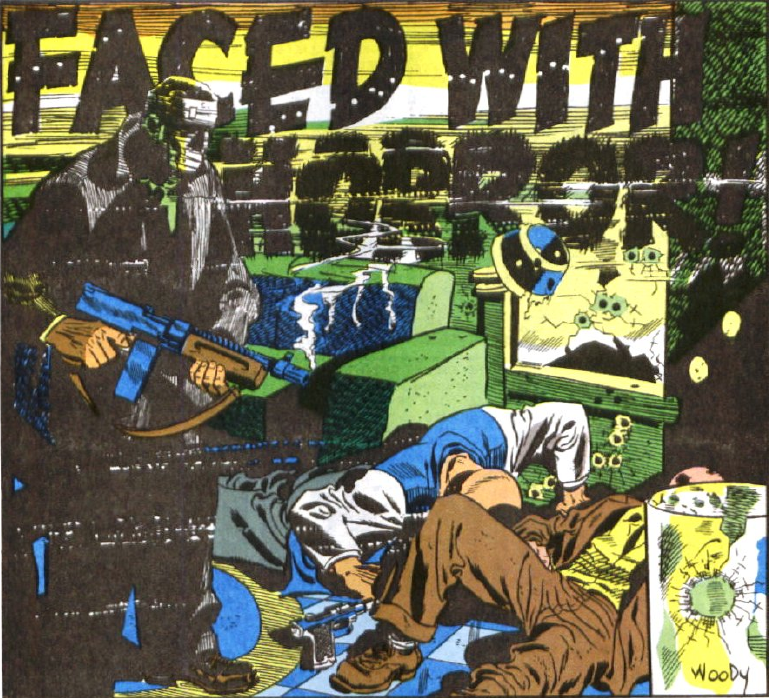
"Faced with Horror!" ★ 1/2
Story by Al Feldstein
Art by Wally Wood

"Blood Red Wine!" 
Story by Al Feldstein
Art by Graham Ingels

Sam Brogen and Willie Cooper are making a neat operation of their latest bank heist when it suddenly goes south after Sam plugs a heroic teller and an on-the-spot photographer snaps a photo right as the thieves bust out of the joint. Listening to radio broadcasts at their hideout, the boys discover that Sam has been positively ID-ed in the photo but Willie, obscured in the action, remains in the clear. With everyone in the next three counties keeping their eyes peeled for Sam’s face, the hood figures the most logical thing to do is to get it changed. Some strong-arming and illicit threats upon a renowned surgeon grease the gears just right, and Sam reawakens from his operation with a new face wrapped under bandages. Once clarifying that no follow-ups will be necessary, Sam cuts the doc in half with his tommy gun and then turns it on Willie, figuring one share of the gains is better than two. Sadly for Sam, he’s been the brunt of a cruel comeuppance: after removing the bandages, he finds a stitched-up monstrosity worthy of Shelly staring back at him. Any chance of spending the stolen money or assuming any kind of normal life are shattered, so Sam reasons that there’s only one option left on the table…

Oh Yeah, Wally Wood ("Faced With Horror)
As we’ve seen with several other artists in recent issues, Wally Wood fully comes into his trademark style in this wonderfully gritty hardboiled egg. “Faced with Horror” trades on some hallmarks of the genre, namely the criminal who undergoes plastic surgery to elude the fuzz, and Wood serves it all up with illustrations that have all the swagger of prose by Chandler or Cain. The panels seem inadequately equipped to contain the characters’ bursting forms and, as Jack points out, sometimes they don’t. With this story, Wood demonstrates that he is the master of action.

Also in this issue are not one but two stories, back-to-back, that have husbands briefly exulting in the freedom afforded them by killing their terrible, terrible wives. We don’t see the murder take place in Johnny Craig’s “Poison,” we only hear about it from our gloating protagonist whose braggadocio is cut off at the knees by his housekeeper’s insinuation that she knows what really happened to her former mistress. Boles is understandably frightened and gives in to Elsa’s demands lest he face a death sentence. His funds all but sapped, Boles hits on the bright idea of imbibing the very same poison he used to off his wife and then placing all the blame upon Elsa. Boles gets a little too deep into his cups, and when he awakens from his stupor he’s told by the attending physician that he was roused with two full tumblers from the bottle of whiskey where Boles had hidden the poison. Although Craig’s work is perfectly adequate here, there was a certain “safe” quality to the story that kept me from ever getting fully caught up in the events, a pity since the twist was pretty good.

An uneasy glimpse of death from "The Giggling Killer"
More poetic justice is served up to the henpecked loser in Harvey Kurtzman’s “The Giggling Killer.” Loman not only shares similar homicidal thoughts with Mr. Boles from “Poison” but an identical sense of cunning that involves marking another criminal as the true perpetrator of the crime. Reading the detailed reports of the eponymous murderer in the newspaper, Loman figures he can easily replicate Giggly’s M. O. and escape persecution by staging a simultaneous “business trip” to Chicago to act as his alibi. The plan goes off without a hitch when Loman garrotes his shrewish partner and marks the corpse’s forehead with a lipstick triangle, but Loman’s return trip is ruined when he decides to pick up the wrong hitchhiker. Credulity and patience are strained in equal measure with Kurtzman’s story following Craig’s so closely, and even the former’s typically unique art looks rushed and unattractive here. A sign that Kurtzman was becoming more preoccupied with the company’s war titles?

"Blood Red Wine"
The Old Witch digs into a moldy volume from her library and offers up an acknowledged variation on Poe with “Blood Red Wine.” The story follows the same basic trajectory as “The Cask of Amontillado,” the insulted aristocrat of Poe’s tale transformed into a monkey-faced vintner here who’s just been ruined by a bad review from a wine critic. Naturally, the vintner invites the critic to the subterranean catacombs where he stores his barrel-pyramid of wine and plies the snob with Chianti until his guest is properly sloshed. When the vintner makes his intentions known, the drunk critic pulls a gun but loses the ensuing struggle and ends up sealed inside one of the chamber’s alcoves. The vintner basks in his glory until he realizes a stray bullet has pierced one of the barrels and toppled the pyramid, causing an avalanche of alcohol to come charging his way. The play on Poe’s story is lightly imaginative and fun—thankfully it doesn’t attempt to reinvent the wheel outside of issuing the typical EC payback to the guilty—and while Ingels’s art shows a clearer level of care and precision I don’t find it to be quite the revelation that my cohorts did this time around. -Jose

Peter: While the Ghastly art for "Blood Red Wine" is fabulously creepy (Graham's characters, more and more, seem to be reverting to their simian roots), the highlight of the issue, for me, is Wally Wood's noirish masterpiece, "Faced with Horror." Wood's characters are almost three-dimensional, especially the heater-loving Brogen. We've watched Wally evolve in the past few posts (although the earlier work may have been muddied by diverse hands) and here it's as if he's turned the corner and become "Wally Wood," the artist who would revolutionize science fiction funny books in the 1950s. According to Tales of Terror/The EC Companion, "Poison!" is inspired by "The Interruption," by W.W. Jacobs, author of "The Monkey's Paw" (which would be famously adapted for The Haunt of Fear in 1953) and inspiration for "Blood Red Wine" comes from Poe's "The Cask of Amontillado." The difference in adaptation and source is that Poe let the guilty go free.

Dame Elsa! ("Poison")
Jack: For me it was a tie between Ingels and Wood for best story of the issue. Wood's art here alternates between photo-realism and classic Wood. I see an Eisner influence in the panels where the plastic surgeon is killed and the horrible face at the end is all that Johnny Craig's monster in this month's Vault of Horror was not. It's interesting that the last panel implies that the main character plans to commit suicide. Dr. Wertham was shaking his head in disgust. The Ingels art on the Feldstein/Poe story is simply stunning--his second majestic work this month. For once, the story actually gives credit to the original author! Kurtzman's story is fun but not his best work, though the panel where the murder takes place reflected in shadows on the wall is great and I love how the husband giggles extra loudly to make sure the neighbors can hear him. Craig's story is probably the weakest, though not bad at all. There is a strong Eisner influence throughout and I love hard-boiled dame Elsa, who seems to have a cigarette dangling from her lips throughout the story.

John: I was ready to drink the "Poison!" by the end of the first tale, and Kurtzman's art once again turned me off; I just can't take the stories he illustrates seriously.  Fortunately, "Faced with Horror!" was a good story, with a great creepy reveal at the end. The splash page of Brogen reminded me a bit of Frank Miller's Marv from Sin City. Having read enough issues with no redeeming qualities, I guess I shouldn't complain when there's one good one in the contents. 


Feldstein
Tales from the Crypt #22

"The Thing from the Grave!" 
Story and Art by Al Feldstein

"Blood Type 'V'" 
Story by Al Feldstein
Art by Graham Ingels

"Death's Turn!" 
Story by Al Feldstein
Art by Jack Kamen

"The Curse of the Arnold Clan!" 
Story by Al Feldstein
Art by Johnny Craig

Pretty Laura Mason chooses kind James Barry to marry instead of scary Bill Ferth, so when Jim goes on a business trip Laura fears for her safety. Jim swears that, if she's ever in danger, he'll save her, no matter where he is. Bill waits in the middle of a lonely road for Jim and murders him when the car stops. After Bill buries the body and sinks the car in a lake, he waits awhile before going to see Laura. She still carries a torch for Jim, so a disappointed Bill admits that killing her husband was a waste of effort. He says he has to kill her too! Bill locks Laura in her cabin and sets fire to it, but her shrieks cause Jim to rise from the dead and "The Thing From the Grave" shambles along and rescues Laura. Bill conveniently trips and falls into Jim's grave, and the rotting corpse joins him and pulls the dirt back in, burying the two former rivals together forever.

"The Thing from the Grave!"
What fun! Feldstein sure can draw a great, rotting corpse and Laura is a honey. This is what I would call a story in the classic EC tradition.

Driving too fast down a deserted road at night, Freddy and Jean's car crashes into a fallen tree. Fred staggers for help and calls Doc Benson, who examines Jean and announces that she needs a blood transfusion. A spooky man pops up from out of nowhere and offers to give his blood to Jean, since it turns out he and she share "Blood Type "V"! After Jean disappears from the hospital, Doc mentions that he saw a couple of bite marks on jean's neck and everyone realizes that there's a vampire about. Jim returns to the scene of the crash, where he finds and stakes the vampire. Unfortunately, it turns out to be Jean. The spooky guy shows up and admits he's a vampire, too. He fell in love with Jean and turned her into one of the undead with the blood transfusion. Having failed to talk Jim to death, he announces that he will use another method to kill him.

"Blood Type 'V'"
Ingels's art in this story isn't quite as big a knockout as the other two stories he contributed this month, but it's still great. Feldstein's story is a bit of a muddle and we just saw this same twist ending this month in the werewolf story in Vault.

Kane and Crossen own a failing amusement park but when Bixby comes along with plans for the world's fastest roller coaster, they agree to make him an equal partner. The giant new ride is built and the original partners decide it's "Death's Turn!"to act, so they push Bixby in front of a speeding roller coaster car, killing him instantly. They hush up the death and soon open to a big crowd. Kane and Crossen are the first to ride the super coaster but when the car arrives at the end, they are dead, having failed to realize that no human could survive the speed without suffering a broken neck.

"Death's Turn!"
Kamen's art works better than usual in this story, which is pretty good until the flat ending, which requires a last-panel explanation by the Old Witch.

It's New Year's Eve of 1950, and Robert Arnold is looking in the attic for some clothes to wear to a costume party when he happens upon a book titled "The Curse of the Arnold Clan!" He reads it and discovers that, due to a fratricide in 1750, the eldest Arnold will be buried alive every 50 years on New Year's Eve. Guess what? Robert is the eldest Arnold and tonight is 50 years since the last tragedy. At the costume party, Robert participates in a scavenger hunt and ends up at the cemetery where his ancestor is buried. Robert manages to lock himself in his ancestor's coffin and fulfills the prophecy.

I'm seeing Eisner everywhere this month, but there are parts of this story where Craig must have had some Spirit sections open on his drawing board. I really enjoy his art, but the ending of this one was too easy to predict.-Jack


"The Curse of the Arnold Clan!"
Peter: A very weak issue for me, with just two positive aspects of the issue to keep the pages turning. "The Thing from the Grave" is readable mostly due to its charming campiness. I love how when Jim catches up to Bill and takes him to his grave, the hole is already dug. I want to see the missing panels where Feldstein shows Jim digging the grave with the handy shovel before setting off to find his murderer. Ghastly's art is the only reason "Blood Type V" gets two stars from me. Ingels's vampire is no suave Hungarian with table manners but, rather, a giant bat-monster. The reveal is too predictable, though. The remaining two stories are immensely forgettable.

Jose: “The Thing from the Grave” may very well be the ur-text of “vengeful corpse” stories in the pre-code comics; it reads like it’s the first time all the requisite pieces fitted together to compose a satisfying whole. (Or hole, in the case of our tireless zombie.) Feldstein smoothly draws the action out over the eight pages so that it never feels drawn-out or lacking. It’s just right, like Baby Bear’s porridge. “Blood Type ‘V,’” however, appears to cram two separate storylines in with neither of them really taking off. It’s built very much on convenience, but perhaps not as offensively as “The Curse of the Arnold Clan,” a story whose ghostly legend-vibe is shattered when Feldstein has his hero make some ridiculously inane decisions all for the glory of winning a prize at a New Year’s scavenger hunt! “Death’s Turn” is much like the roller coaster at its center, mathematically sound in construction but hampered by a minor flaw, this being the lukewarm art of Jack Kamen. I’m still holding out hope that we’ll be seeing the artist take some exhilarating twists and turns soon.

John: Our first tale this time out, “The Thing from the Grave,” is cut from very familiar cloth, though Feldstein's rotting corpses are always a welcome sight. I was pleasantly surprised by the final twist; it was clear Bill was going to end up in the grave he dug for Jim, but it was clever to have Jim join him for their eternal rest. "Blood Type V" reminded me of a story Peter wrote (under a pseudonym) for our 'Worst in Horror' issue of The Scream Factory, notably mocking just this sort of cliché ending used here. "Death's Turn" shows us that the building of a roller coaster does not make for an interesting comic story, even with a splash of well-deserved deaths. In "The Curse of the Arnold Clan!," we're asked to believe that someone would go to the trouble of digging up a grave in order to win a scavenger hunt. Ray Russell had a better idea ten years later in his story "Sardonicus," when he had a son dig up his father's grave to get his winning lottery ticket.

Jack: Sounds like "Post Mortem" by Cornell Woolrich.


Next Week...
He-Man Adventures in
Star Spangled DC War Stories #81
On Sale June 20th!


Thursday, June 9, 2016

The Hitchcock Project-Robert C. Dennis Part Twenty-Four: "The Crocodile Case" [3.34]

by Jack Seabrook

Robert C. Dennis adapted "Fatal Figures" for the small screen, then followed that teleplay with his adaptation of Cornell Woolrich's story, "Post Mortem," which I discussed here in my series on Woolrich.

Next up for Dennis was to adapt a story by Roy Vickers titled "The Crocodile Case," which was first published in the March 1949 issue of Ellery Queen's Mystery Magazine. Vickers (1889-1965) was born William Edward Vickers in England. He studied at Oxford but did not earn a degree; he worked as a salesman, a newspaper crime reporter and a ghostwriter before settling into a long career as a writer. In his lifetime he wrote over 70 books, the first in 1914, but he is best remembered today for his mystery short stories, especially the series known as the Department of Dead Ends, which concerned a "fictional department of Scotland Yard where evidence from unsolved crimes is kept." Many of his stories in this series were published in Ellery Queen's Mystery Magazine, and they have been called "the best detective stories of the 1940s."

One of the stories in this series is "The Crocodile Case," which has been reprinted several times as "The Crocodile Dressing-Case." The story begins by referring to the famous "Thomson-Bywaters case" of 1922. Though Vickers does not go into detail, the case involved a British couple named Edith Thompson and Frederick Bywaters, both of whom were executed in 1923 for the murder of Edith's husband Percy. To summarize the facts briefly, Edith married Percy and later had an affair with Frederick. One night, when Edith and Percy were returning home from a show in London, Frederick jumped out from behind some bushes and stabbed Percy to death. Frederick was soon caught and arrested, and Edith was arrested as well under the British legal theory of Common Purpose, which said that anyone involved in participating in a criminal enterprise is guilty of the crime even if they did not carry it out.

Freddy Bywaters, Edith Thompson, Percy Thompson.jpg
Frederick Bywaters, Edith Thompson and Percy Thompson

The case became famous after Edith's trial and execution by hanging. She was the first woman to be hanged in England since 1907 and she was one of only 17 women hanged in the United Kingdom in the twentieth century. There has been quite a bit written about the case and, in 1937, Alfred Hitchcock himself expressed an interest in making a film about it. Critics have speculated that this case was one of the influences that led Hitchcock to explore the idea of women being punished for their morals, a theme that appears repeatedly in the director's works, including Stage Fright (1950).

Vickers mentions this case briefly at the beginning of his tale and uses it as an inspiration for his fictional murder mystery, which he refers to as the Chaundry-Lambert case of 1936. In the story, Phyllis Chaundry is 24 years old and married to Arthur Chaundry, a much-older 47 years old. After only two years of marriage she begins to lament her husband's "infirmities of age" and to say that his death would be a "mercy-murder." A 26 year old car agent named James Lambert begins to think that her suggestion is a good one and "his passion for Phyllis overwhelmed him." Lambert ambushes and murders Chaundry on a lonely stretch of road as the husband drives to pick up his wife at the Palais, where she and her sister had been dancing.

"The Crocodile Case" was
first published here
Lambert arrives at the Palais to take Phyllis and her sister home and Phyllis does not seem to realize that he had planned to murder her husband: "I never supposed for a moment that you would be mad enough to do it!" Phyllis asks Jim if her crocodile dressing-case was in the car and wishes that he had brought it along with him. Jim takes her home and instructs her on how to behave when the police arrive. The police later question the widow with the Thompson-Bywaters case in mind, wondering if this is another example of a wife and her lover murdering her husband. Phyllis is genuinely upset when the police tell her that her crocodile dressing-case was not found in the car and must have been stolen.

The police suspect Jim of the murder but have no proof. Jim tells Phyllis that they can't be seen together, they can't be married for at least six months, and they should not write to each other. When they do marry in October, Jim realizes that "the sense of triumph, of at last possessing the object of his desire, was altogether lacking." Phyllis continues to complain about the lost dressing-case, so Jim buys her a replacement but she is disappointed when it is not as nice as the one she lost. Soon, Phyllis leaves Jim for another suitor named Wilfy. Seventeen months after the murder, Chief Inspector Karslake of Scotland Yard tracks down the dressing-case, which had been stolen by a passing tramp. The case has the initials "P.C." (for Phyllis Chaundry) carved into its side.

Superintendent Karslake with the crocodile case
The inspector calls Lambert to Scotland Yard to identify the thief, assuming that the thief must be the murderer, but when Jim explains that the case bore the initials "P.C." then Karslake realizes that he must be the murderer. Phyllis had described the case in detail but never mentioned the initials, which had only been added when it was repaired right before Arthur's death. Karslake knows that the only way that Jim could have known about the initials is if he himself were the killer. The story ends with Jim telling the police that Phyllis never knew of his plan.

Comparing the story by Vickers to the details of the famous murder case reveals that, while Vickers may have used the real crime as the inspiration for his short story, he did not use many of the actual details. In fact, the main thing the two tales have in common is this: a woman's lover murders her husband and, when caught, tells the police that the woman had nothing to do with the crime.

A.E. Gould-Porter as Arthur Chaundry
Robert C. Dennis wrote the teleplay for "The Crocodile Case," which was broadcast on CBS on Sunday, May 25, 1958, near the end of the third season of Alfred Hitchcock Presents. In adapting the story for the small screen, Dennis followed its events faithfully, taking a work that was mostly narrative and turning it into a lively, dynamic half-hour that is driven by dialogue. The show opens with a scene that shows Arthur driving alone at night. He is forced to stop because a car is blocking the narrow road. He gets out to investigate and is bludgeoned by Jack Lyons, who drags his body off to the side of the byway. Lyons then leans inside Chaundry's car to turn off the radio and inspects the dressing case. We see the initials "P.C." clearly on the front of the case. Once again, Dennis is careful to highlight a key object right at the start of the show.

The scene at the Palais follows, and Phyllis Chaundry's sister Aileen gets more exposure than she does in the story, perhaps because she is played by Patricia Hitchcock. Phyllis arrives home and, after she confirms that her husband is not home, she turns with a devilish smile on her face and embraces Jack. This is the first time we realize that they are lovers.The performances by Hazel Court as Phyllis and Denholm Elliott as Jack are outstanding.

Denholm Elliott as Jack Lyons
When Superintendent Karslake arrives and questions Phyllis, he mentions that Arthur was attacked "on a deserted road leading to Bywater"--this is a sly reference by Robert C. Dennis to the Thompson-Bywaters case, which Vickers had mentioned in the original story. Hazel Court is wonderful in this scene, as she is able to turn her crying on and off instantly to suit the occasion.

Later, when Jack and Phyllis are trying to stay apart to avoid causing suspicion to fall upon them, Phyllis and her sister "accidentally" run into Jack in a restaurant and Robert C. Dennis works in another reference to the Thompson-Bywaters case when Jack tells Phyllis that they'll be sunk if they write to each other and the police find even one letter--this recalls the real case, where love letters exchanged between Edith and Frederick were used as evidence to convict her.

Hazel Court as Phyllis Chaundry sports a devilish
grin when she realizes that her husband is not home.
Throughout the episode, Hazel Court is very amusing in the way she ignores the fact of her husband's death and fixates on her lost item of luggage. At the end, Dennis makes the tramp who stole the case into a former car washer at Lyons's garage and Karslake intentionally tricks Lyons into identifying the case with the initials; in the story, it was a happy accident.

"The Crocodile Case" is another example of a very good mystery story that was adapted by Robert C. Dennis into a highly entertaining half-hour of television, helped immeasurably by strong performances by the two lead actors.

Denholm Elliott (1922-1992) gets top billing and plays Jack Lyons (James Lambert in the story). Born in London, Elliott served in the Royal Air Force during WWII; he was shot down and spent the rest of the war as a POW. His movie career began in 1947 and TV work followed soon after in 1949. He worked until his death from AIDS-related pneumonia. He was on Alfred Hitchcock Presents twice and made many other TV and movie appearances. His most famous roles were in Raiders of the Lost Ark (1981) and Trading Places (1983).

John Alderson as Karslake
The gorgeous Hazel Court (1926-2008) gives an enthusiastic performance as Phyllis Chaundry. She made movies from 1944 to 1981 and was on TV from 1956 to 1975, appearing in episodes of The Twilight Zone and Thriller. Born in England, she starred in many great horror films of the 1950s and 1960s, including Curse of Frankenstein (1957), The Premature Burial (1962), The Raven (1963) and The Masque of the Red Death (1964). Her autobiography, Hazel Court-Horror Queen: An Autobiography, was published in 2008. Court said that CBS brought her to America, where she appeared in four episodes of Alfred Hitchcock Presents; this was the first. When she filmed this episode in 1958 she was married to actor Dermot Walsh; however, in 1963, she divorced Walsh and married Don Taylor, whom she had met when he directed "The Crocodile Case."

The role of Superintendent Karslake, the investigating policeman, is played by John Alderson (1916-2006), who was onscreen from 1951 to 1990. He appeared in many TV episodes and movies, including Fritz Lang's Moonfleet (1955) and Hitchcock's To Catch a Thief (1955). He was on the Hitchcock show three times and on Night Gallery once.

Pat Hitchcock and Hazel Court--sisters?
In smaller roles are Pat Hitchcock (1928- ), the director's daughter, who was last seen in this series of articles when she appeared in "Silent Witness," which starred Don Taylor, the director of "The Crocodile Case." British character actor A.E. Gould-Porter appears briefly as Arthur Chaundry, who is murdered in the first scene. He was onscreen from 1942 to 1973 and appeared in Assault on a Queen (1963), Hitchcock's Torn Curtain (1966) and ten episodes of Alfred Hitchcock Presents, including "Back for Christmas" and "The Glass Eye." The tramp who stole the crocodile case is played by Frederic Worlock (1886-1973), who was onscreen from 1914 to 1970 and who was in four episodes of Alfred Hitchcock Presents.

Frederic Worlock
Robert C. Dennis's script for"The Crocodile Case" is in the collection at Duke University. Roy Vickers, who wrote the story on which it was based, never wrote for the screen himself, but three of his stories were adapted for episodes of Alfred Hitchcock Presents and three others were adapted for films. A French TV series titled Le service des affaires classées that ran in 1969 and 1970 dramatized thirteen of his stories from the Department of Dead Ends series.

Don Taylor (1920-1988), the episode's director, was at the helm for seven episodes of Alfred Hitchcock Presents; the previous one was "Fatal Figures," which also featured a teleplay by Robert C, Dennis.

"The Crocodile Case" is available on DVD here or may be viewed online for free here. Read the GenreSnaps take on this episode here.

Sources:
"The Crocodile Case." Alfred Hitchcock Presents. CBS. 25 May 1958. Television.
"The FictionMags Index." The FictionMags Index. Web. 30 May 2016.
"Galactic Central." Galactic Central. Web. 30 May 2016.
Grams, Martin, and Patrik Wikstrom. The Alfred Hitchcock Presents Companion. Churchville, MD: OTR Pub., 2001. Print.
IMDb. IMDb.com. Web. 30 May 2016.
"Roy Vickers." Contemporary Authors Online. Gale, 2000. Web. 30 May 2016.
Vickers, Roy. "The Crocodile-Dressing Case." 1949. The Black Cabinet: Stories Based on Real Crimes. Ed. Peter Lovesey. London: Xanadu Publications, 1989. 151-69. Print.
Wikipedia. Wikimedia Foundation. Web. 30 May 2016.