Showing posts with label Mad. Show all posts

Monday, July 9, 2018

EC Comics! It's An Entertaining Comic! Issue 61


The EC Reign Month by Month 1950-1956
Issue 61: May 1955


Johnny Craig
M.D. 1

"The Fight for Life"★1/2
Story Uncredited
Art by Graham Ingels

"Janie Some Day"★★
Story Uncredited
Art by George Evans

"To Fill the Bill"★1/2
Story Uncredited
Art by Joe Orlando

"The Antidote"★★★
Story Uncredited
Art by Reed Crandall

From ancient times till only recently, illness was treated in the dark, as medical knowledge grew in fits and starts. Today (that is, 1955) the friendly doctor knows how to take good care of you.

George Evans gives
"Janie Some Day" crazy eyes
Yes, that's about all there is to "The Fight for Life," a six-page history of medicine illustrated by (of all people) Graham Ingels, who does his best to make things interesting. There's only so much one can do with such a dry topic.

The kids on the playground call her "Janie Some Day," because the six-year-old gal has had both legs in a cast since birth due to congenital osteomyelitis, a bone infection. The nice doctor cures one leg and the cast comes off, but the other one has to be amputated. Janie fears she'll need a wooden leg, but instead she is fitted with a modern prosthetic and now she can run and play with the other kids.

Seriously, did Bill Gaines really think this would sell? Who would buy this comic? Young doctors-to-be? George Evans can draw just about anything and, like Ingels in the first story, he gives it the old college try, but the subject is just not one I really want to read about in comic book form, and I'm a guy who likes adult-themed graphic novels.

Which is it? Bobby or Jimmy?
"To Fill the Bill"
When Jim Saunders pays the bills each month, he ignores Dr. Bennett's bill because he knows the doctor will always come when he's called. Little Bobby, who suddenly becomes Little Jimmy in the middle of one panel, swallows a safety pin and dear old Dad uses the tried and true method of pounding on his back. A call is made to Dr. Bennett, who races to the Saunders' apartment, where Bobby cannot breathe. The doc realizes right away that (just like on Baywatch!) an emergency tracheotomy is called for and, before you know it, the heroic doc uses a kitchen knife to open an airway and a pair of tweezers to extract the safety pin. Jim sheepishly tries to pay the doctor, who gallantly refuses money for now, understanding the family's financial situation.

What a load of hooey! I think Dr. Bennett should have told the Saunders family to pound sand and let little Bobby (or is it Jimmy?) pass on to the next world. That would have been better than making us suffer through six pages of Joe Orlando's art, which is not exactly pleasing to the eye. How did he get so good in the 15 years or so between this and when he started drawing Cain for House of Mystery?

A riveting panel from the "appendectomy sequence"
in "The Antidote"
It's been a long day for Dr. Anders, but he still has to meet with a neurosurgeon who's coming in from out of town to do brain surgery. Danny Borden's parents insist that Dr. Anders see their son, who (it turns out) has appendicitis and needs emergency surgery. Anders agrees to participate and the boy is saved. When the neurosurgeon finally arrives, he tells Anders that the brain surgery can go forward at eight a.m. There's no reason to delay removing the tumor--from the brain of Anders's wife!

Reed Crandall to the rescue! His fine art keeps the story interesting enough that the final twist is a welcome surprise. If this first issue of M.D. is a harbinger of the next four, it's going to be a tough read, but the art is at least bearable, for the most part, though I wish Johnny Craig had done more than just draw that fine cover.--Jack

"The Fight for Life"
Peter: The first issue of M.D. opens with a (ostensibly unintentionally) hilarious travelogue of pain through the ages that makes this reader wonder if "The Fight for Life" (with its cavemen who speak almost Shakespearean English) was, instead, scheduled for MAD! My favorite bit (reprinted here) is the Polynesian form of doctoring, which isn't that far from the methods practiced by my GP. "The Antidote" has a nice twist in its tail but, otherwise, the contents of M.D. #1 are universally silly, dated, and boring. "To Fill the Bill" is a monologue on paying bills and "Janie Some Day" is a nauseatingly maudlin precursor to the hospital dramas we grew up with on TV. Obviously, the prevailing sentiment in Bill Gaines's office was that funny books based on "professions" were going to be the next big thing. Thankfully, M.D. and Psychoanalysis proved otherwise or, fersure fersure, we'd have gotten Two-Fisted Plumbing Tales, Stock Exchange SuspenStories, and Tales from the Mailroom.


Panic 8

"Irving Oops" ★
Story by Jack Mendelsohn
Art by Will Elder

"Carmen" 0
Story by Jack Mendelsohn
Art by Joe Orlando

"Panic Peeks Into Some Old Underpaints" 1/2★
Story by Jack Mendelsohn
Art by Jack Davis

"Gone with the Widow" ★
Story by Jack Mendelsohn
Art by Wally Wood

Guess who drew short straw yet again? My thesaurus only goes so far and I believe I've dried up every possible variation on the word "awful" but here we go anyway. I'm just not sure why even Bill Elder can't work up enough enthusiasm to fake his way through a seven-page strip when he's been (half-) responsible for several out-and-out comedy classics over at that other rag. "Irving Oops" is dreadful (there ya go, that's another word for "awful"), boring, lifeless crap and, doubtless, Al knew it. Just like he knew that "Carmen" was embarrassingly bad (I assume that's publisher Gaines as our emcee, Melvin Kross) but moved it along anyway. "Carmen," by the way, receives a rare 0 score from me. How rare? I've never used it. "Underpaints" is no better, nor is "Gone with the Widow," the hilarious movie send-up we've been begging for. Scarlip O'Hare and Rhett Buttons gives you a mere taste of just how rib-tickling this parody is. But, no wait, there's more . . .

Four issues more to be dreadfully, awfully, horribly, odiferously exact. -Peter
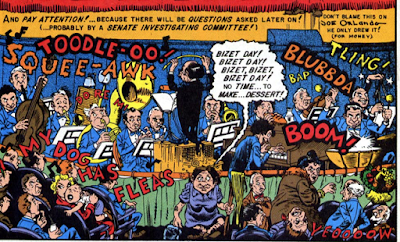
In this case, one panel will have
to be worth a thousand words

Jack: "Irving Oops" makes me think about how hard it is to pull off an effective parody. Bill Elder's work with Harvey Kurtzman is hilarious, but he can't bring life to a Jack Mendelsohn script. Since I've never read "Alley Oop," the jokes fall flat for me. It seems that parody only works when the reader is familiar with the subject being parodied. At least "Carmen" has a quick reference to Stan Freberg's "John and Marsha" routine, so I got a smile thinking about that. Joe Orlando does draw a good-looking Carmen. The parody of classic paintings was surprising because I've never seen Jack Davis draw seriously before. I guess he was able to do more than the usual style he made his living at for decades. As for "Gone with the Widow," Wally Wood's art is gorgeous, and of course his Scarlip is a knockout, but this time even with knowledge of the story being parodied it wasn't a tiny bit funny.


Crandall
Piracy 4

"Pirate Master" ★★★
Story Uncredited
Art by Reed Crandall

"By the Book" ★★★
Story by Carl Wessler
Art by George Evans

"The Sheba" ★★1/2
Story Uncredited
Art by Graham Ingels

"Inheritance" ★★★
Story Uncredited
Art by Bernie Krigstein

No one is feared on the seven seas like Captain Satan, the "Pirate Master," a man so devoid of kindness even his scurvy crew fears him. Satan and his men attack and board a merchant vessel and murder every one on board save a couple of women stored below deck during the journey. As Captain Satan prepares to unveil the potentially-valuable cargo, two of his men wonder what could possess a man to be so heartless and cruel. What indeed? Well, luckily we get to see into Satan's mind and what we see makes his cruelty understandable. In his past life, Satan was blacksmith Juniper Dell, who did everything he could to keep his wife, Viola, content and comfortable but nothing was good enough for his vicious mother-in-law, who henpecked Juniper into leaving home. While musing on the docks,  the morose young man is shanghaied and becomes a pirate under the notorious Captain Ambrose Cates, who takes a shine to young Juniper. A year later, Cates is fatally wounded and turns the ship's wheel over to his apprentice, who quickly earns the fear, if not respect, of the crew. Finally coming out of his daydream, Satan watches as the two women are brought up from below and . . . suddenly, Juniper is confronted with wife and mom-in-law. Mom wastes no time in reminding her good-for-nothing son-in-law who's boss and Juniper finds himself aboard the merchant ship, heading back home to his blacksmith job, the laughter of his former crew receding in the distance.

Every pirate's nightmare

A bit of a change of pace from the usual Piracy tale; well, actually the first three-quarters are just like the usual Piracy tale, rip-roaring and bloody, with fierce battles and inhumanity abounding. Then comes the about-face in the final panels, a hilarious and startling swerve into something akin to a MAD parody. Yes, the twist of Juniper/Satan's past catching up to him is predictable, but our uncredited tale-spinner does a great job of making the sudden infusion of humor work after such a violent build-up. Reed Crandall was born to draw pirates; that much is obvious.

The fact that Midshipman David Price does everything "By the Book" is driving the rest of the crew of the Troy, an American ship fighting in the War of 1812, crazy. To Price, it all comes down to the regulations listed in his Maritime Manual but, to his comrades, there's no time for rules during engagement and the book should go the way of the used coffee grounds. When a chance to sink a British ship comes, Price leads a band of brave men in a rowboat armed with a single mine to blow the Macedonian to kingdom come (or United Kingdom come). The smoke that allowed the little rowboat to approach the Brits without being seen lifts and the Macedonian opens fire on the men. Price grabs the mine, leaps into the water, and manages to attach the explosive to the ship before being fatally shot. The British ship seriously compromised, the longboat returns to the Troy and Midshipman Price's book is tossed into the deep to sink with his brave body. A rousing sea tale with a bittersweet finale (nothing maudlin about that climax), "By the Book" proves that even Carl Wessler was being bitten by the "novelty bug" that was bringing out the best in writers who had seen better days (or had yet to see good days, for that matter); most of these guys were probably sick to death of horror, crime, and shock tales and something fresh like Piracy was infusing them with new ideas. George Evans, like Reed Crandall, is ideally suited to the genre.

Ben has always hated "The Sheba," a ship he helped build with his father; the massive construct of wood seems always out to harm the poor young man. When the Sheba breaks its constraints at the shipyard and mows down Ben's father, Ben vows one day to destroy her. Meeting the love of his life, Ivy, seems to put destruction to the back of Ben's mind but, when one of the ship's pulleys breaks loose and cracks Ben across the skull, he stands on the verge of sanity and once again makes the destruction of the Sheba his top priority. His captain puts Ben ashore at a tiny island so that he can hop another boat to make it back to Ivy but, months later, it's the Sheba that arrives to pick him up. Ben steals onto the ship in the dark of night and sets her adrift; he watches in glee as the Sheba wrecks on a nearby reef and sinks with all crew aboard. But when Ben makes it back to his beloved Ivy, he realizes the torture he was subjected to by a hunk of wood has not ended . . . Ivy boarded the Sheba and took her to the island to see Ben. Another good, solid six pages of sea-faring adventure, though the climax is a bit predictable and I'd question Ben's seesawing sanity; one moment he's lucid, the next he's a raving maniac. Graham (difficult not to type "Ghastly!") proves again that switching genres was no problem but it might have helped that "The Sheba" was just one rising sea-corpse away from being a Tale from the Crypt.

Count Charles Devigny rules his French war frigate, the Bon St. Louis, with an iron hand and only his brother, Emile, is sympathetic to the complaints of the "common" crew. That's what the crew thinks, at least, but at night Emile reports the murmurs of mutiny to his brother, effectively playing double spy. Charles, we come to discover, was granted the family power and wealth while Emile stands penniless and jealous. If Emile can somehow talk the men into a mutiny and Charles is out of the way, Emile is next in line for the "Inheritance." The crafty dog talks the men into murdering the entire crew but finds his victory is short-lived when the Bon St. Louis docks at Cherbourg just after the Bastille has been stormed. Having ascended to Count, Emile is put on trial and sent to the guillotine. Not really a tale of piracy but close enough I guess, "Inheritance" is another well-written and exciting tale à la Shock SuspenStories. Krigstein seems to be finding his sea legs after a rough, cartoony start last issue; the human beings are not as exaggerated. I continue to be impressed with this title, which has already ascended (maybe by process of elimination, but still . . .) to the top of the New Direction books. -Peter

Jack: It's good to know that even a feared pirate had an overbearing mother-in-law! I began to suspect the identity of the passengers in "Pirate Master" around page five but the end was still very funny. "By the Book" demonstrates some thrilling and unexpected heroism, while I found "The Sheba" rather dull and note that Ghastly is still being assigned the quasi-horror stories. Krigstein's technical skill continues to lag behind his cinematic imagination in "Inheritance," though I did like the final panel, where Emile is being guillotined.


MAD 23

"Gopo Gossum!"★★★★
Story by Harvey Kurtzman
Art by Wally Wood

"Scenes We'd . . . Like to See!"★★★
Story by Harvey Kurtzman
Art by Jack Davis

"Ripup's Believe It Or Don't!"★★★
Story by Harvey Kurtzman
Art by Wally Wood

"The Barefoot Nocountessa!"★★★
Story by Harvey Kurtzman
Art by Jack Davis

Back from a trip to the big city, "Gopo Gossum!" tells all his friends in the swamp that they need to stop standing around making great puns and start thinking about politics. Before you know it, political parties abound, as do caricatures of political leaders of the time. The natural end of all this is an atomic explosion, witnessed by four very familiar Disney animals passing by through the woods.

"Gopo Gossum!"

Reading this story not long after suffering through an issue of Panic really shows how much Harvey Kurtzman meant to the success of MAD. The story is very funny and a perfect (and loving) parody of the great Pogo strip, right down to Wally Wood signing it "Walt Wood." This is witty, intelligent, clever writing and great comic art.

"Scenes We'd . . . Like to See!"
In "Scenes We'd . . . Like to See!" a series of typical movie scenes are presented then repeated in a more likely fashion. A couple kiss passionately but get slobber all over their faces. Two swordsmen fight and one is killed with a well-placed thrust. A western hero does not arrive in time to save a fort, some Nazis prevail, a detective gets shot instead of talked to death.

This sort of thing would become more prevalent as MAD continued, with endless (nine pages, in this case) comparisons of the way things are with the way the MAD staff would like to see them. It's funny enough, just not outstanding, and I get tired of Jack Davis quickly.

Do you remember the newspaper strip, "Ripup's Believe It Or Don't!"? Sure you do! It had fascinating facts about unusual folks, such as Galusha Sturdley, the tallest man in the world, and Joseph Stalin of Russia, who was really born in the Bronx.

At three pages, this is just the right length. Wood imitates the Ripley's drawing style perfectly and the "facts" are just absurd enough to be funny and to seem reminiscent of the real strip's panels.

Harry Drawers stands in a cemetery in the pouring rain, recounting the story of "The Barefoot Nocountessa!" Harry was sent by a Hollywood mogul to bring her back from Spain. Men fought over her because of her beauty and, eventually, one killed her.

I've never seen The Barefoot Contessa, so this is kind of foreign to me, but I can appreciate Jack Davis's takes on Bogart, Ava Gardner, and Sinatra. It's all pretty funny and puts a fitting capper on an above-average issue of MAD.--Jack


"The Barefoot Nocountessa!"

Melvin Enfantino: The final issue of funny book MAD is a mixed-bag. On one hand, "The Barefoot Nocountessa!" is proof that Harvey had had enough of movie parodies and was just cruising while, on the other, "Gopo Gossum!" was just as much proof that Kurtzman could probably continue satirizing comic strips and make readers guffaw until he ran out of material. "Gopo" is chock full of hilarious little nuances (like the little guy who spouts gibberish, including "NBCTV" and the polliwog in a glass who notes how nice the art is) and fourth-wall breakers but, curiously, is missing the Elder section of KurtzElder. Wally is perfectly suited for swamp creatures, anyhow. "Ripups's Believe It or Don't" is a knee-slapping collection of silliness and startling facts (5+3-2=7248 has always been debated at our EC Club meetings) but "Scenes We'd . . . Like to See!" is monotonous and a chore to get through. Obviously, it was popular, though, since it became a regular feature in the zine-sized MAD, which debuted its new 68-page, magazine-sized, two-bits cover-priced incarnation in July 1955. Goodbye, MAD, we'll miss ya. But wait, in the words of Gopo Gossum, "You ain't heard the worst!" We're stuck with Panic for four more issues!


Next Week . . .
Will Jeb Stuart get to meet
his ghostly ancestor on the other side?

ATTENTION!

Desperately needed for an upcoming project. If you have scans for the following Atlas comic books, or can make us a scan, please contact us:

Adventures Into Weird Worlds #1, 4, and 23
Journey Into Unknown Worlds  #38 (3rd issue), 9, 10, and 48
Mystery Tales #4, 8, 11, 12, 21, 42, 43, 49, and 51
Mystic #13
Spellbound #14
Suspense #26 and 28

See your name in lights on this very website!

Monday, June 25, 2018

EC Comics! It's An Entertaining Comic! Issue 60


The EC Reign Month by Month 1950-1956
60: April 1955 Part II


Evans
Aces High 1

"The Way It Was"★★★
Story by Irv Werstein
Art by George Evans

"The Outsider"★★★
Story Uncredited
Art by Wally Wood

"The Mascot"★★1/2
Story Uncredited
Art by Bernie Krigstein

"The New C.O."★★★1/2
Story by Carl Wessler
Art by Jack Davis

A boy watches a modern jet zoom by at an air force base and asks his grandfather to tell him about air warfare way back in WWI. Gramps proceeds to give the lad a history of "The Way it Was," from the first planes used for observation to the deadly bombing runs, all of which developed at a rapid pace during the Great War.

"The Way it Was"
The first issue of Aces High opens with a lovely story. While there's no plot, the history lesson is fascinating and sets up the premise for the comic clearly, with great plane illustrations by Evans. This line of storytelling will lead, in about a decade, to Joe Kubert's classic work on Enemy Ace.

Lt. Tom Pomeroy is a new addition to the 37th Blue Blazes Aero Squadron in France and he finds that the other men treat him coldly because he's "The Outsider." One day, he returns from a solo mission to find the base under attack; he holds off a slew of German planes until his colleagues join him in the air and foil the assault. Now beloved by the other men, he soon finds himself giving a new arrival the same cold treatment he had received.

"The Outsider"
Another winner, with terrific art by Wally Wood, this story worked for me right up to the end, where I was disappointed that Pomeroy acted like just as big a jerk to the new guy as the others had acted toward him. Didn't he learn anything? What's the benefit of treating a new recruit badly? Not much of a message, if you ask me.

At an American air base in 1918 France, a dog named Prop is "The Mascot" for the men. When a flier takes off, the pooch won't leave the air strip until the flier returns. If the flier is thought lost, Prop's behavior predicts whether he will come back alive. When Art Hayes is lost in a cloud and forced to land and try to make his way back to base on foot, Prop waits for him, even though Germans are fast approaching. Prop is right again, Art makes it back alive, and the last men waiting for him make their escape.

Three good stories in a row signal promising things for Aces High! It's odd to see Krigstein drawing such a straightforward tale, but he does a decent job. His weakness tends to be human faces, and when there's no weird, expressionistic storytelling going on, that flaw is more evident, as it is here. Still, I love a good dog story and was happy to see Prop, the European cousin to our friend Pooch from the DC War Comics.

"The Mascot"
By May 1918, the U.S. air fighters over France had an unusual relationship with the German air fighters--they respected each other! This chivalrous behavior goes on until squad leader Mike Pepper is killed in battle. His replacement, Frank Worth, has a different attitude, and leads the men on a mission to wipe out as many planes and kill as many Germans as they can. Why the tough approach? "The New C.O." reveals to his men that, while they were playing games, the Germans had been attacking Allied troops on the ground elsewhere.

This is a harrowing story, where Carl Wessler, of all people, plays the reader's emotions like a fiddle. We hate Major Worth and later respect him. Davis's art is good but not as good as what we saw from Evans and Wood earlier in this issue; Wessler's story, however--and I can't believe I'm saying this--is the best of the four.--Jack

"The New C.O."
Peter: An editorial inside the first issue of Aces High informs us that this title is the result of a fan outcry for more World War I aerial dogfight stories. While I admit there were probably a few classics among those WWI tales found in Two-Fisted and Frontline, I'm not sure an entire title devoted to the subject is going to tread water. Case in point: issue #1. There's a samey-ness to all four stories. "The Way It Was" reads like an Encyclopedia Britannica entry on the origins of dogfights. Grandpa sits down to tell Jimmy about his exploits as a pilot but succeeds only in putting the poor kid to sleep with his long-winded oratory. I swear "The Outsider" is the foundation for just about every Bob Kanigher DC war story ever written; all that's missing is the catch phrase. Pomeroy's cold shoulder to the new guy in the final panels is about as fake as it gets. Looks from some of the panels of "The Mascot" that Bernie Krigstein might have gotten a hand; the story is entertaining fluff, but fluff nonetheless. One of the best war stories I've read in a long time, "The New C.O." shows I may be wrong about there not being enough decent WWI tales to tell. Carl Wessler turns the usual gung-ho nonsense on its ear and has us rooting for "the bad guy" by the climax. An interesting turn after three narratives that accentuated the respect pilots had for each other. And Jack Davis's stuff has never looked this good. A "New Direction" classic.


Craig
Extra! 1

"Dateline: Cayo Romano, Cuba!" ★★
Story and Art by Johnny Craig

"Camera!" ★1/2
Story by Colin Dawkins
Art by John Severin

"Holiday for MacDuff" ★★
Story Uncredited
Art by Reed Crandall

"Dateline: Key West!" ★★
Story and Art by Johnny Craig


Reporter, lover, macho man,
and .400 slugger
Ace reporter/muscleman/ daredevil/superhero Keith Michaels has been given the toughest assignment of his adventurous career: find former Nazi/current arms dealer Henry Gavell, who may have been kidnapped by Cuban rebels. The government is itching to find Gavell before the plot becomes news and Keith's editor wants to make it front-page before Uncle Sam can lower the boom. Intel puts Gavell on a remote island and, thanks to a sea plane, Michaels ventures to the rebel fortress and finds Gavell, who is being held prisoner. Our hero frees Gavell but, in an excruciatingly devilish twist, discovers that Gavell set up his own kidnapping to throw Uncle Sam off the trail. Keith takes Gavell in and democracy rules once again. "Dateline: Cayo Romano, Cuba!" is not a great intro for new series character Keith Michaels, who will star in ten high-energy adventures in the five issues of Extra!  For one thing, we know nothing of this guy's past; was he Marine commando, World War II sergeant, or just Yale Judo champ of 1942? Craig, who has always been a favorite of mine, is in deep "Steve Canyon mode" here not only in story but in art style. Even in a story set in the naive, golden age days of the 1950s, it's hard for me to fathom a reporter so important that he's able to get to the goods before the government; that he's so well-trained he's able to outfox a band of rebels; that this newspaper has enough dough to fly Keith all around the world for a story. I'll give Johnny another installment to flesh some things out; EC was obviously thinking about the future by introducing these series so late in the game.


Noted photog "Slick" Rampart has been sent to Geneva to cover a peace conference with his "Camera!" when an odd duck crosses his path, a fellow picture-taker who's changing bulbs faster than he can take the dang pics. Something rubs "Slick" the wrong way and so he tails the camera guy back to his hotel, where he discovers that the man's equipment is loaded with bullets. "Slick" alerts the local gendarmes and helps nab the would-be assassin before he can ventilate his target, a French General. If I had reservations about Keith Michaels's debut, I'm rolling my eyes at that of "Slick" Rampart, whose adventure is tantamount to a really bad '40s programmer (right down to the badly-choreographed fist fights and lame bad guy talk). Like Michaels, we'd better get used to this nonsense, as "Slick" will see an adventure in every issue (and a team-up with Michaels, as well!), It seems that, with the exception of Piracy and Aces High, the New Direction was down.

All newspaperman Jock MacDuff is looking for is a wee bit of peace, and possibly a stout ale from the pub now and then, but what he finds is still more danger and intrigue when he stumbles across "one of the world's greatest scientists" and his daughter hiding under assumed names on a tiny island. It's not long before Jock's instincts and great biceps come in handy as he must save the girl and her pop from enemy agents. Though we're told MacDuff's vocation is reporter, there's not really much of that skill in evidence here (other than the fact that his keen eye picks the scientist out of a line-up), only a skimpy plot and some fairly interesting caption-free panels where Jock goes toe-to-toe with the enemy agent. The caption-free panels are a godsend by the time we get there as Jock's Scottish brogue is annoying to say the least.

Fresh from his dangerous excursion in Cuba, Keith Michaels heads to Key West for some relaxation with his lovely gal-pal, Vicki. Keith's got one thing on his mind but, unfortunately for Vicki, it's not romance; the sometimes-reporter, most-times-brawler is dying to get his wet suit on and go spear-fishing. Michaels and Vicki attend a soirée at the home of Mr. Edson, the head of the Miami World Press Service, who invites Keith to join him on his boat the next day. While at the party, Keith runs into the daughter of Edson and her new beau, Rod Atkins, but the pair brush our hero off as if he was a nobody. Next day, while diving, Keith comes across a body and brings it on board. Mr. Edson identifies it as the PI he's hired to investigate his daughter's boyfriend. After springing an elaborate trap, Keith reveals he knew something was going on when he saw track marks on Atkins's arm and assumed the man was a narcotics trafficker. Bingo! Like "Holiday for MacDuff," there's not a lot of reporting or newspaper-oriented stuff to be found in "Dateline: Key West!" and, like the previous adventure, this is nothing more than a thread-bare plot laced with a skirmish or two. The only thing we're quite clear on is that Keith Michaels gets a lot of time off, has a very understanding editor, and lands a hell of a right hook while underwater. Not much to get excited about. -Peter


Jack: Overall, not a great issue, even with two stories by the great Johnny Craig. I like the way he uses blue and black for night scenes in the first story and I love his storytelling and kinetic art, mixing words and silent action. The second story has sharp Severin visuals but there's not much to the plot, while the third story is marred by that Scottish accent, despite stunning art by Crandall, who once again demonstrates his expertise at drawing a gorgeous gal. The last story, by Craig again, is a letdown, highlighted only by another girl in a bikini and a neat underwater spear gun battle.


Kurtzman
MAD 22

"The Child!" ★1/2
"The Boy!" ★
"The Young Artist!" ★
"The Commercial Artist!" ★1/2
"The Old Pro (Mole)!" (reprint)
"Senility!" ★
Stories by Harvey Kurtzman
Art by Bill Elder

According to Frank Jacobs, in his "Incomplete History of MAD Comics" (found in the magazine-sized reprints published by EC in 1999), by 1955 "Harvey Kurtzman was running out of steam." The all-Elder "Special Art Issue" is a result of Harvey's burn-out, a very unfunny parody of Bill Elder's career beginning as a toddler scrawling in chicken-fat and culminating in a reprinting of "Mole" (from #2). Perhaps, years before, this might have been an imaginative skewering of a funny funny book artist but all that sticks out here is how guffaw-free the material is. Some of the faux ads point to the direction the magazine is heading very soon; perhaps it was only a matter of time before the KurtzElder team ran out of steam anyway (Elder would be MIA in the final comic-sized issue). 
-Melvin Enfantino


Jack: Hard as it is to believe, here we have an entire issue of MAD done by Kurtzman and Elder, who were (in my opinion) the premier MAD writer/artist team, with nary a laugh. The first three sections are painfully unfunny, while the section about Elder as commercial artist raises a few tepid smiles for some of the fake ads. Worst of all is that the issue is capped off with a reprint. I guess that readers would plunk down a dime for anything EC put out with MAD on the cover, but this issue is a complete misfire.


Next Week in Star Spangled DC War Stories #133
Could this be the return of . . .
Captain Storm?

ATTENTION!

Desperately needed for an upcoming project. If you have scans for the following Atlas comic books, or can make us a scan, please contact us:

Adventures Into Weird Worlds #1,4, and 23
Journey Into Unknown Worlds  #38 (3rd issue), 9, 10, and 48
Mystery Tales #4, 8, 11, 12, 21, 42, 43, 49, and 51
Mystic #13
Spellbound #14
Suspense #26 and 28

See your name in lights on this very website!

Monday, May 28, 2018

EC Comics! It's An Entertaining Comic! Issue 58


The EC Reign Month by Month 1950-1956
 58: February/March 1955, Part II


Crandall
Piracy #3

"Blackbeard" ★★★
Story Uncredited
Art by Reed Crandall

"U-Boat" ★★★ 1/2
Story by Carl Wessler
Art by Bernie Krigstein

"Mouse Trap" ★★
Story Uncredited
Art by George Evans

"Slave Ship" ★★
Story by Carl Wessler
Art by Graham Ingels


"Blackbeard" 
"Gentleman-turned-buccaneer" Stede Bonnet wants only one thing more than joining Blackbeard's pirate fleet, and that's ascending higher than the famed pirate someday. After Blackbeard is bested by Bonnet in a duel of swords, he has no choice but to accept the upstart into his gang of merry men and it's only a matter of time before Bonnet becomes second-in-command. But runner-up is not what floats Stede's boat now; he wants command of the entire fleet of pirates and he's got a plan to fulfill his dream. Unfortunately for Bonnet, Blackbeard is just as crafty and, through a series of crosses and double-crosses, the older man finds himself still in charge. Not for long, though, as the Albatross is attacked and boarded by the crew of a British man-o-war. Bonnet finally gets his wish as his corpse is hung from the yard arm of the Albatross, higher than Blackbeard's. Our writer may have played around with the details of history a bit in order to make for a more entertaining read (Bonnet was actually hanged in South Carolina), but it works. Reed Crandall can really work up the atmosphere; we feel as though we're at sea with these blackguards and rabble. The multiple back-stabbings had me re-reading the text more than once but a big plus was the absence of any "Arrrr, matey . . ." dialogue to gob up the action.

"U-Boat"
Eric Von Krohner, commander of a German U-Boat during World War II, may be unlike any other Nazi as he shows sympathy for the "enemy" and holds to his own moral code. That doesn't sit well with his second-in-command, Hitler Youth poster boy Heinrich Hass. When the U-Boat destroys a battleship and rescues two American survivors, it begins a deadly cat-and-mouse game between Hass and his CO. "U-Boat" isn't what I'd call a "pirate" tale but perhaps editor Feldstein considered Nazis pirates or scavengers and so I can live with the bending of the rules a bit. It helps that the story is dynamite, an exciting and (literally) deep sea saga which benefits from some fabulous dialogue:

Von Krohner: No, lieutenant, it is you who are the traitors! You Nazis . . . who betrayed a nation . . . a whole world . . . for the glory of a few greedy, brutal madmen!

Hass: Spoken like a true Prussian! You admiralty men thrive on war and when you think you may lose one, you look around for someone else to blame!

"U-Boat"
Hard to believe this is Carl Wessler's handiwork, rather than Harvey's, but Wessler seemed to be elevating his level of writing towards the end (as evidenced by several stories that appeared in this time frame); staying up late and absorbing all those EC back issues seems to have helped. Bernie Krigstein was an artist with two styles-- 1/detailed but abstract and 2/cartoony--this here features a whole lot of that Grandenetti-esque cartoony squiggling and I'd be a hypocrite for raving about BK's work on "U-Boat" and shoveling manure on Jerry, so I'll take the easy way out and say that this is one hell of a script and sometimes that's all you need (smiley face).

Martin Hawley only wanted to be a good sailor but the rest of the men on the Sea Spray would never let him forget how scrawny he was. Nor would they give him a break, stealing his food and making him take the top bunk (fer heaven's sake!), wearing the poor soul down. So, when Martin is caught stealing food from the store room and given six lashes with a cat-o-nine-tails, his patience runs out and he puts into play an elaborate plan to turn the men against the skipper and commit mutiny. The joke's on Martin, though, when the men murder the Captain and toss Hawley into a rowboat with no food or water to give the impression the Sea Spray had been scuttled. When he's found, nearly dead, by a passing ship, Hawley confesses his sins and tells the true story of the Sea Spray. The ship's doctor laments that Hawley never got a word out due to his lack of energy. "Mouse Trap" isn't a bad story but it's a bit on the ho-hum side; that might be down to the fact that the first two tales this issue are such firecrackers and "Mouse Trap" seems like such a familiar story. George Evans's art is just as tame as the script, with Martin Hawley resembling a skinny Quasimodo.

"Mouse Trap"

"Slave Ship"
Farmer Tod Ellis awakens after a long night of drinking to find himself at sea. Tod has been shanghaied! While making his discontent known to the first mate, Tod shows his fellow crewmen he's not one to be bullied and quickly earns their respect. Because Ellis knows he's trapped in the middle of the ocean, he swallows his anger and makes the best of a bad situation. That is, until the ship reaches Africa and he discovers the true nature of the trip: Tod is aboard a "Slave Ship"! Once under way, the first mate murders the Captain (whose heart really wasn't in the smuggling trade) and tosses the corpse into the water, all in full sight of Ellis. When Tod explains the situation to the crew, the first mate sucker punches him and moves in for the kill. At the last moment, one of the slaves (who Tod has been kind to) breaks his chains and breaks the first mate's back. The crew have a complete change of heart and head back to Africa to free their new friends. I'm not sure how to react to what surely must be the first EC story we've run across with a happy ending. On one hand, there's the syrupy, overly-familiar script (this ship of fools is manned by a boatload of cliches) but, on the other hand, there's the graphics which prove Ghastly (who now signs his work simply "Graham") had lots of oomph left, even after his gravy train was shut down by the Senate Stooges.--Peter

Graham may not be Ghastly anymore
but he still has the Ghoods!
("Slave Ship")

Jack: As I read "Blackbeard," I suspected that besting the title character in a sword fight might not be the smartest way to ensure long-term survival, and I was right. This is a great adventure tale with a satisfying conclusion and Reed Crandall's art is the best of what we see in the four stories in this issue. I was not that impressed by "U-Boat" and Krigstein's art did not work for me up until the end, when it kind of started to work. As I looked at the panel Peter selected above it finally hit me whose art Krigstein's reminds me of here (and sometimes elsewhere), with those heavy black lines: Frank Robbins! That's not a good thing. "Mouse Trap" is a pretty good story with an unexpected and effective twist, though it hardly showcases Evans's best work. Finally, "Slave Ship" is the second story this issue to feature an unexpected artist, though I think Ingels handles the task much better than Krigstein and this reminds me that the artist did some pulp work before he ever heard of EC.


MAD 21

"Poopeye!" ★★★★
Story by Harvey Kurtzman
Art by Will Elder

"Slow Motion!" ★★
Story by Harvey Kurtzman
Art by Jack Davis

"Comic Book Ads!" ★★★★+
Story by Harvey Kurtzman
Art by Will Elder

"Under the Waterfront!" ★★ 1/2
Story by Harvey Kurtzman
Art by Wally Wood


"Poopeye!"
Our favorite old salt, "Poopeye!," is being stomped on by his gal pal Mazola Oil for checking out a hot babe, so he downs some spinach and turns the tables. He then has to defend the honor of baby Swee'back, who has been hit by Mammy Jokeum (presumably visiting from the Mad version of "L'il Abner")--of course, more spinach is required. Poopeye then gets into a big fight with Melvin of the Apes, who is also accused of whacking little Swee'back. After Melvin knocks Poopeye around for a while, more spinach allows Poopeye to knock Melvin into a tree. Here comes Swee'back again, crying that Clark Bent hit him. Though Bent finds a phone booth and changes into Superduperman, it's not long before Poopeye is shoveling spinach down his gullet and knocking out the last son of Krypton. Finally, Swee'back himself gives Poopeye a good beating, complaining that his Broccoli empire is being harmed by Poopeye's devotion to spinach. Guess what? Poopeye eats spinach out of a garbage can and knocks Swee'back into a pile of ashes.

"Slow Motion!"
I can't believe I just typed all of that. Harvey and Bill are at the top of their game in this eight-page story, skewering a cross-section of comic book and comic strip heroes and satirizing the Popeye family of characters at the same time. The usual nonsense in the backs and sides of the panels is present in full force and, perhaps because I'm so familiar with the characters being spoofed, this strip really made me smile.

Gosh, isn't it cool when you see a portion of a sports event shown in "Slow Motion!"? That golf swing, that boxing punch, that water-skiing moment--none is quite what it seems. Jack Davis works a little harder than usual on the art in this six-page series of vignettes, but by about page three all the humor has been drained out and it's just an endurance contest to get to the end.

Man, those "Comic Book Ads!" sure are stupid, aren't they? Learn how to use the power of hypnosis, sell greeting cards door to door, build muscle--we know them all. But wait! The amazing duo of Kurtzman and Elder turn the ads on their heads and give us five of the funniest pages I've seen yet in Mad. At first glance, these could almost be mistaken for the real ads, but (for once) reading the fine print is worth every moment it takes. Satirizing other companies' comic stars is one thing, but such a dead-on attack on the classic comic book ads took major guts. They really get the point here and tempt the young readers with promises of freebies. They also put a line for the name of your lawyer and spaces for your fingerprints. This is great, classic Mad!

Genius!
("Comic Book Ads!")

Things sure are tough "Under the Waterfront!" Terry just wants to get along with his girl and maybe do a little boxing, but labor troubles keep resulting in people getting killed. Terry nearly takes a dirt nap himself but manages to stay alive and keep working. This spoof of On the Waterfront doesn't worry too much about plot or even logic, but Wally Wood's art continues to amaze me. I always liked him, but reading our way through the EC line has made me love him and want to learn more about poor, doomed Wallace. This issue of Mad is really up and down--but that's kind of what Mad was all about, I guess--throwing lots of gags against the wall to see what stuck. On a side note, there are several pages of ads for the New Direction line and I must admit I'm not salivating at the prospect of a comic about psychoanalysis with art by Jack Kamen!--Jack


"Under the Waterfront!"
Peter: Aside from the insanely detailed cover and a few of the interior "Comic Book Ads!," this is one of the weaker of the recent issues. "Poopeye!" is smart in the way KurtzElder dismember comic icons but it's not very funny. It's repetitive and overly long and I laughed out loud exactly once (the first time Poopeye gets his spinnitch and his muscles expand, forcing his eyeball from its socket--now that's funny!). "Slow Motion!" is a cute one-note joke expanded into a feature-length snore (a la "Sound Effects" in MAD #20). "Under the Waterfront!" takes its one good joke (the fact that everything in On the Waterfront is LOUD!) and rams it right into the ground; there's nothing else humorous in this strip. As noted, "Comic Book Ads!" (the best feature this issue) has some pretty funny sections to it, the best being the "Uncle Louie" ad (below), promising the world "without one cent of cost!" The escalating prizes are a hoot.

For selling 1,000,000,000 packs . . .
Jack Seabrook's unlisted number!
("Comic Book Ads!")

Kamen
Crime SuspenStories #27

"Maniac at Large" ★★★
Story by Jack Oleck (?)
Art by George Evans

"Just Her Speed" ★★★
Story by Jack Oleck (?)
Art by Bernie Krigstein

"Where There's Smoke . . ." ★★★
Story by Carl Wessler
Art by Jack Kamen

"Good Boy" ★
Story by Carl Wessler
Art by Graham Ingels

Pretty young thang librarian Blanche is all a-quiver over the string of strangulation murders that have been plaguing her fair city, each blaring headline denoting the killer’s continued elusion from the police. One rainy night head librarian Mrs. Pritchard leaves Blanche to her own devices while she fetches some coffee and sandwiches for their all-night inventory inspection (librarians know how to party!), but the jittery bookworm sees potential danger in every patron and passer-by, from a sinisterly-smiling reader to a disgruntled man who Blanche won’t allow inside to return his overdue book. When Mrs. Pritchard returns and hears of her employee’s apprehensions, she laughs them off and morbidly begins to theorize that the killer could just as well be a woman. Hearing this, Blanche realizes that she must protect herself from danger and wrings old Mrs. Pritchard’s gizzard right on the spot, just as she had done for all seven of those other maniacs who had threatened her before.

Eh, eh, ehh...
("Maniac at Large")
The majority of “Maniac at Large” may not be great shakes when it comes to the story department—my opinion may have been colored by the fact that I was already familiar with this one from its adaptation for the HBO series, which was pretty good—but it’s always a pleasure to see George Evans bringing his no-nonsense work to the drawing board, especially when it comes to the depiction of insanity and violence. Ol’ George was more of a realist than the other EC artists, so when he drew a pair of glazed eyes and a hanging jaw or displayed a scene of manslaughter it just hit that uncanny valley nerve where we could see a disturbing correlation to our reality in his two-dimensional illustrations.

Ed has finally managed to track down that no-good son-of-a-gun Marty Selzer to a roadside diner where Marty works as owner and server. Jubilant that his years-long search is finally over, Ed surprises his old chum with an order for some hot steaming lead served into Marty’s guts. But Marty being Marty, the soda jerk who stole Ed’s fiancé Shirley and a wad of dough (the money kind) tells the gunman that he’d be better off dead, explaining how miserable his life has been since that fateful day what with Shirley taking up with any man in town who will have her and spending Marty’s wages as soon as he earns them. But Marty isn't confessing all this just to cleanse his soul: he hopes he can stall Ed long enough for when the state trooper arrives at the diner for his nightly cup of coffee. Marty tries to appeal to random diners and travelers that briefly stop in, but they all exit quickly and leave the traitor to his fate. Finally the sound of the trooper’s motorbike fills Marty with victory and he gleefully tells Ed that everything he said was a lie and that Shirley is the best wife on Earth. Too bad for him that the trooper catches sight of a speeding car and hightails it out of the diner parking lot before he ever makes it inside. Ed takes this news in stride, killing Marty on the spot and leaving just as the trooper has caught up to the speedsters. Inside the car are Shirley and her latest boyfriend who kindly ask the policeman not to let Mr. Selzer know of their rendezvous.

A typical Krigstein breakdown.
("Just Her Speed")

Though the jury seems to be out regarding the penmanship of this story like “Maniac at Large” before it, “Just Her Speed” is a neat and efficient little killer with a nice double-socko ending that wouldn’t have been out of place at all on a program like Alfred Hitchcock Presents. Though the story does make us privy to Marty’s scheme to string Ed along so that the trooper can intervene, the reveal that Marty’s story has been one big hoax comes as a genuine surprise, and the grim dénouement that finds the weasel getting plugged over what was, as it turns out, the actual truth about trifling Shirley comes across as a nicely-delivered cosmic joke. Bernie Krigstein, up to his usual tricks with panel divisions, is seen in a more subdued form here.

Ed has just about reached his last nerve in having to deal with his wife’s Mae constant nagging and complaining after he’s put in a hard day at the used bookstore he owns, and her incessant chatter about local gossip lulls him into an angered sleep. But Ed still has his dreams to himself, dreams like having pretty young Alma to himself, the winsome lady who works for Ed at the bookstore. Though Alma hasn’t made any forward advances or dropped any hints, Ed feels that all it would take to win her over is a dead wife and a heartfelt proposal, so armed with this bulletproof conviction he proceeds to hatch his own bonafide Spousal Murder Plot (patent pending from EC). Ed’s plan involves convincing the world (re: 1 other person) that Mae is a habitual smoker before dousing her with a can of benzene back at home and—presto!—accidental death by immolation, as far as the authorities are concerned. But before Ed can go through with his plan he’s introduced to Alma’s very young and handsome fiancé and given her notice all at once. Tail tucked between his legs over the foolishness of his enterprise, Ed later wakes up after his evening nap to find Mae flicking a lit cigarette at him after she’s doused him with the benzene.

Do husbands dream of exploding shrews?
("Where There's Smoke...")
Move along, folks. Nothing to see here. Just another in a long line of Jack Kamen “husband kills the wife” rigamaroles. Oh, but that ending! In all honesty, I give “Where There’s Smoke…” a whole ‘nother star just for that giddy, out-of-left-field climax. The sight of Mae gleefully flicking the butt at Ed, himself the butt of yet another particularly black joke this issue, is enough to elevate this sub-potboiler to the level of “pretty good.”

Jim’s son Paul is a jerk. Everyone knows Paul is a jerk. Everyone but Jim, who doles out spankings and punishments but ultimately caves to his son’s sweet-talking ways. This develops over time into a mutually-harmful relationship wherein Jim is constantly suckered and Paul is constantly embroiled in affairs of increasingly criminal quality. When Jim is finally confronted with news of Paul’s nefariousness by no less than the police who tell the father about Paul’s shooting of a bootlegging kingpin, Jim turns and fills the closet where he has hid his son from the law full of lead. Jim then cries over his jerk son’s corpse.

Bust out the Kleenex, folks, cause we’ve got a weepie made to order here. “Good Boy” is about as hand-wringing as they come, a sorry swan song for Graham Ingels and this issue. Crime was never Ghastly’s forte, but like the story’s title suggests the artist was handed a real dog for his final assignment on this series. You can practically hear the organs piping by the time the last panel comes around.--Jose

This would've never happened if he hadn't
smoked those 5 marijuanas!
("Good Boy")
Peter: Yet another of the foundation titles comes to a screeching halt after 27 issues. Looking back over my notes for the entire run, I see the majority of stories in CSS were mediocre at best; it certainly didn't contain the quality stories found in its sister pub. How does the final issue score? I liked "Maniac at Large," even though it's built around a cheat (but a cheat that's nicely explained away, so . . .) and Evans knows his way around a cashmere sweater. "Just Her Speed" is even better (though I could have done without the final word balloon that basically reiterates the punchline for those of us who didn't get it) and Krigstein treads the fine line between his cartoony style and the experimental. Jack Kamen is given an assignment unlike any other he's accepted before. "Oh, Peter, you're being sarcastic again," I hear you say but, no, I don't mean that Jack's broken out of his "guy who dreams of adultery and murdering his wife" rut but this time around Kamen busts out his rarely-used "old people" stencils and adds a certain . . . oh, never mind. It's a deadly dumb script illustrated with a modicum of style. But worse is the EC-version of a Hallmark Movie of the Week, "Good Boy," a serious-as-a-heart-attack condemnation of parenting in America (at least that's how I read it). It's a wonder we didn't see good boy Paul reading an issue of Tales from the Crypt between jobs. So, the 27th and final issue of Crime SuspenStories is just about as average as the 26 that came before it.

Jack: I liked it much better than you did, Peter. "Just Her Speed" is my favorite, with its race against the clock story reminding me of a Cornell Woolrich setup. Krigstein's art is back to form and the twist ending was a complete surprise. Though "Maniac at Large" is overwritten and almost seems like an illustrated short story, Evans does a nice job with it and the ending was not completely predictable. I loved the guy banging on the window in anger because his book was going to be overdue! Ingels carries the day with "Good Boy," which is a rare Wessler script that doesn't begin at the end of the story and then unfold in flashback. The dad shooting the son behind the door reminded me of the Bugs Bunny cartoon, "Bugs and Thugs" from 1954, where Bugs throws a lighted match into a stove to prove that Rocky could not be hiding in there. I wonder if Wessler had the same thought? The timing is close. As for "Where There's Smoke . . .," the less said the better.


Panic #7

"Mel Padooka" ★★
Story by Jack Mendelsohn
Art by Bill Elder

"You Axed For It!" ★ 1/2
Story by Jack Mendelsohn
Art by Jack Davis

"Travel Posters" ★★
Story by Jack Mendelsohn
Art by Joe Orlando

"Them There Those" ★★ 1/2
Story by Jack Mendelsohn
Art by Wally Wood

Yeowch! Gulp! Ugh! Is it that time already for us to gulp down another tepid serving of Panic, the medicine that is the only officially sanctioned parody rag of MAD? Well yeah, I guess so!

Child abuse: the stuff of comedy!
("Mel Padooka")
“Mel Padooka”: Another comic strip lampoon by Bill Elder. Mendelsohn is no Harvey Kurtzman though, and even the rampant and usually reliable chicken fat seen here (and recycled endlessly throughout the rest of the issue) can’t help but feel off. Things don’t seem to really start going until the arrival of beloved orphan kid Lit-ul Marx, who Mel beats senseless for betting against him in his title-defending match against Hungry Humphrey Meatloaf, only for the smiling tot to turn around and hand the boxer his ass. Now that’s the stuff!

“You Axed for It!”: No, we did not. Neither did Jack Davis, who is seen here wading his way through the sewage of yet another laborious TV show parody.

You said it!
("Them There Those")
“Travel Posters”: Mendelsohn’s attempt to ape Harvey’s gimmicky fillers, which were hit-and-miss to begin with anyway. The main purpose of these six pages is to apparently have Joe Orlando stuff as many strained puns into solitary illustrations of various exotic locales as much as possible, and the effect is about as side-splitting as you would expect.

“Them There Those”: Mendelsohn finally seems to get his sea legs and manages to deliver a fairly compact and outré parody of the SF classic Them! Most of the jokes land pretty well here, like the dazed little girl turning out to be a member of the EC Fan-Addict Club and a lush to boot. My favorite component of the story is secret FBI agent K-9, who has the uncanny ability to disguise himself as a globe, a hat rack, and finally a giant shoe, among other things. It’s such a bizarre non sequitur in what is for the most part a straight parody, and I only wish that Mendelsohn had followed his instinct to be weirder for the rest of the issue. It might not have meant that the material would have been funnier, but it sure would have been more memorable.--Jose

Peter: There's really no sense breaking down the contents of Panic #7, though I will say that, for a title that had become the nadir of the EC line, this issue sees an absolute scraping of the bottom of the barrel. There's an almost desperate plea from writer Jack Mendelsohn to like some of his stand-up material but, try as I might, I couldn't muster even a half-hearted smile. So, rather than waste any more space, I'll simply point to the header atop the Russ Cochran/Gemstone reprinting of Panic as the perfect summation of the title:


Jack: As a glutton for punishment, I read every last word and every single gag in this issue and did not get a single smile, much less a laugh. Jack Mendelsohn may have had a long and successful career, but I doubt he'd hold up this issue of Panic as one of his stellar achievements. What a waste of Elder and Wood's talents. Between Panic and Mad, EC really wore out the TV show parodies. I get that early '50s TV was bad, but they really harp on it and it's just not funny.

Next Week . . .
Will The Losers stay afloat?