Saturday, April 6, 2013

The Caroline Munro Archive: The Escapists, 1972

by John Scoleri

I'm back again with yet another rarity from my Caroline Munro collection, an ever-growing series here on bare•bones.

This time out, I'm sharing another instance of Caroline Munro on the cover of a novel. The Escapists is described as a 'big business' novel by Alexander Fullerton. It's worth noting that this is the 1972 paperback from Mayflower Books (583-12385-6), of which a handful of used copies are available through Amazon.


While neither the photographer nor Caroline is credited, the Jewellry (sic) is attributed to Hooper Bolton.

It is believed there are other books out there for which Caroline specifically modeled for the cover, but I've only tracked down one. Unfortunately, unless these legs are hers, it doesn't look like she appeared on any other Alexander Fullerton 'big business' novels, at least that I could find...


If you spot any in the wild, please post a comment below!

A special shout out is due to Holger Haase, fellow Caroline Munro aficionado who as far as I know was the first fan to spot her on The Escapists. Check out his excellent blog: Hammer and Beyond.

Thursday, April 4, 2013

The Hitchcock Project--An Introduction


by Jack Seabrook


Alfred Hitchcock Presents and The Alfred Hitchcock Hour ran for ten seasons on CBS and NBC from 1955 to 1965. I was born in 1963 and was thus too young to see it or even be aware of it on its first run. I was also too young to see Hitchcock's Frenzy when it was released in 1972, so my first exposure to a Hitchcock film was his last, Family Plot, which came out in 1976. At some point around that time I discovered reruns of Alfred Hitchcock Presents on local New York TV stations, and I was hooked right away.

Star Trek fans were probably the first to compile and publish detailed episode guides to a TV series, but I first encountered such guides in Don Rosa's Information Center, a regular column that ran in the fanzine, Rocket's Blast Comic Collector (RBCC), beginning in the mid-1970s. These were followed by Gary Gerani's book, Fantastic Television, which was released in 1977. I bought that book and wore it out, combing through the pages and checking off episodes I had seen. As good as Gerani's book was, it was missing one thing--an episode guide to Alfred Hitchcock Presents and The Alfred Hitchcock Hour. Undaunted, I began to compile one. I spent hours after school in the public library, poring over microfilm rolls of the New York Times TV listings to collect details about the series. On weekends, I took the train to New York City, where I became a regular visitor to the Lincoln Center Library of the Performing Arts, home to a bound collection of old TV Guides, which provided more details about the shows. One Saturday, as I sat flipping through TV Guide volumes taking notes, Tony Randall sat down across from me and Jerry Stiller sat down next to me. They were there to do research of their own.

It was there that I discovered what I think was the first attempt to study the Hitchcock TV show in a scholarly fashion: an article from the fall 1971 issue of Cinema called "The Television Films of Alfred Hitchcock." This article only discussed the episodes directed by Hitchcock himself. Much to my dismay, the RBCC began to publish an episode guide to the Hitchcock series in 1978 ("based on data submitted by Bob Reed"). I had corresponded with Don Rosa about my intention to complete such a project, and he was kind enough to telephone me about it. I have never forgotten that phone call from someone I greatly respected and who would go on to become a well-known creator of comics himself.

After the initial disappointment of the RBCC episode guide, I decided to continue my work with the intention of publishing a book on the TV series. In the late '70s and early '80s, Alfred Hitchcock Presents could be seen in the middle of the night on New York stations. I would try to stay up, usually falling asleep at some point during The Tonight Show, or else I would set my alarm for 2:30 A.M. On the rare occasions when I actually managed to wake up and turn on my TV, I saw classic episodes like "The Dangerous People" and "A Night With the Boys."

By the early 1980s, publications such as Rod Serling's The Twilight Zone Magazine had begun to publish more detailed episode guides of series like The Twilight Zone, and books ("companions") about specific shows began to appear. Marc Scott Zicree's The Twilight Zone Companion and David J. Schow's The Outer Limits: The Official Companion were favorite examples. I made a trip into the CBS offices in New York City, where I was given access to their old microfilm files on the Hitchcock series but, once again, I was "scooped" when John McCarty and Brian Kelleher's book, Alfred Hitchcock Presents: An Illustrated Guide to the Ten-Year Television Career of the Master of Suspense, was published in 1985, with a foreword by Robert Bloch.

McCarty and Kelleher's book led me to discard all of the notes on the series that I had compiled over the years. Their volume was a great resource; it lacked air dates and detailed credits and occasionally got plot details wrong, but it was the only place that collected so much information about the series and it made for a very handy checklist. On television, Alfred Hitchcock Presents returned, first on NBC and later on USA, with new episodes that ran on and off from 1985 through 1989. The series used colorized versions of the Hitchcock introductions from the original series and featured new versions of old episodes interspersed with original stories.

My hopes for writing a book on the Hitchcock show appeared dashed but my love for the series continued unabated. My wife and I married in 1988 and moved into an apartment where we spent most nights watching The Alfred Hitchcock Hour in reruns on the USA network. In the 1990s, Alfred Hitchcock Presents began to turn up here and there on emerging cable networks such as Nick at Nite and TV Land. I watched the occasional episode, such as "The Contest for Aaron Gold," but these runs seemed always to start with season one and rerun the same bunch of shows, petering out before reaching the later--and less familiar--seasons.

In 2001, The Alfred Hitchcock Presents Companion by Martin Grams Jr. and Patrik Wikstrom was published, with a foreword by Patricia Hitchcock. Despite receiving mixed reviews, this massive tome contains more information on the Hitchcock series in one place than any other source and is much more detailed than the 1985 book that preceded it. The most exciting development regarding Alfred Hitchcock Presents occurred in 2005, when Universal released season one on DVD. I am sure I was not the only Hitchcock fan who thought his dreams had come true! After decades of watching the shows on TV in syndicated reruns, I could at last possess all 39 episodes of the 1955-1956 season, to watch and treasure at leisure. The production of this first set was not perfect, since they were burned on two-sided DVDs that sometimes caused problems with quality (my copy of "Breakdown" does just that), but it was a thrill nonetheless, made more exciting by the prospect of future releases of the rest of the series.

In subsequent years, seasons two (2006) and three (2007) were released annually, just in time for Christmas. Then the delays began. It took two years for season four to come out (2009) and over two years for season five to appear (early 2012) Each series was a thrill to see, and I can only hope that the rest of the ten seasons will be released in time.

In the meantime, I had been writing about popular culture. My first book, Martians and Misplaced Clues: The Life and Work of Fredric Brown, came out in 1993, and my third, Stealing Through Time: On the Writings of Jack Finney, was published in 2006. In late 2010, I stumbled across the blog, A Thriller a Day, while looking for online reviews of the TV series Thriller, which was just then being released on DVD. I began following the blog and commenting, and this led to an invitation from Peter Enfantino, one of the authors, to write for another blog, bare bones e-zine. I began with a series of articles on Fredric Brown, supplementing my book with material I had uncovered in the years since it was first published. This led to my first series on classic TV, Fredric Brown on TV, which included Brown's work for Alfred Hitchcock Presents along with other series where his stories had been adapted.

When this series ended, I began a series called Robert Bloch on TV, which focused solely on that author's work as shown on the Hitchcock series. By this time, I had discovered that episodes that were unavailable on commercial DVDs could often be found online on channels such as Hulu or You Tube, placed there by fans. I also discovered that the final five seasons of the Hitchcock series were available from other fans on DVDs whose quality was not up to the Universal standard, but whose rarity made them irresistible.

As the Bloch series continued, I decided that I would finally fulfill a lifelong dream and write about the entire ten-year Hitchcock series, dividing it up not chronologically but rather by subject, whether it be by author or by another creative personality. Bloch was followed by a series on William Shatner's appearances on the show (Shatner Meets Hitchcock), then by a series on the Ray Bradbury episodes (Ray Bradbury on TV) and, most recently, by a series on the John Collier episodes (John Collier on TV). Along the way, I made a few decisions.

1. Enough has been written about the introductions by Alfred Hitchcock. The 2001 Companion transcribed all of Hitchcock's introductions, following the trend set by Zicree back in 1982. Yet next to nothing had been written discussing the actual episodes themselves in detail. I determined to focus on the stories rather than the frames.

2. Detailed cast and crew information is easily available on sites like imdb. I chose not to include detailed credits in my articles, instead focusing on important or interesting contributions and giving background on creative talents of interest.

3. Pictures are important. I chose to illustrate each article with a combination of magazine or book covers and screen grabs from the DVDs themselves. I am confident that this represents a fair use exception to any copyrights that exist. The website Galactic Central is an excellent source for old magazine covers.

4. Title cards are not necessary. After reproducing title cards for my first several articles, I gave up the practice because I don't think it adds anything to the analysis and is visually dull.


5. Links are useful. Whenever possible, I include links to a source to purchase a DVD of the episode being discussed or a place to view it online. This allows interested readers to watch the episode that inspired each article.

6. Read the stories or the books. In preparation for each article, I track down and read the short story or book from which the episode was adapted. This allows for a comparison with the filmed episode.

Now that I am committed to doing the entire series, I have decided to change the umbrella title for these articles to The Hitchcock Project. Articles will appear every other Thursday on the bare bones e-zine website for many years to come, as long as the site remains viable and I remain conscious, until every episode has been discussed. When it is all over, I hope to collect the articles into a book, either paper or an e-book. I offer sincere thanks to Peter Enfantino and John Scoleri, founders of bare bones, for providing a place to publish this work, and to everyone who reads and/or comments on the articles. Suggestions for topics are welcome. Henry Slesar, surely the most prolific writer on the series, will be profiled next, in a group of articles that will take about two years to complete.

Every so often I will update the episode guide, which begins below. I will provide links to the articles I have written on each episode in order of their network airing. The episodes will be coded with two numbers, the first representing the season aired, the second representing the order within that season (for example, the first episode of season one is coded 1.1, etc.). Happy reading!

8/29/22: An updated list of episodes discussed is here.

Monday, April 1, 2013

Batman in the 1970s Part 64: July and August 1979


by Peter Enfantino
& Jack Seabrook


Batman 313 (July 1979)

"Two for the Money!"
Story by Len Wein
Art by Irv Novick and Frank McLaughlin

Two-Face has stolen the codes for the US Missile Defense System. He kills gang member Specs for trying to turn him in. Bruce Wayne gets romantic with Selina Kyle at a Children's Telethon, then puts on his cape and cowl and tracks down Two-Face. Government agent King Faraday is also on the villain's trail and tells Batman to stay out of his way. Two-Face robs the money collected by the telethon but gets away; Faraday is ready to kill Dent but Batman argues that he is mentally ill and needs help, not bullets.

PE: All kinds of confusing nonsense this time out. A page of domestic squabbling between Lucius Fox and his son Timothy is inserted midway through the action and then abandoned. It's better off abandoned as it feels lifted from similar squabbles between The Amazing Spider-Man's Robbie Robertson and son Randy back in the 1960s. I applaud Len Wein trying to add side dramas to a title that has never had sub-plots but it's so random it doesn't work. There's no connection to the main story at hand (well, at least until we find out that Timothy has been hanging out with the wrong boys who just happen to be Two-Face hoodlums--but that's just a guess) and the scene feels forced.

How was Specs able to gain access to the giant piggy bank to hide the binary code when, ostensibly, the company would have had security on guard? Maybe it was the same security company that allowed Two-Face and his mob to drive off with the armored car filled with tons of dough! I'm pleased one of the rogues was dusted off but after the last two Wein-written issues, this is a big letdown. And what self-respecting FBI guy would allow himself to be named King Faraday? I'd have my own parents arrested.

Jack: When Faraday shows up for the first time it's unclear who he is--I thought it might be Jason Bard. Then Batman says, essentially, "who the heck are you?" and I felt better. I don't mind the subplots. In addition to the Fox family saga, there is also the ongoing business with Bruce and Selina. While Wein is not as skillful at this as Englehart was, I still think it's a good sign and adds to the book's overall depth. Novick and McLaughlin turn in their usual serviceable art job--nothing outstanding, but good enough and much better than Calnan.


Detective Comics 484 (July 1979)

"Assault on Olympus!"
Story by Denny O'Neil
Art by Don Newton and Dan Adkins

Patterning himself after a God, Maxie Zeus tries very hard to dispose of the thorn in his side, our hero, The Dark Knight. Zeus throws lightning bolts, falling walls, killer wolves, and a master bowman at Batman but all it does is make him tired and mad.

PE: A "novel-length thriller" it says on the contents page and this story is neither. It is, in fact, one page shorter than most of the Batman stories we've been reading lately and devoid of anything resembling thrills. What, may I ask, is Maxie Zeus' grand scheme here? Shoot lightning bolts at the Batmobile to prove what? And The Caped Crusader says this guy is "as dangerous as The Joker... as Ra's al Ghul." I don't think so. He's about as dangerous as Victor Buono/King Tut and that may have been the inspiration. O'Neil's story lacks focus and depth but not so Don Newton's art, which is gloriously noir-ish. Just the way I like it!

Jack: This story is typical of late '70s Denny O'Neil--it aspires to be grand but ends up grandiose. Maxie Zeus isn't much of a villain and he just gives up at the end of the story. I felt bad about how Batman disposed of the wolves. I agree about the Newton art, though I don't think this is his strongest work to date.


"The 'Who Is Floyd Fenderman Anyway?' Contract!"
Story by Len Wein
Art by Dick Giordano

An anonymous caller informs Christopher Chance that Floyd Fenderman is a dead man and if Chance gets in the way he'll be a dead Human Target. Since Chance knows no one by that name, he's a bit intrigued and a little detective work leads him to a tailor shop where no one seems to be bringing their suits. Once inside, he's manhandled by a couple of roughs after he drops the name of Fenderman. After putting the thugs in their place, Chance finds out that Fenderman is the owner of the building that houses the tailor shop and has found out the business is actually a front for a numbers racket. He's given the proprietors their walking papers and they, in turn, have slapped a contract on his head. The Human Target nabs the assassin who's been hired for the job and Floyd Fenderman lives happily ever after.

PE: Here's a light and amusing little feature starring a character who may just grow on you, one with a sense of humor. The art's not  up to Giordano's standards but it's good enough. Ironic that the best back-up in a superhero title is the one without costumes.

Jack: I liked this better than last issue's Human Target story. It reminded me a little bit of the sort of hard-boiled things Max Allan Collins writes. Chance is a real whiz when it comes to makeup and disguises--he can even change the entire shape of his head!

"The Race Against Murder!"
Story by Jack C. Harris
Art by Bob Oksner and Vince Colletta

Batgirl takes a personal interest in the attempted murder of her pop, Commissioner Gordon, who's nearly atomized by a letter bomb. When she follows a lead, she finds out there may be more than one person who wants to see her dad permanently retired.


PE: Commissioner Gordon opens up a letter bomb that seemingly blows up his office but he's pretty much unscathed. And the forensics guys do a fabulous job of piecing together what looks to be an equally unscathed letter! Poor Batgirl can't seem to catch a break, constantly thrust into sub-par "thrillers."

Jack: This story is hilarious if for no other reason than the loopy positions Bob Oksner puts Batgirl in! We could reproduce a half-dozen panels or more to show what I mean. In one shot, she looks like Elongated Man! Compare the kooky art here to the terrific cover by Ross Andru and Dick Giordano. One of the chief joys of reading Batgirl stories is ogling her great body. Gil Kane knew just how to draw her to make her assets look their best. Bob Oksner's take on Ms. Gordon is just funny!

"The Return of the Flying Graysons!"
Story by Jack C. Harris
Art by Kurt Schaffenberger and Frank Chiaramonte

Bedlam reigns as Dick realizes he's backed over Aunt Harriet
Dick Grayson finds an old friend setting up shop on the outskirts of Hudson University. The Haly Circus, where once Dick was a Flying Grayson, has come to town. Not long after having a two-page flashback to his youth, Dick is facing an escaped lion as Robin! Having caged the wild beast, the Boy Wonder visits the tent city and finds out from circus owner Haly that a lot of bad luck has befallen Dick's old stomping ground. Not one to turn his back on trouble, Robin investigates and discovers that one of the "Flying Graysons" is not what he says he is.

PE: If not for the "All New" banner on the cover, I'd swear this is another of those bad reprints from the 1960s. The credits only reinforce that feeling. It's perfectly good reading for pre-teens but anyone hoping for more than a cliched "Robin revisits his past" tale should look elsewhere. You gotta love when Dick literally rolls under a car and comes out the other side as Robin, set to fight off a lion.

Jack: When I was a kid, I kind of liked Schaffenberger's art. It fit the Captain Marvel strip. Now, it's hard to take. Yet I enjoyed this story more than I wanted to. I have a soft spot for origin flashbacks, and Robin's origin was a good one. I also liked the fact that the circus owner secretly realized Robin's secret identity but never let on. If only the villain didn't have blue hair and a '70s mustache to match!

"Tyme Has No Secrets!"
Story by Len Wein
Art by Steve Ditko

Enraged by Merlin's empty coffin, Baron Tyme attempts to force Jason Blood to give up what he knows. Unfortunately for all concerned, the only being who may know what's going on is Jason's alter ego, Etrigan the Demon, and he's not around to talk just now. Just as Tyme is about to dispatch Blood, an angry mob from the local village storms Castle Branek and Jason is forced to call upon The Demon. Tyme and Etrigan put aside their differences to fight the villagers but the crazed Baron takes a powder when the numbers become too great. Just as he's about to make headway into the location of Merlin's body, one of the villagers blows up the tomb and Tyme is buried under the rubble. Not for long, though.


PE: After three installments I still have no idea what The Demon stands for, what his powers are, or whether he's a hero, villain, or anti-hero. Who cares? After, a bumpy second chapter last issue, I'm loving this strip. The goofy castle backgrounds, the angry mob right out of a Universal monster movie (the village is even named Wolfenstag, a torch's throw from Vasaria, I'd wager) and, of course, Ditko's dynamic visuals. One nit: the two main characters spent a good portion of the first half of the story mouthing pretty much the same dialogue:

Tyme: You will tell me where Merlin is!
Jason: I don't know where he is!
Tyme: Of course you do!
Jason: No I don't!
(repeat several times)


Jack: I'm right with you on this one! His Demon doesn't always look quite right, but there is no one else like Steve Ditko. His art is instantly recognizable and looks like no one else's. Think about it--can you name anyone else who draws remotely like Ditko? I'm grateful to see him still working in 1979 after the bumpy road his career followed.

"The Galileo Solution"
Story by Denny O'Neil
Art by John Calnan and Frank McLaughlin

In an "Unsolved Case of The Batman," The Dark Knight relates the terrifying story of Professor Higley and the mistake he made with The Galileo Solution, a potion that can eat through anything.

PE: Awful script, terrible art. The "Unsolved Cases" strip is still batting a thousand. I love when Batman tells Professor Higley, a scientist who just murdered someone with a chemical mixture, that he'll be just fine in a Gotham prison since they'll set him up with his own lab and let him do whatever the hell he wants to do. This must be the same prison they used for that show where the Rogues were allowed to wear their costumes while playing softball in the yard. These wardens never learn!

Jack: It's stories like this that will keep Denny O'Neil from winning my "best writer of the decade" vote when we get to our final post. And if I thought John Calnan's art in Batman was bad, this is awful! This must be what happens when they tell him it's only a backup story so don't waste too much time on it.

Jim Aparo's beautiful back cover to Detective 484


Batman 314 (August 1979)

"Once Beaten, Twice Sly!"
Story by Len Wein
Art by Irv Novick and Frank McLaughlin

Batman and King Faraday have tracked Two-Face to New Orleans, where he has set up shop on a river boat and plans to sell the missile codes for $22 million dollars to the man who wins his special coin toss. After escaping a deadly room rigged with laser beams, Batman and Faraday catch up with Two-Face, who has stolen $44M and is attempting a getaway in a blimp. Batman convinces Dent to flip his coin before killing him, giving Faraday time to intervene with a well-placed bullet that knocks the coin from the villain's hand. Two-Face dives out of the blimp after his beloved coin, seemingly falling to his death with the missile codes still in his pocket.

PE: Someone at the 1979 DC Bullpen should have come to Irv Novick's rescue and got him a new inker. We know that Irv can pencil a mean Batman but Frank McLaughlin is ruining the man's work and will continue to do so throughout the rest of our journey. A little dash of Giordano would have helped immensely.  I thought this was a weak ending to a disappointing story line. Len Wein + Two-Face should = magic. I may just have to do some research and reading forward into the 1980s to find out how they explained Harvey surviving that fall thousands of feet from the blimp.

"Batman--hold me . . . tight!"

Jack: I'll bet he had a hidden parachute! In fact, I'll flip you for it. I thought this story was about as good as this trio could do. Two-Face is true to form with his incessant coin-flipping and the Caped Crusader takes advantage of his mania at a key moment. You're right about McLaughlin but I still like the Novick pencils underneath.

Thank goodness he didn't head for Rutland, VT!

Coming April 29th!

Saturday, March 30, 2013

The Caroline Munro Archive: The Devil's Brand, 1969

by John Scoleri

As I promised in the last installment of this semi-regular features on bare•bones, I'm back with the most recent acquisition to my Caroline Munro collection. 

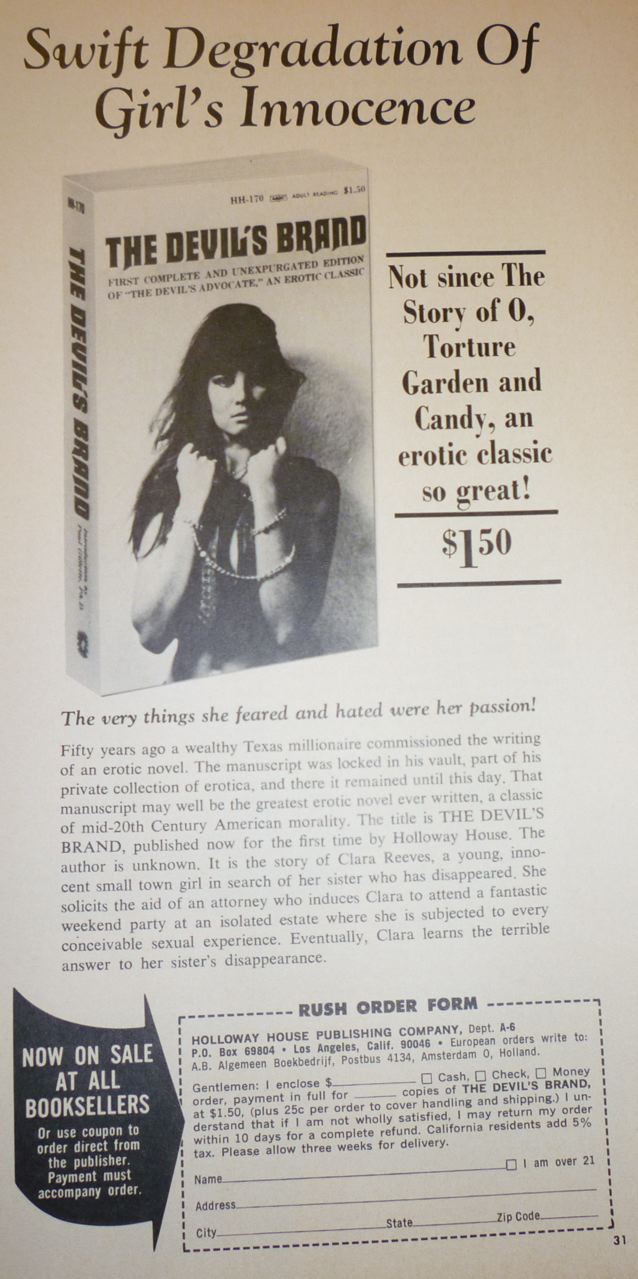
After seeing the following ad in the June 1969 issue of Adam magazine with Caroline on the cover, I knew I had to seek out a copy of The Devil's Brand.


A quick search on Amazon turned up not only the edition pictured (Holloway House HH-170) but a second variation (BH-170)!


HH-170 is clearly the first edition, as it sports a nine-digit SBN (replaced by the ten-digit ISBN on the BH-170 printing. The copyright page doesn't specify a printing, but the text-only ads for other books are replaced in this edition with illustrated ads for similar books for the discerning reader.

The book itself is described as the first complete and unexpurgated edition of The Devil's Advocate, an erotic classic. Perhaps the 50 Shades of Grey of its day.

As I had imagined, the cover photo is once again courtesy of noted photographer Alan Houghton, who took many of the early photos of Caroline (and all of those that appeared in her November 1968 and June 1969 appearances in Adam magazine). Sadly, Houghton passed away a few years ago. I'd love to know if he still had the contact sheets from his early photo shoots with Caroline in his archives.

If you're interested in adding a copy to your collection, a few are available through Amazon sellers at a variety of prices.

This is not the only time Caroline Munro has graced the cover of a paperback novel. I look forward to sharing another example in my next installment of the Caroline Munro Archive!

Monday, March 25, 2013

Batman in the 1970s Part 63: May and June 1979


by Jack Seabrook
& Peter Enfantino


Batman 311 (May 1979)

"Dr. Phosphorus is Back!"
Story by Steve Englehart
Art by Irv Novick and Frank McLaughlin

Glowing footprints leading away from Gotham's nuclear reactor can mean only one thing: Dr. Phosphorus is back! Angry that protesters want his plant shut down, the glowing ghoul plans mayhem! Meanwhile, in Washington, DC, Batgirl stops the Killer Moth just in time to cast a vote in Congress, a vote that sets her at odds with her own party's bosses. Batman seeks information from Boss Thorne, now a resident of Arkham Asylum, but ends up chasing Dr. Phosphorus, who announces his plan to attack the city. Meeting up with Barbara Gordon as she gives a speech to the nuclear protesters, Batman realizes that Dr. Phosphorus plans to seed the clouds with radioactive material. The Dark Knight and the Dominoed Daredoll race to the airport just in time for Batgirl to put an end to the menace--for now.

PE: In her first team-up with The Dark Knight since Batman #214, Batgirl proves to be more than just a gimmick, actually contributing to the capture of Dr. Phosphorus. I vaguely remember Batgirl revealing to her pop, the Commish, that she was Batgirl but I didn't know that Batman knew her secret as well. While a good story, this one's reeeeeally preachy. To be fair, Three Mile Island and The China Syndrome had to be a couple months down the road when Steve Englehart penned this cautionary tale so it's not like he was riding the coattails of "a fad." Obviously, nuclear energy was bothering Englehart and he wanted to get his message out the best way he knew how - through four colors. I have only one nit: I question whether a guy who "burns like the sun" could sit in a cockpit without blowing sky high. A good story with a whole lot of interesting sub-plots (who are these politicos threatening Babs with an early retirement and will we see more of them?) and a great villain (Phosphorus is about as close to a non-supernatural monster as you can get), but that's no surprise since it was written by Steve Englehart.

In a DC comic?
Jack: I enjoyed this story too! Dr. Phosphorus seems a little goofy to me and we won't even mention the Killer Moth, but Novick is at his GGA best with Batgirl. Englehart really is head and shoulders above the other Bat-scripters we've seen in the 1970s with his ability to weave interesting subplots in and out of a 17-page story. In one brief issue, he picks up the Boss Thorne thread that had been dropped some time back. Too bad he won't stick around.

PE: Now editor of all three Batman titles ('tec, Batman, and Brave and the Bold), Paul Levitz contributes a long and interesting letter to readers this issue outlining the future of the Bat-titles. Levitz promises the return of several of the Rogues (and some obscure villains as well) and mentions the idea of crossover stories between titles.

Jack: That's the sort of letter that comic fans drool over--a direct address from the editor in charge that says things are under control and asks fans for their opinions. Let's hope the quality stays high. It's too bad we did not keep up with The Brave and the Bold, since Levitz writes that it, along with Batman and Detective, will feature story lines that intersect with the other Bat books.

Knock it off, Phos---!


Detective Comics 483 (May 1979)

"The Curse of Crime Alley"
Story by Denny O'Neil
Art by Don Newton and Dan Adkins

Once again patrolling Crime Alley on the anniversary of his parents' death, The Batman stumbles onto an insidious plot to smoke out a two-bit gangster who's about to turn state's evidence on a mob boss named Zeus. The gangsters have narrowed their search down to the Skirley Apartments, home to over 900 residents. To bring the rat out into the open, they'll dump poison gas down the ventilator shaft and kill all the occupants. The Dark Knight gets to the scum just as they're about to unwrap their prize and makes quick work of them. He then delivers a message to their boss: he's next.

PE: I think a better tale could have been whipped up to celebrate the 40th Anniversary of the first appearance of The Batman. Proof that going to the well twice is one time too many. Whereas "There is No Hope in Crime Alley" (Detective #457) was a powerful look at what makes The Dark Knight tick, this is just a simple gangster story with old favorite Leslie Thompkins thrown in to make the connection. Nothing here advances Batman's mythos like the former story. Sure, there are a couple powerful scenes (as when Bats is beating on the tough in the apartment hallway) but the whole has no real impact. Despite my fondness for Don Newton, I didn't like the art here at all. Batman looks, in some panels, as though he's having an epileptic seizure and the supporting cast look to be made of lumpy clay (Val Mayerik's "human characters" have the same deformities. I wouldn't go so far as to say this is a bad story but, compared to the fun I had reading the tales in the Batman title this month, it's easily the most inferior.

Jack: I have to disagree! I really like Newton's art, but the Eisner student in me always deducts storytelling points when an artist has to use arrows to guide the reader to the next panel, as on page seven. Still, I like O'Neil's writing and the sense of hope it conveys, and I think this is an excellent story where we once again use an anniversary as an excuse to return to Crime Alley, where it all began.


"The 'Lights!... Camera!... Murder!' Contract!"
Story by Len Wein
Art by Howard Chaykin and Dick Giordano

Christopher Chance, aka The Human Target, is hired by super stuntman Brad "The Nailer" Nayle to find out who's been making attempts on his life. Chance's schtick, disguising himself as his client and becoming a "human target," almost gets him killed before he can get to the bottom of the mystery.

PE: An intriguing premise but, as with a lot of the 'tec back-ups, it's just too short to work in character, suspense, and surprises. This was the first Human Target story I'd read and, despite my problems with the brevity, I wouldn't be adverse to reading another. Nice Chaykin/Giordano art as well. Christopher Chance made a handful of appearances in Action Comics in the mid-70s and then disappeared from the face of the DC-Earth. Interestingly enough, the character was revived again in 1999 by writer Peter Milligan for DC adult-oriented offshoot, Vertigo, and was the basis for two separate TV shows.

Jack: This story left me cold. Wein is just writing filler that is at best average for a DC backup story. As with Simonson in the issue of Batman discussed below, Giordano's inks overwhelm Chaykin's pencils and rob them of much of their individuality.

"A Date with Batgirl"
Story by Bob Rozakis
Art by Bob Oksner and Vince Colletta

While helping the military in a stand-off with the Squadron for the Advancement of Everybody terrorist group, Batgirl is asked on a date by a young sergeant. Unfortunately, the date turns into a disaster when Batgirl's multitude of fans prevent any kind of privacy.

I'd stutter too


PE: In the immortal words of Batgirl: "...rather ludicrous, but what can you do?" This isn't bottom of the barrel, it's underneath the barrel itself, and should have been relegated to DC's Young Love. Come back Don Heck, all is forgiven. About the best thing you can say about Oksner and Colletta's art here is that they draw a very nice tail on Batgirl and they draw it quite frequently.

Jack: That was clearly the highlight of this wretched story! Leave it to Bob Rozakis to make Len Wein's Human Target tale look like high art.

"Return to Castle Branek!"
Story by Len Wein
Art by Steve Ditko

Since he has the Eternity Book, Baron Tyme holds power over Etrigan, The Demon and forces him to break into Merlin the Magician's tomb. Tyme is hoping he'll find a way to unlock the dimension he's trapped in and make his way to our world. The pair make their way to Castle Branek, the final resting place of Merlin. Once there, The Demon manages to free himself from Tyme's control and the two do battle. Tyme gets the upper hand when he conjures the "spell of transformation" and Etrigan becomes his alter ego, the very human Jason Blood. No match for the sorcerer without his demonic powers, our hero watches in horror as Tyme opens Merlin's tomb... only to find it empty!


PE: I like the writing on this strip a lot. There's some neat twists and turns and, despite the fact that I have no history with The Demon, I'm being caught up in the mythos through the flashbacks and fill-them-ins. Having said that...  I may be strung up in the courtyard for saying so, but I much prefer Mike Golden's art on this character.  Unfortunately, with Ditko on board, The Demon becomes just another Dr. Strange knock-off in the graphic department. Watch for the one-armed burgomeister, an obvious "homage" to Son of Frankenstein. When does an "homage" become a "steal," by the way?

Jack: Count me as a fan of '70s Ditko since it was new! The fact that Ditko was drawing a DC character created by Kirby blows my mind. It's clearly Dr. Strange territory all over again, though Baron Tyme looks an awful lot like Shade, the Changing Man. Whatever the case, it's fun to see full-blown Ditko art that is not shackled to godawful Ditko writing.

"Terminus!"
Story by Bob Rozakis
Art by Kurt Schaffenberger and David Hunt

Robin busts up the Crime Syndicate and then reveals to Lori that her new boyfriend is actually The Raven.

PE: A cockeyed strip is this one. One part tepid action, one part insipid dialogue, and a heaping helping of soap opera romance and the pitfalls of young love on campus. I'm not surprised one bit, of course, since the Robin feature that ran as a back-up in mid-70s 'tec wasn't worth the paper it was printed on but what audience would editor Levitz think this was aimed at? The pre-teens would deem it boring due to the lack of action and anyone else would write it off as unimaginative and cliched claptrap.

Jack: The insipid Rozakis script is matched by the bland Schaffenberger art. I was kind of grateful for the lack of word balloons on the last page of the story, since it let me "enjoy" the art unimpeded.


"Gotham's Great Kangaroo Race!"
Story by Denny O'Neil
Art by Dick Dillin and Frank McLaughlin

Using a $125,000 purse as bait, Bruce Wayne attempts to smoke out arms dealer "Swagman" Ginty by sponsoring a kangaroo race. Ginty needs the 125K award to buy illegal firearms. By rigging a detector amidst the bills, Batman tracks Ginty to the deal and puts the kibosh on the terrorist.


PE: This is the same guy who wrote "The Joker's Five-Way Revenge" and "There is No Hope in Crime Alley"? In lieu of a letters page this issue, Mike Barr presents a short but well-written look at the early days and the developing of The Batman in 'tec.

Jack: Does the fact that Julius Schwartz is listed as editor of this story mean it was a leftover used as a fill-in? I have a soft spot for Dick Dillin because he drew the JLA forever, but this story is awful. This dollar comic should have quit at 40 cents.


Batman 312 (June 1979)

"A Caper a Day Keeps the Batman at Bay!"
Story by Len Wein
Art by Walt Simonson and Dick Giordano

The Calendar Man robs Gotham's Metropolitan Museum and escapes Batman's pursuit by means of a special motorcycle and a laser beam that shoots out of a gizmo over his eye. He has been committing a crime each day using costumes based on the origin of the day's name.  On Thursday, while another thief is secretly stealing the secret code to the country's missile defense system, Calendar Man robs an art gallery and gets away, damaging Batman's hearing during the escape. The Caped Crusader is laid up for a couple of days, unable to halt crimes on Friday or Saturday, but when Sunday comes along he sneaks out behind Alfred's back and catches Calendar Man as he is about to leave town. Batman is unaware that Two-Face has the missile defense codes and plans to sell them to the highest bidder.


PE: It's been way too long since two consecutive issues of Batman brought a big smile to my face but I'm happy to report the drought is over. I'm not sure if it's a result of Paul Levitz taking over for grumpy, stodgy Julius Schwartz or just the elevation of quality in writing and art. No David Reed, Frank Robbins, or John Calnan. Instead we're blessed with the talents of Wein, Englehart, Giordano and Novick. "A Caper a Day" is the perfect example of how different things are being done around the Batman offices this month. A story centering around the exploits of a nothing villain like The Calendar Man, in the hands of David Reed, would be silly or, worse, boring. Len Wein knows The Calendar Man is a sixth-tier baddie and plays up that aspect within the story. He's wearing the most outlandish costumes and going to all sorts of trouble to stage elaborate heists when all he really needs to do is knock over some jewelry stores. There's something really wrong with this guy. In one scene he asks Bats: "So who appointed you servant of the people anyway? You're just another guy in a crazy costume -- like me!" I've got a hunch that line was borrowed by the Nolans for a similar scene in The Dark Knight. Paul Levitz gave us the heads-up that we'd be seeing some obscure characters pop up in these titles and, true to his word, we get a nut whose last appearance prefigured the eccentric baddies on that show by eight years! Simonson and Giordano contribute fabulous art as usual. Who knew some of the most exciting Batman stories would appear at the end of the decade? Not me.

Simonson's tribute to Mike Sekowsky?
Jack: I was disappointed by this issue after the prior issue was so good. Simonson's art seems overwhelmed by Giordano's inks; the trademark Simonson touches only peek through in a few spots. The Calendar Man is a dopey villain and some of his outfits seem like the worst excesses of Mike Grell. The story left me cold, but I do like the direction the book is heading. I've yet to be convinced that Len Wein can write a good story because he seems all too willing to fall back on old cliches, such as getting stuck on the railroad tracks.

The back cover of Detective 483

Mike Barr's piece on the first 40 years


Do You Dare Enter on May 13th?


Saturday, March 23, 2013

The Caroline Munro Archive: Adam, June 1969

by John Scoleri


Welcome to the latest installment of another one of our semi-regular features on bare•bones, in which I feature rarities from my Caroline Munro collection. This time out I'm featuring another appearance of Caroline from the popular men's magazine, Adam.
 
Adam
June 1969, Vol. 13 No. 6
 
Cover photo by Alan Houghton
Unfortunately, unlike her November, 1968 appearance, which included a cover and four full-page photos, this time out she's only on the cover (referenced as Carolyn Munroe once again). 
 
Or at least that's what you'd think, unless you're an eagle-eyed observer. Turns out there's an ad for a paperback book on page 31 that features a photo of Caroline on the cover!


The Devil's Brand will be featured very soon in the next installment of the Caroline Munro Archive. If you can't wait that long (like me), no need to clip the above coupon—here's a link to order a copy on Amazon!