Monday, April 18, 2022

Batman in the 1980s Issue 51: October/November 1984


The Dark Knight in the 1980s
by Jack Seabrook &
Peter Enfantino


Hannigan/Janson

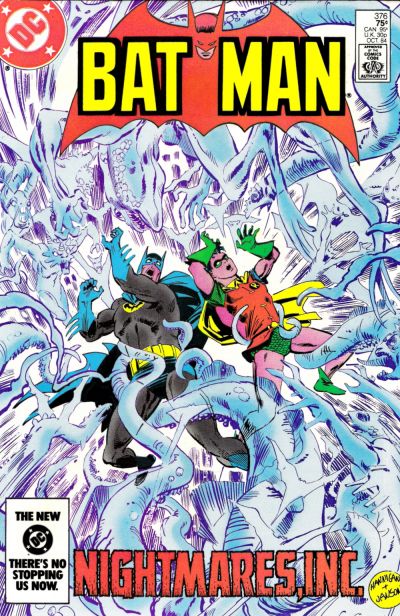
Batman #376

"Nightmares, Inc."
Story by Doug Moench
Art by Don Newton & Alfredo Alcala

Wealthy Simon Platz returns home to a scene of horror: his butler lies dead with a knife in his back, monsters murder his date right before his eyes, and he is face to face with a masked madman wielding an axe. It turns out to be an elaborate stunt that was set up as part of a surprise party, and the monsters are employed by "Nightmares, Inc.," which sets up creative scenarios to jolt the jaded.

Two days later, Alfred tells Bruce Wayne that Platz's home was burgled the day after the party and suggests that Nightmares, Inc., might be behind it. That night, Batman investigates and learns that Sturges Hellstrom, who runs Nightmares, Inc., is both a prior burglary suspect and a former Hollywood stuntman and special effects wizard. The Caped Crusader finds two other rich people who were robbed not long after a visit from Nightmares, Inc., and when Bruce attends a party where the same group stages another surprise, he embarrasses Hellstrom by pulling off his mask. Batman visits their office and is met by a very angry Hellstrom, who manages to escape. The villain makes his way to a cave, where he confronts his silent partner: Nocturna!

Peter: Doug decided a whole lot of soap opera was needed to stretch out the flimsy plot involving Nocturna's return. Thank goodness we have Newton and Alcala to keep our eyes open. It's unclear (so far) why a woman with Nocturna's powers needs to hatch an overly elaborate scheme to case the houses of the rich. I did like the "Manners the Peeper" scene. It shows that Doug wants to add as much of an "adult" vibe as he can to the Bat-titles; at least as "adult" as the CCA will allow. Nocturna becomes a recurring character for the next several issues.

Jack: I thought this was a terrific issue! Yes, the art is outstanding, but the story worked for me as well. Moench seems completely in control of his material, weaving subplots in and out of the main story and keeping Vickie, Julia, and Jason from being forgotten. The "Manners the Peeper" scene is funny--Batman interrupts a rich man to interrogate him, and we see that the man is watching a pretty neighbor through a telescope. The scene where Bruce speaks with Alfred and the butler tips him off to Nightmares, Inc., is very well done. I recall thinking Nocturna wasn't much of a villain in prior comics, but maybe Doug can do something worthwhile with the character.


Colan/Giordano

Detective Comics #543

"Shadows of Vengeance"
Story by Doug Moench
Art by Gene Colan & Alfredo Alcala

Nightshade announces to Nocturna that he plans to pull another big heist; this time, it's at a rich man's party located at an amusement park funhouse. Nocturna tells him she wants nothing to do with the robbery nor anything to do with Nightshade's proposals of love and cuddliness. Her heart belongs to no one but the Thief of the Night, who sits rotting in jail. Nightshade storms out of the apartment and Nocturna ponders who to leech money off of now. A newspaper headline about Bruce Wayne's battle to adopt Jason Todd (slow news day in Gotham) switches on the light bulb over the beautiful but pale villainess.

Meanwhile, Vicki Vale goes out to dinner with co-worker Bill, just as Bruce calls work to invite her out. He reaches Julia, instead, who gets another one of those brilliant ideas on how to land herself a man, and she innocently admits she's pretty hungry (wink wink!). Bruce and Julia dine at the fabulous Gotham Restaurant and Alfred's favorite under-sexed daughter puts the moves on the billionaire. Feeling uncomfortable, Bruce takes Julia home and denies her the gift of a good night kiss (dumb!). At Gotham Penitentiary, a big storm provides cover for the escape of Anton Knight (aka Thief of the Night), who heads for Nocturna's pad. He spies Nightshade putting the moves on Nocturna and simmers.


Nightmares, Inc., prepares to pull off their latest caper at the funhouse but, based on a clue found at the group's HQ, Batman heads them off at the pass and saves the rich partygoers from harm. As he's about to put the kibosh on Nightshade, a dagger flies out of the shadows and finds its mark in the villain's chest. As Batman examines the lifeless body of Nightshade, he hears the Thief of the Night deliver a warning: anyone who tries to put the moves on his babe will get the same treatment. Two days later, Bruce Wayne confronts Natalia Knight (aka Nocturna) outside a Gotham courtroom and asks what she's up to in her attempt to adopt Jason Todd. The pale but gorgeous woman replies that she'll make a great mom, but she could use a little help with the precocious brat. Would Bruce consent to marriage?

Peter:
If Batman #376 felt a bit heavy with sub-plot drama, then "Shadows of Vengeance" feels like a stuffed Thanksgiving turkey. It's not a bad read, but it's inconsequential and filled with dumb beats. Nocturna's adoption plans are too contrived and coincidental to have any credibility. Nor is the fact that Batman finds a card with details of the heist at 1 Nightmares, Inc. Plaza. Why not a marquee out front announcing the event? Can't you just picture the henchman putting on his bifocals, licking the end of his pencil, and asking his boss what time that deadly hit was going down? 

Bruce's sudden emotional meltdown at dinner when Julia brings up Vicki Vale ("...once you get Jason back, I suppose Vicki Vale would make a very good mother for him...") made me want to gag. Get over yourself, rich boy. There are so many women in this strip you want to bed. Don't make it seem as though Vicki is the light of your universe. The bright spot of this underwhelming episode is the emergence of Thief of the Night (who really needs a snappier moniker and will get... at least a different one very soon) as a jealous, homicidal maniac. We need more lunatics around this place after tame adversaries like Penguin and Mr. Freeze. Do I really need to add that Colan and Alcala continue to do a fabulous job visualizing this dark and dangerous world?

Jack: I thought the art was a bit shaky until the finale at the funhouse. Newton and Alcala's work in Batman looked better than Colan and Alcala's work n 'Tec. Nocturna really treats Hellstrom harshly, don't you think? She tells him her heart is pledged to the weird guy in prison. Julia is about as successful with Bruce as Hellstrom is with Nocturna. It's a romantic minefield. I still can't get worked up over Nocturna as a villain. Why have they started putting the writer and artist credits at the top of the front cover?

"It's No Fair!"
Story by Joey Cavalieri
Art by Shawn McManus

Oliver Queen visits the apartment of Tommy Doyle (aka the "Printer's Devil" from the last arc), ostensibly to save the man from a life of crime because, for some reason, Ollie has deemed the guy as "misunderstood." True, Doyle was reacting to economic and ecological adversity when he donned the cape and cumbersome helmet of the Printer's Devil, and maybe this guy can become a vital part of American society. In any case, Ollie gets there and finds Doyle tied up on his couch, with another victim of society's woes donning the Printer's Devil disguise.

PDII escapes and Ollie goes back to work, where he receives a clue as to the whereabouts of his new enemy. He tells the boss he'll be at the World's Fair, reporting on all of Star City's new environmental breakthroughs. The boss tells him that's fine, but saddles him with the gorgeous photog, Sharon Greenglass. Though Ollie would rather be flying solo, the boss insists and the duo depart.

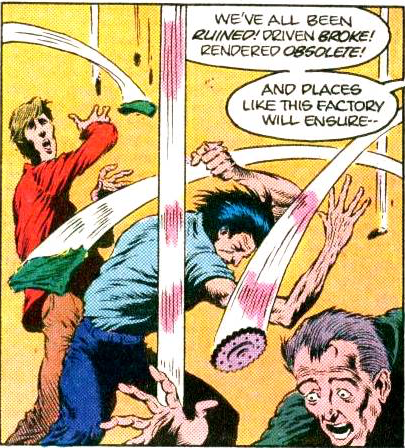
They arrive at the World's Fair in time to see Printer's Devil II and his new pals, Pinball Wizard (who shoots metal balls out of his ass arm, and Bad Penny, who... does something. All three deliver monologues about how the main exhibit, the "Auto-Auto Factory" (a workplace that requires no workers), stole their jobs and will do the same to the rest of Star City's working population. All three let fly with their weapons and the falling detritus threatens our hero and his new gal pal.
Peter:
Is there any reason to cover these things anymore? Let's put it to a vote. All for ignoring the seven or eight pages of kindergarten doodles at the back of each issue of Detective Comics, raise your hand. (Raises his hand.) I don't question whether Joey Cavalieri's heart was in the right place when he stood up in his cramped office at DC, looked out the window at the picketers in front of Schlatzkey's Deli across the street (Importing olives is unfair to local farms!), threw his Ham on Rye to the floor, and said "Damn It! Someone has to do something, and I'm a comic book writer with 80,725 loyal pre-teens who eat up every one of my adjective-filled sentences. I shall change the world!" I just wish he could weave his pet projects into a captivating yarn rather than type some random... stuff. There is literally nothing memorable about the script, and the art looks like something I saw flash before my eyes when the EMTs put the nitro tablet under my tongue. It's ugly and contains no distinguishable style. Just look at the panel I've reprinted here. The guy on the far left looks like he was drawn by Val Mayerik and the poor soul on the far right was ripped out of a strip by Steve Ditko. Somebody please tell editor Len Wein that a back-up in 'tec really isn't needed.

Jack: Before reading your attack piece, I was going to trash this strip. Now I want to defend it! The art is amateurish, but every so often it looks like the artist has promise and might get better if he keeps practicing. My problem is with Cavalieri's super-villains. Where do these bozos come from, and why do they always pause (marked by an ellipsis--...) before announcing their name? "Cower before the spare change of ... Bad Penny!" Still, it's better than Nemesis.


Hannigan/Giordano

Batman #377

"The Slayer of Night"
Story by Doug Moench
Art by Don Newton & Alfredo Alcala

It's not easy being millionaire playboy Bruce Wayne! Sadly, the judge won't listen to him and looks likely to grant Natalia Knight's request to adopt Jason Todd. Batman visits Jason and learns that the lad asked to be adopted by Natalia because he thought it was the best way for him to end up with Bruce. Anton makes his way to Nocturna's place, only to have her spurn him when he reveals that he murdered Daimon Sturges Hellstrom.

Bruce chats with Alfred over chess while Vicki Vale fends off her horny date, Bill, and Julia pockets a photo of Wayne that she finds in Vicki's desk drawer. Bruce agonizes about the hot pants he has for Nocturna before making tracks to her place, where he seems to discover that she wears a necklace that emits a fragrant drug that makes men weak in the knees. Anton shows up and he and the Dark Knight fight over Nocturna; just as Anton is about to deliver the coup de grace, Nocturna shoots him in the back. She then puckers up and plants a big, wet kiss on the lips of Batman, who is woozy in the moonlight.

Peter: Since taking over the chores for both Bat-titles, Doug Moench has avoided the flowery prose that was his downfall at Warren but, for some reason, that bad habit comes back to haunt us in "The Slayer of Night." From the clunky self-examinations ("What have I done? What have I created? What have I destroyed?") to bizarrely worded observations best reserved for Psych 101 ("It's Vicki Vale I love... even Julia... anyone but... but her. And yet... and yet... why must the night be so confusing? Why must it form the division between what I am and what I can't resist?") to head-scratching title nods ("It was the Night-Thief who murdered Sturges Hellstrom on Empire Island... making him now a slayer of night."), this script smells like that month-old broccoli in the back of the fridge. None of the character motivations make much sense and where the heck is the magic bed that Jason rides on the cover? Get us out of this romantic crap and back to the danger.

Jack: How did Hannigan and Giordano come up with that cover from this story? I want to see more of Jason's nightmare! As good as Newton and Alcala's art is in the shadowy sequences (something shared with Colan), they can't draw Bruce Wayne to save their lives. Moench is fully in soap opera land with this story, which revolves around Bruce's tangled love life and all of the women who can't get by without him. I don't see the big appeal of Nocturna, with her pale, white skin, and it seemed out of character for her to turn on Anton as soon as he revealed that he had murdered Hellstrom. Where is this story arc going?


Colan/Giordano

Detective Comics #544

"Deceit in Dark Shadows"
Story by Doug Moench
Art by Gene Colan & Alfredo Alcala

Natalia Knight has saved Batman by shooting the Thief of Night/Night-Slayer/Whatever but, once they finish their canoodling, Bats and "the darkly white mystery known as Nocturna" notice that Anton Knight's body is gone. He's leaped off the roof and vanished, leaving a trail of blood behind. Natalia tells Batman she knows his secret identity and wants him to marry her, not for money but for love, and vows never to reveal his secret, no matter what.

Bats follows the crimson breadcrumbs to a deserted alley, but finds no Anton, dead or alive. Meanwhile, would-be assassin Slade has been released on bail and Harvey is none too happy about the news. The Dark Knight follows Slade and confronts him in the alley where he lost Anton. The blood spooks Slade and he spills his guts to the Caped Crusader, explaining that Mayor Hill was the puppet master all along. Across town, Nocturna pays a visit to the temporary home of Jason Todd. Jason has suited up and hit the streets in his Robin Underoos, tired of being cooped up and under a microscope. Natalia explains to the Boy Wonder that she knows Bats is Bruce and that Robin is Jason and that she promises to be a great mom. Batman visits the mayor's mansion and warns Hill that his days are numbered.

Peter: A bit of an upswing in quality since this month's Batman, but still not racking up a lot of stars on my ratings sheet. The splash is odd in that it clearly shows a different scene than where we left off in Bats #377; in that chapter, Bats was leaning against a wall when Anton tried to skewer him, but here our hero is hanging precariously from the ledge. Lack of communication, I guess. Anton/Thief disappears and we don't see him again. We're still not clear on why Natalia has decided laundry and three squares for the circus brat is what she's always desired in life. The climax, where Bats tips his hand to Hill, is an odd one in that it just peters out without any real closure. "Deceit in Dark Shadows" reminds me of the career of Bo Derek: Nothing consequential but boy, oh boy, is it nice to look at.

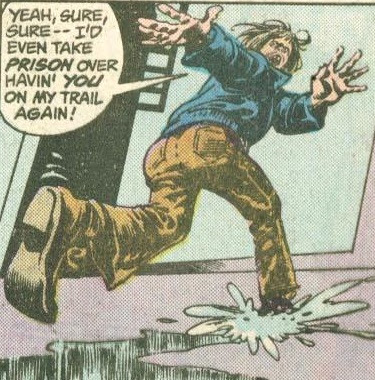
Jack: I think we read different stories! There are panels where this looks like the Gene Colan we know and love, and there are panels and large parts of pages that look like another artist entirely--neither Colan nor Alcala. I've reproduced one here. It reminds me of Jack Sparling. In any case, Moench drops the Nocturna storyline midway through and pivots hard to the Bullock storyline, which is much more interesting. Unfortunately, Dr. Fang is mentioned, which means we may have to suffer through another appearance by him.


"It's No Fair II:
Fair from the Madding Crowd"
Story by Joey Cavalieri
Art by Shawn McManus

The three costumed terrorists, Printer's Devil, Bad Penny, and Pinball Wizard, have taken over the Auto-Automat at the World's Fair and they mean business. They've taken photographer Sharon Greengrass as a hostage and demand six million dollars in ransom. The baddies insist they will not talk to the cops, so they demand an impartial deal broker: Oliver Queen. As Ollie is entering the building, Bad Penny demands to look through our hero's bag. Uh-oh, that's where he keeps his Green Arrow uni!

Peter: More meandering story and blacklight poster art. Laughably, there's this terrorist strike going on and the authorities have decided it's not dangerous enough to warrant an evacuation of the Fair! On the bright side, the Auto-Automat's design is immensely original... if you've never seen one of the original McDonald's restaurants. 

Jack: I'm flummoxed by Bad Penny's wage loss calculations. On page 7, Sharon Greenglass says "the girls who worked the automat" mean business, and on page 5, Bad Penny announces that she and her colleague would have made $100,000/year had the fair not stolen their jobs. I ran an inflation calculator online, and $100K in 1984 equals $269K today. For working at the Automat? I knew I was in the wrong line of work.

Next Week...
Warren's longest-running series begins...
but is it worth a damn?

Monday, April 11, 2022

The Warren Report Issue 82: February 1977


The Critical Guide to
the Warren Illustrated Magazines
1964-1983
by Uncle Jack
& Cousin Peter


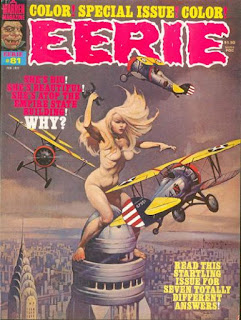
Frazetta
Eerie #81

"Goodbye, Bambi Boone"
Story by Cary Bates
Art by Carmine Infantino & Dick Giordano

"Taking of Queen Bovine"★1/2
Story by Gerry Boudreau
Art by Ramon Torrents

"The Bride of Congo: The Untold Story!"
Story by Bill DuBay
Art by Carmine Infantino & Gonzalo Mayo

"You're a Big Girl Now"
Story by Bruce Jones
Art by Richard Corben

"Starchild"★1/2
Story by Louise Jones & David Michelinie
Art by Jose Ortiz

"The Giant Ape Suit"★1/2
Story by Roger McKenzie
Art by Luis Bermejo

"Golden Girl"
Story by Nicola Cuti
Art by Leopold Sanchez

A strategically placed word balloon!

Thirty-foot tall actress Bambi Boone is a hit as Gullivera in a movie, but when a producer suggests that she let camels mount her in a foreign legion flick, she tosses him in her swimming pool. Bambi is tired of being eye candy and wants to be taken seriously! After a humiliating appearance on a talk show, where she explains that silicone shots to enlarge her breasts resulted in giant mammaries and the doctors had no choice but to make the rest of her just as big, she films the concluding scene of Queenie Kong atop the Empire State Building. Unfortunately, her insistence on feeling real pain results in the planes shooting real bullets, so it's "Goodbye, Bambi Boone."

Oh no, a theme issue! These are deadly. We're not off to a very good start with Bambi Boone, though the Infantino/Giordano art looks nice. The story is ridiculous and not funny at all, though the sight of a nude, thirty-foot tall beauty is supposed to be entertaining. This time around, it was the airplanes.

A beautiful spy with the code name of Queen Bovine is assigned to protect Gnik Gnok, an alien military officer from a miniature world, in the year 2090. She meets the small, apelike alien, who is being trailed by the dangerous Ecurb Tobac, and protects him; this requires her to climb a miniature replica of the Empire State Building as it looked circa 1990, clutching a toy ape that fools the enemy. Queen Bovine is shot down, but Gnik Gnok is saved and lives a long and happy life.

Fairly good art from Torrents isn't enough to save this dreadful, muddled script. "Taking of Queen Bovine" may be eight pages long, but it felt like three times that. In the prior story, we saw a giant woman climb the real Empire State Building. In this one, we see a normal-sized woman climb a miniature Empire State Building. What could be next? And the reversing of King Kong and Bruce Cabot as Gnik Gnok and Ecurb Tobac is really dumb.

Back in 1933, after the giant ape named Congo had fallen from the top of the Empire State Building, Chuck Gauntlet married Amy Libido, only to discover that she had really loved the giant ape. He dons an ape suit in an attempt at seduction, but when Amy learns that a mad scientist has kept Congo alive, she rushes to his side. A botched blood transfusion between Amy and Congo results in her growing to giant size, after which she follows his lead and ends up at the top of you know where. This time, however, "The Bride of Congo" is not killed; instead, she and the big gorilla escape together back to his island and have a baby.

After the first two stories, anything with even a whisper of humor or creativity is a welcome relief. Surprisingly, Bill DuBay manages to provide both. I'm not saying this is good, just that it's not as bad as what preceded it. The idea of the blood transfusion recalls one or more of the Universal Frankenstein movies, and having Amy grow to giant size and repeat Congo's actions is clever. I especially liked her poor husband trying to seduce her by putting on an ape suit, and the panel where she reaches through a window and grabs him tickled me. Now that's a devoted hubby!

When astronauts land on a dead planet, they find a tape recorder that tells a strange story. Many years ago, a woman died in childbirth and her daughter was the largest baby on record. The baby's father was distraught, but the little girl, Rachel, grew at a rapid rate, soon becoming unusually large, though beautiful and perfectly proportioned. The only person to show her kindness is a reporter named Lowery, and when she grows to womanhood, she falls in love with him. When he rejects her due to their size disparity, she loses interest in everything, eventually starring in a movie where she stands atop the Empire State Building, etc. She continues to grow and becomes a threat to humanity. The astronauts on the dead planet are revealed to be aliens and the planet is Earth, which died when Rachel grew so large that she knocked the planet out of its orbit.

Leave it to Bruce Jones and Richard Corben to rescue this issue of Eerie! "You're a Big Girl Now" starts off with a clever transition from black and white to color, since its 10-page length required black and white opening and closing pages. Corben stages the fatal birth scene in shades of red and purple, and on page three the story turns to full color. The tale of poor Rachel (and her parents) is tragic, and Corben's 3-D art style emphasizes her size in contrast to everyone and everything around her. The fact that she develops into a gorgeous young woman makes the reader feel slightly uncomfortable for ogling her bikini-clad form, and the last pages, where she grows so large that she loses her mind, are no more far-fetched than anything else. It's no big surprise that the astronauts are aliens, but by the end it really doesn't matter, because this is such a satisfying story.

A beautiful, giant, female "Starchild" is born and raised in a lab before being sent into space, where she is put on a planet and given the task of building a replica of 1930s' New York City. When she becomes fond of the small, monkey-like creatures that inhabit the planet, she forgets to check in with Earth, and her brother is sent in a spaceship to retrieve or destroy her. She climbs a replica of the Empire State Building and battles her brother's spaceship but, in the end, he decides to report back that he killed her and the planet is uninhabitable. In truth, he left her alone to live out her days happily.

Unfortunately, we're back to the dregs with this mess. It's hard to believe it took two writers to finish this five-page waste of paper. Jose Ortiz can draw, and once again we have the sight of a beautiful, naked blonde up on the skyscraper, but the complicated way she ends up there is uninteresting.

When the big ape fell from the Empire State Building back in 1933, few realized that it was actually a robot with a man inside at the controls. Years later, two crooks kill to get the blueprints for the ape robot and locate the inventor's forgotten lab, where they find another robot in the shape of a giant, naked, beautiful blonde. One crook kills the other and climbs inside the robot, setting it off on a rampage that ends--you guessed it--atop the skyscraper.

Will this issue never end? "The Giant Ape Suit" is yet another example of twisting events around like a pretzel to come up with a way to get a giant, naked blonde on top of the Empire State Building. There's more funny business with names in this one, as the inventor of the robots is called Edgar Cooper, presumably after Edgar Wallace and Merian C. Cooper. Bermejo's art is fine, but the story is so uninvolving that there's not much for the artist to do.

A "Golden Girl" arrives on a distant planet in 2133 to investigate why the men sent there before her have found nothing of value. She is captivated by rumors of a lost island made of solid gold, but when she reaches it, it turns out to be a miniature replica of mid-twentieth century New York City. Forced to remove her clothing when it bursts into flames, the woman climbs the ESB in a desperate attempt to survive. She is killed and made into a replica of the Statue of Liberty.

The Sanchez art is not bad, but once again the story is nonsense. I wonder what Peter thought of this? The issue as a whole is terrible, with the exception of the Corben story. Honestly, I don't even like the cover, and I'm a fan of Frazetta. It's just ugly.-Jack

Peter-Whereas Warren's last experiment in building an issue based on a cover painting worked for the most part (that would have been way back in Creepy #64), the Kong-girl theme is a washout. I can't blame these guys though; how do you come up with seven fresh ideas based on such a vacuous image? Cary Bates almost strives to make "Goodbye, Bambi Boone" as dumb as humanly possible, while Boudreau's "Bovine" is like a really boring 1960s Italian spy flick with obvious Easter eggs (Ecurb Tobac? Gnillor Seyeym!), just to show how hip Gerry can be.

Good parodies are clever or funny, and "Bride of Congo" is neither. I mention below, in my Creepy coverage, that the best inkers only enhance Carmine's work, rather than make it their own. Mayo is not Infantino's best partner. The only funny thing in the entire story is the fact that dopey Chuck sleeps in his ape outfit. Sorry to say that Sir Bruce Jones doesn't do much better. "You're a Big Girl Now" is a slow-moving chore; our narrator carting his tape recorder off to his death and it magically surviving the end of the world provided the only smiles in my reading. 

"Starchild," the debut of Louise Jones as a writer, is mercifully short and, as is the case with most of the stories contained herein, struggles to manipulate itself in order to reach the cover image. That's definitely the case with "The Giant Ape Suit," a story whose plot could be politely described as "threadbare." Oddly enough, the name "Kong" is not used until the final page, as if it were being avoided and then was dropped in by accident. None of it makes any sense. Which is a perfect segue into our final story, the uber-ridiculous "Golden Girl." This one pinballs from ludicrosity to ludicrosity but my favorite bit has to be the way writer Nick Cuti gets his femme to shed her clothes. This entire "Special Issue" must have been an eleven-year-old boy's wet dream but, incredibly enough, it convinces me that Eerie should stick to the series format, as bad as those series might be!


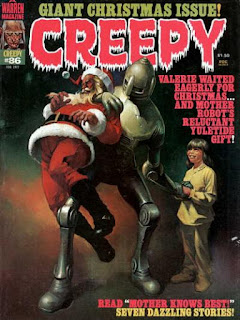
Kelly
Creepy #86

"A Noggin at Mile End" ★1/2
Story by Budd Lewis
Art by Leopold Sanchez

"Dick Swift and His Electric Power Ring!" 
Story by Bill Dubay
Art by Carmine Infantino & Bernie Wrightson

"The Greatest Christmas of All" ★1/2
Story by Roger McKenzie
Art by Leopold Duranona

"Mother Knows Best" 
Story by Bruce Jones
Art by Al Williamson

"Bloodstone Christmas" ★1/2
Story by Gerry Boudreau
Art by Carmine Infantino & John Severin

"Season's Grievings" ★1/2
Story by Bruce Jones
Art by Gonzalo Mayo

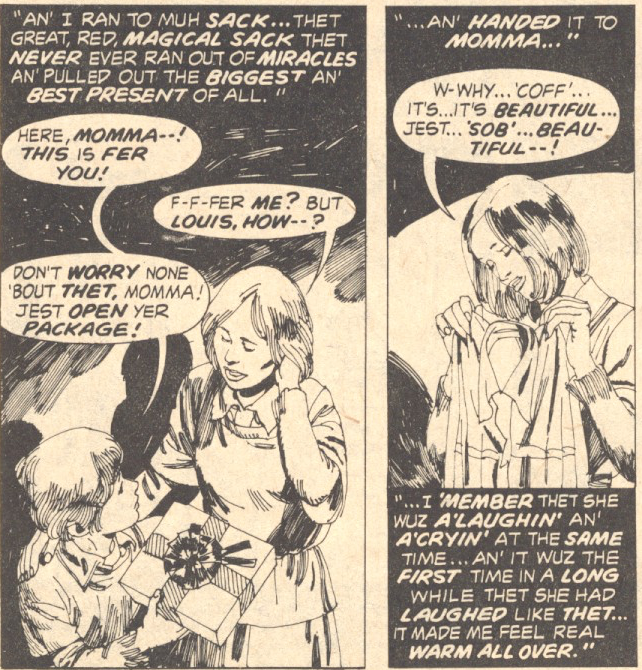
"A Gift for Mama" 
Story by Roger McKenzie
Art by Luis Bermejo

Checky Nuttwise, one of Santa's busiest elves, heads down a chimney and spies a mug of ale laid out for "Father Christmas." Believing himself to be the right-hand man, Checky grabs the mug and is about to glug down the frosty brew when the owner of the house enters, lugging a shotgun and demanding to know the meaning of the little man's trespassing. Before Checky can blurt out an answer, the man sighs and asks for a shilling, explaining he already knows what's what.

The man identifies himself as Elbod Crooken and beckons Checky to follow him to a curtained room. Crooken pulls back the curtain and shows Checky "Dinosaur Boy," a misshapen youngster sitting on a stool on a small stage. Crooken explains that the boy is the victim of a nasty condition and earns the man his money by public display. Disgusted, Checky tells Crooken that he'll give him his "magic bag," which can grant its owner any wish he desires in return for the boy's freedom.

Crooken scoffs until Checky tells the boy to make a wish and reach into the bag. The lad pulls out a mirror that transforms him into a normal boy and Checky offers the boy a job as an elf. Crooken takes the bag as the duo exit the building and board Checky's sleigh, but the bag proves to be empty and the mean old man screams vile obscenities at the sleigh and attempts to block its takeoff. Later, the neighbors discover Crooken's broken body, hoof prints all around it in the snow.

"A Noggin at Mile End" is a pleasant enough dark fairy tale, with a nice EC-style climax. Boy, those elves can be rough customers sometimes. I wonder if Checky had to fill out a report with the boss when he got back to the plant. Leopold Sanchez's art is just right for this, although "Dino-Boy" isn't really all that much of a "freak"; nothing a good bath couldn't wash away.

The only things that keep young, sickly Peter going are his friend, Mr. Music, and the Dick Swift adventures Music reads to him. Every week, "Dick Swift and His Electric Power Ring" beat the odds and save Pearl Pureheart from the dastardly Luigi, the Pasta-Pusher! Peter has sent away for his own Power Ring, but the damned thing is taking its time getting there and, as Doc Needles keeps reminding us, the kid's time is just about up. Sensing the Postal Service will once again let down one of its customers, Mr. Music saves the day by delivering a gen-u-wine Power Ring to his favorite youngster. 

Peter uses the ring to fly out the window to find adventure. Needles and Peter's aunt mourn the little boy, who has died in his bed, and wonder aloud if Mr. Music might just have been something more than an imaginary companion. For the first half of "Dick Swift," I was thinking DuBay had finally hit a home run. The tale was charming and fanciful and the funny little nuggets, such as Pearl meeting her bloody end tied to the train tracks, had me laughing out loud. But, in the end, Dube couldn't help but pour on the schmaltz. Peter's endless "Oh... but doctor... I'm so very tired..." vignettes in the midst of his excitement for Dick's latest adventure were a constant reminder that we were, in fact, dealing with a very serious subject.

The art by Infantino and Wrightson is aces, absolutely gorgeous. What I like so much about it is that it appears Bernie decided Carmine's pencils were pretty special and only gave them a light dusting of inks. Frequently, I feel as though an inker (especially one established as a lead artist) wants to leave his stamp on the work. Not so here. 

Louis Bay looks back on "The Greatest Christmas of All" and reveals to no one in particular how he came to be Santa Claus. One day, as a kid with a dying mother, Louis watched as a red sack fell from the sky. The amazed lad took a look inside the bag, only to discover a multitude of presents, all addressed properly. He ran home to show his momma (who was dying of asthma) and his two little sisters the present from the sky. When he got there, he was delighted to see a beautiful, green Christmas tree in the living room. Surely this was magic, as his sickly mother and dead-drunk father couldn't afford such a luxury.

Louis shows his mother the bag and its magical powers and Mom, despite being very sick, insists that she and her little urchins hit the pavement and deliver the goods. After spreading the joy in a snowstorm, poor Mama's lungs give out and she drops dead. Louis and his sisters return to their dingy apartment, where their father has returned from a long night of bar-hopping. He beats Louis and steals the bag, reaching far down to the bottom to see what he can use for whiskey dough. A giant snake is what the sod receives. Story told, the adult Louis freezes to death on a city street, buried under snow.

A cheery St. Nick story! Make no mistake, I like a sadistic, bloody Christmas story as much as the next guy (see "Bless Us, Father" in #59), but "The Greatest Christmas of All" is depressing, boring, and, worst of all, pointless. Would Santa's bag really contain a giant viper, even when opened by a drunken child-beater? I kept thinking, "If this bag is so magical, why doesn't Louis pull out an inhaler for his (all together now) dying mother?" And why does this story look like it takes place in the big city, but Louis speaks as though he's from Cripple Creek? Most of all, why does a good-hearted boy grow up to die so miserably? One too many magical bag stories for one issue. 

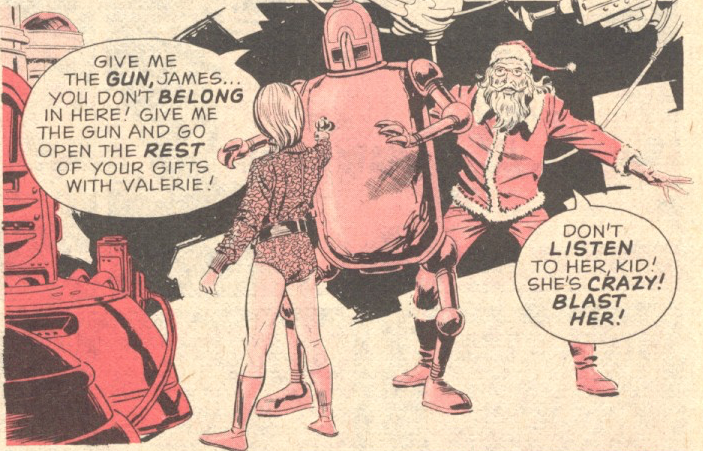
James and Valerie can't wait to see Santa Claus every Christmas and their "mother," a six-foot robot, does everything she can to oblige them. First up, she heads to the control room to fire up the manufacturing machine in order to craft gifts, then she thaws out Santa from his cryogenic sleep and awaits the glee.

This year is a little different in that the children have grown a bit older and Santa feels it's the right time to tell James the real story. They are the only survivors of a space expedition whose population was killed off by rogue robots. Now, Santa is hoping James will help him to take the ship back so that they can turn the ship around for Earth. Despite mother's protests, James blasts her and heads to the front of the ship with Santa. There, they discover the truth: the ship has crash landed on another planet. They are lost in space.

We've seen Warren tout "gorgeous, vivid, full color" on their cover before, but they somehow missed the boat this time, choosing not to advertise "Half-Assed Red and Black!" Seriously, this is a very good science fiction drama, something we all know was a rarity in the Warren funny books, but what's with the two-tone gloss? I believe this was the only time such a presentation was made (outside of those disposable inside cover vignettes). The color doesn't detract from a solid Christmas entry, though. Bruce Jones does a spectacular job not steering "Mother Knows Best" towards familiar territory (who needs another take on Colossus: The Forbin Project?), and instead delivers an entertaining read with a humdinger of a final panel. Why would this mechanical matron keep the kids alive after she and her metal mates had wiped out the rest of the crew? 

That's definitely Carmine!
Outlaw Jess Cade returns to Bloodstone, where he had robbed the town bank and shot its manager dead three years before. He returns for his fiance, Cora, but what he finds is the sheriff waiting for him. Years before, Sheriff Morgan Tucker had been living a good life: a peaceful town, a plentiful supply of hops, and the companionship of the wife of the town's banker. Though Sarah refused to leave town with Morgan, the lawman had held out hope she'd change her mind someday. 

Happiness came crashing to Earth when Cade and his gang decided to rob Bloodstone's sole bank on Christmas Eve and its manager surprised the robbers mid-haul. Cade cut the man in two with his shotgun, and his comrades were killed during the escape by Morgan. After the violent incident, Sarah refused the advances of her lover and blamed Morgan for her husband's death, adding that she would not forgive the sheriff until he brought her the head of Jess Cade. Three years later, with the return of the killer to Bloodstone, Morgan gives Sarah the payment she'd demanded.

Unmistakably Severin

"Bloodstone Christmas" has all the ingredients of a good oater: the dead-end town, the outlaws, the half-drunk lawman, the pretty maiden, and the gunfights. Boudreau tones down his poetic ramblings and just lets a Louis L'Amour-style western (albeit with quite a bit more bloodshed) unwind and reach its satisfying conclusion. I can't say enough about the job Severin does to enhance but not dissolve Infantino's pencils. Some pages look like Carmine, some like John, some a combination. The entirety looks painstakingly choreographed, as if the men were called in to storyboard a Budd Boetticher film. I want more Infantino/Severin!

Was Denise's psychiatrist husband really a mad-dog killer? A year before, Jason had been accused (and acquitted) of the Christmas Eve murder of his first wife. Now, Denise is having horrible dreams of Jason performing the same crime on her. She can't sleep and Jason is out on call, so she checks on her stepson, Pualo, but the boy is sleeping like a baby. Wet tracks in the hallway send the woman into a panic and, as she's searching the house for a mad killer, Pualo emerges from the shadows, gleaming blade in his hand and madness in his eyes.

Pualo chases his stepmother around the house for several panels until the woman remembers she's bought a shotgun (ostensibly for Jason) as a Christmas present. She discards the lovely wrapping and fancy bow and blows a hole in her stepson's midsection. Jason comes home to find his son dead and his wife in a trance. "Damn," he sighs, "the boys at work warned me that marrying a homicidal maniac could be trouble!"

That's right! It was Denise who was acquitted of murdering her spouse! Hoo boy, "Season's Grievings" is like a bad giallo with the subtitles turned off; a whole lot of running around from room to room, mad stalker at heels, and not a lot of sense to the proceedings. Jason's reaction to his son's corpse is priceless; what father would leave his child in the care of a possible lunatic? And talk about a whirlwind romance. Denise's dead hubby is barely cold when her psychiatrist pops the question. "Look, I know you might be a loony, and you stabbed your husband 150 times with a scalpel, and I've got a pre-teen kid at home, but I think we really got something special here! Will you marry me really quick?" For the most part, Mayo does his job, making Denise look pretty but there was a lot of action in the shadows I couldn't make out. Just like a giallo. More evidence that Bruce Jones is human after all.

Two boys search for the perfect Christmas tree to lift their momma's spirits. See, Mom was killed, beaten by their stepfather, and now she doesn't smile much, propped up in her rockin' chair in front of the window. But step-pop's not going to be hurtin' Ma much anymore, since he took an axe to the midsection while he was lying in a drunken stupor. If only their Pa was still alive; he died in that mine collapse the year before. Ta-da, Pop returns from his grave in the mine to take Ma to Heaven. The End.

The only talent on display in "A Gift for Mama" is Luis Bermejo's stark, stunning penciling. The script is bad, microwaved EC with the obligatory revived corpse cameo surprising absolutely no one ("Man, I wish Pop was here" "Man, I really wish Pop was here right now!" etc. etc.). The final panels, of Ma and Pop sauntering through the snow back to the mine, only confuse me. Does Ma's corpse rise from the rocking chair and exit the house, leaving her sons to die from starvation and the cold? Never mind, reasons Roger McKenzie in his final caption, "...it had been a pretty good Christmas after all." I'd say the same about this special issue of Creepy, the last Christmas issue until 1981.-Peter

Jack-It's certainly better than this month's Eerie! Ken Kelly's cover is excellent. Of the stories inside, I liked "Mother Knows Best" the most; despite the limited color (Christmas-themed red?), I thought Williamson's art was superb and the ending unusually subtle for a Warren tale. Next came "A Noggin at Mile End," which seemed to mix just enough sentiment and creepiness for a Christmas-themed issue. I gave everything else two stars, from "Dick Swift," whose ending surprised me but which featured too many of those annoying DuBay character names, to "The Greatest Christmas," which seemed like a revision of "Night of the Meek" with annoying dialect and way too many captions. The severed head at the end of "Bloodstone Christmas" made a fairly boring western more interesting, while "Season's Grievings" was one long slasher tale with a confusing last page. "A Gift for Momma" had some nice, wordless storytelling in the middle, which was a welcome relief from some overwriting in this issue.


Next Week...
Who (or what) lurks
in the Shadows?

Thursday, April 7, 2022

The Hitchcock Project-Sarett Rudley Part Two: Mr. Blanchard's Secret [2.13]

by Jack Seabrook

"Mr. Blanchard's Secret" was directed by Alfred Hitchcock, with a teleplay by Sarett Rudley that was based on a story by Emily Neff. The TV show aired on CBS on Sunday, December 23, 1956, but the story was not published until June 1978, when it ran in Ellery Queen's Mystery Magazine.

As the story opens, Edith Fenton wonders why Mrs. Blanchard, whose son Charlie rides to camp three days a week in a carpool with her own son, Jerry, has never been seen. Did her husband murder her and bury her in the garden? Edith's husband Tom suggests other, more likely explanations. Mr. Blanchard is a professor who recently moved from Chicago to Edith's town. From the start, he has taken his family's weekly turn to drive in the camp carpool, and Edith begins to picture his wife as "a prisoner in her own home." On the last day of camp, at a party for the boys and their mothers, Charlie and Mrs. Blanchard fail to appear, having been concerned by the weather report, and Edith agrees to take Charlie's art projects to him at home. That afternoon, Celia Blanchard unexpectedly shows up at Edith's house, looking much younger and more attractive than Edith imagined. Celia compliments Edith on her home and its decorations, and Edith decides that "the professor was psychopathically jealous," hiding his wife away in order to keep her to himself. Celia leaves and, twenty minutes later, Mr. Blanchard telephones to ask if Edith is missing anything, such as "'an urn-shaped table lighter? Silver?'" Edith confirms that the item is gone and realizes that Mr. Blanchard's secret is that his wife is a kleptomaniac.

"Mr. Blanchard's Secret"
was first published here
Sarett Rudley's teleplay for the TV version is available; it is dated July 26, 1956, and it shows how she changed the story for television. The script opens with a scene where a sleeping woman screams as she is approached by a shadowy figure; this turns out to be a scene from a murder mystery being typed by Babs Fenton (the story's housewife, named Edith, has become a mystery writer named Babs). Voice-over narration is used to convey Babs's thoughts to the viewer as she details her suspicions about her next-door neighbors, the Blanchards. Gone is the carpool and the end of season party for the campers and their mothers; in its place is a nosy woman who writes mysteries and lets her imagination run wild.

Babs's husband John (as Tom has been renamed) pretends to be asleep in bed as Babs prattles on, and only when she leaves the room does he turn on the light to read a book in peace. For no reason that is ever explained, Mr. Blanchard suddenly appears, peeking through the Fentons' back door. As a result, Babs goes next door to investigate and walks into the Blanchards' house, uninvited. She explores the home and has just entered a woman's bedroom when Mr. Blanchard surprises her, though he does not seem concerned that his next-door neighbor is wandering through his house alone at night. Blanchard assures Babs that his wife is fine and sends her on her way. The next day, Babs works at her typewriter and a scene plays out in her imagination, as Blanchard murders his wife with a fireplace poker. As in the story, Mrs. Blanchard visits Babs unexpectedly, but her husband appears and orders her to return home. That night, Babs again talks to her husband as he tries to sleep, and she imagines Blanchard is keeping his wife a virtual prisoner. She looks out of her bedroom window and sees Blanchard dragging a heavy sack to his car; after rushing next door and getting no answer, she calls the police to report that she suspects her neighbor of murder.

Mary Scott as Babs Fenton
The following day, Ellen Blanchard (Celia's new name) reappears at Babs's house, alive and well. She lights her cigarette with the lighter and leaves; not long after, Blanchard returns the lighter to Babs. The teleplay tacks on an additional twist, as Babs finishes writing her story the next morning, only to be shocked when the police telephone to say that Blanchard killed his wife with a fireplace poker the night before and has been arrested for murder.

Rudley's teleplay for "Mr. Blanchard's Secret" uses the basic plot threads and characters of Neff's short story and expands them into a longer piece in which the characters are next door neighbors and Babs is a mystery writer. This provides a reason for her vivid imagination and makes it easier for her to snoop on the Blanchards. The twist ending, where her fantasy comes true, is unnecessary. As in Rudley's teleplay for "The Baby Sitter," there is a reliance on voice-over narration to provide exposition and to move the story along. Violent scenes are added that are not in the short story, but they are explained away as scenes that Babs imagines as she writes. There are some parallels to Hitchcock's Rear Window (1954) in that Babs spies on her neighbors, worries that the husband has murdered his wife, and sneaks into their residence. In Emily Neff's short story, the title secret is that the wife is a kleptomaniac. In Rudley's teleplay, the secret is that Blanchard turns out to be a murderer after all.

Robert Horton as John Fenton
The TV version of "Mr. Blanchard's Secret" was rehearsed and filmed on October 18, 19, and 22, 1956, with Alfred Hitchcock directing. Comparing the filmed version to the teleplay reveals that there must have been at least one more draft of the script before filming, since important changes have been made and it is unlikely that Hitchcock made them at the time of filming, especially in light of the three-day schedule. The initial scene, where the shadowy figure attacks the sleeping woman, is replaced by a close-up of a typed page, with a pencil moving across the lines that describe a scene similar to the one in the script. The following scenes feature a combination of voice-over narration and soliloquy by Babs, whose incessant chatter makes the viewer envy her husband as he pretends to sleep.

Meg Mundy as Ellen Blanchard
The most effective scene is the one that portrays Babs's fantasy of Blanchard murdering his wife. Instead of hitting her with a fireplace poker, he strangles her, and the scene is played as melodrama, with a theremin providing eerie background music under dialogue that establishes that Ellen is an alcoholic who has ruined her husband's career. One drawback to the TV version is that the viewer never gets to see what Babs sees outside her window, which makes comparisons to Rear Window less apt. In "Mr. Blanchard's Secret," there is more talk than action, to the show's detriment, and any action that does occur usually turns out to be in Babs's fertile imagination.

Dayton Lummis
as Mr. Blanchard
Another significant change occurs near the end. When Mr. Blanchard picks up the cigarette lighter, Babs remarks that it does not work and Ellen remarks that she adores silver. At the end of the scene, Babs hears her Irish stew sizzling on the stove and rushes out of the room. Ellen gets up to leave, steps, turns, picks up the silver lighter, and walks out with it. Babs returns and immediately notices that the item is missing. She remarks, "'Now I know what Mr. Blanchard's secret is!'" The TV version then departs from the script. The scene where Blanchard returns the lighter and apologizes is deleted, and when the police telephone, they do not tell Babs that Mr. Blanchard has murdered his wife; instead, she is told that they have found a woman's body and she is asked to come to the morgue to identify it. The viewer assumes that her suspicions have come true, and Babs blames herself for precipitating the murder. However, a new twist is added as she opens the door to find Mr. and Mrs. Blanchard standing outside. Ellen hands Babs the lighter, saying that her husband repaired it, and the show ends with a fade-out on Babs's face, surprised once again. There is no murder at all, and Mr. Blanchard's secret, if he has one, is that he is good at repairing lighters.

The TV show is uninspired, marred by an overly flamboyant performance by Mary Scott as Babs and by dull direction by Hitchcock, who only stages one scene with interest--the imaginary murder of Mrs. Blanchard by her husband.

"Alvin Brickrock Presents"

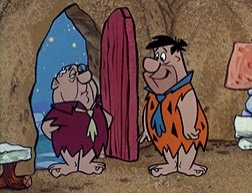
Five years later, the animated show, The Flintstones, ran a parody of Alfred Hitchcock Presents that may incorporate aspects of "Mr. Blanchard's Secret" along with aspects of Rear Window. On Friday, October 6, 1961, an episode titled "Alvin Brickrock Presents" aired on ABC; the seventh and final season of Alfred Hitchcock Presents was set to debut on NBC the following Tuesday. In the cartoon, Fred Flintstone is hooked on murder mysteries and he and Barney Rubble enjoy watching through his window as Fred's new neighbors fight. Alvin Brickrock, who resembles Alfred Hitchcock, has moved in next door, and his wife Agatha has disappeared. Fred, like Babs in "Mr. Blanchard's Secret," becomes concerned when Brickrock asks to borrow a shovel, and when Fred reads a detective magazine before bed, his imagination runs wild.

Fred and Barney investigate the neighbor's house and Brickrock discovers them, much as Blanchard discovers Babs investigating his house. They suspect that Agatha's body is hidden in a large trunk, but their suspicions turn out to be incorrect, though Brickrock's final speech to the camera (a parody of Hitchcock's typical closing comments) seems to suggest that he did kill his wife, after all.

"Mr. Blanchard's Secret" was remade in color in 1989 as "Murder in Mind," an episode in the fourth and final season of the Alfred Hitchcock Presents series that ran in the mid- to late-1980s. Starring Melissa Sue Anderson as Julie (as Babs has been renamed), the episode aired on the USA network on Saturday, January 28, 1989. Surprisingly, the teleplay is credited to Sarett Rudley, based on a story by Emily Neff, and this version of the story is closer to Rudley's teleplay than the 1956 version, with one important addition.

Melissa Sue Anderson as Julie Fenton
Instead of the voice-over narration that is used in the version directed by Hitchcock, this version finds Julie speaking directly to the camera, and this time the viewer sees what she sees when she looks out of the window. The character of her husband, who has been renamed Donald, spends the entire episode in bed, vainly trying to sleep despite her chatter. There is an added flashback where Julie runs into Mr. Blanchard while shopping, and one scene where the murder is imagined is a parody of the shower scene in Psycho. This version also follows the 1956 TV show in regard to the lighter; this time, Mrs. Blanchard slyly pockets it when Julie is not looking. The episode as a whole is more enjoyable than the 1956 version, mainly because Melissa Sue Anderson is more likeable as Julie than Mary Scott is as Babs. The show's success is marred by a new scene that has been added at the very end. After the Blanchards have returned the lighter, Julie climbs into bed next to her husband, who has spent the episode trying to sleep. Presumably in response to her incessant chatter, he suddenly sits up, looks at the viewer, smiles, pulls out a large knife, and stabs his wife as she lies next to him! This supposedly humorous, violent murder is wholly unexpected and unwelcome and leaves a bad taste in the viewer's mouth after a reasonably successful episode.

The 1956 version of "Mr. Blanchard's Secret" is one of the less enjoyable episodes of the series, though that is not the fault of Emily Neff (1922-1999), who wrote the original story. Neff worked as a newspaper reporter and wrote a handful of short stories that were published between 1948 and 1978. Three of her stories were adapted for Alfred Hitchcock Presents (including "One for the Road"), and one was adapted for The Alfred Hitchcock Hour. For more about Emily Neff, click here.

John Fenton reads
The Case of the Slippery
Spouse
 in bed.
Robert Horton (1924-2016) receives top billing as John Fenton, though his role is secondary to that of his wife. Horton had been active in film since 1945, but from 1952 to 1989, he was a busy TV actor, co-starring in Wagon Train (1957-1962), and then starring on the short-lived series, A Man Called Shenandoah (1965-1966). A website devoted to his career is here. This was one of seven episodes of Alfred Hitchcock Presents in which he was featured, including "Crack of Doom," and after his television career ended he spent many years on stage.

Ellen Blanchard is played by Meg Mundy (1915-2016); this was one of her two appearances on the Hitchcock series, including "The Orderly World of Mr. Appleby." Born Margaret Anne Mary Mundy in London, she came to the U.S. at age six and began appearing on stage in 1934. By 1940, she was a top model, and she appeared on TV from 1949 to 2001, including a long run as a regular on the soap opera, The Doctors, from 1972 to 1982. She was also in films from 1978 to 1987.

The lead character, Babs Fenton, is played by Mary Scott (1921-2009). Born in Los Angeles, she appeared in movies beginning in 1942 and on TV beginning in 1951. She is best remembered today for her roles in eight episodes of the Hitchcock TV show, including "The Diplomatic Corpse." In the late 1940s, she was on Broadway in a production of Shaw's Caesar and Cleopatra when she met the English actor Cedric Hardwicke; she got pregnant and he divorced his wife. Hardwicke and Scott wed in 1950, when he was 57 years old and she was 29. She later wrote an autobiography called Nobody Ever Accused Me of Being a 'Lady,' and there is an interesting obituary here.

Finally, Dayton Lummis (1903-1988) plays Mr. Blanchard. He was on screen from 1946 to 1975, appeared in Hitchcock's The Wrong Man (1957), which was released less than three months after this episode aired, and appeared in two other episodes of Alfred Hitchcock Presents, including "Crack of Doom," with Robert Horton. He also appeared twice on Thriller.

Despite being a mediocre episode of the TV series, "Mr. Blanchard's Secret" continues to generate interest; a stage adaptation by Lawrence Ripp was scheduled to run in Minneapolis in April 2022, days after this article was written.

Watch "Mr. Blanchard's Secret" online here or buy the DVD here. Watch "Murder in Mind" online here. Thanks to Melissa McMullen from the University at Albany Library for providing a copy of the teleplay!

Sources:

"Alvin Brickrock Presents." The Flintstones, season 2, episode 4, ABC, 6 October 1961.

"Apr 1 Mr Blanchards Secret: Minnesota Association of Community Theatres." Apr 1 Mr Blanchards Secret | Minnesota Association of Community Theatres, https://www.mact.net/?page=member-events%2Fapr-1-mr-blanchards-secret-1900.

The FICTIONMAGS Index, www.philsp.com/homeville/FMI/0start.htm.

Grams, Martin, and Patrik Wikstrom. The Alfred Hitchcock Presents Companion. OTR Pub., 2001. 
IBDB.com. IBDB, https://www.ibdb.com/. 
IMDb.com. IMDb, https://www.imdb.com/.

"Mr. Blanchard's Secret." Alfred Hitchcock Presents, season 2, episode 13, CBS, 23 December 1956.

"Murder in Mind." Alfred Hitchcock Presents, season 4, episode 8, USA, 28 January 1989.

Neff, Emily. "Mr. Blanchard's Secret" Ellery Queen's Mystery Magazine, June 1978, 25-31.
Rudley, Sarett. “Mr. Blanchard's Secret.” 26 July 1956.
Stephensen-Payne, Phil. Galactic Central, http://philsp.com/.
Wikipedia, Wikimedia Foundation, www.wikipedia.org/.

In two weeks: Our coverage of Sarett Rudley continues with "My Brother Richard," starring Royal Dano and Harry Townes!

Listen to Al Sjoerdsma discuss "Fog Closing In" here!

Listen to Annie and Kathryn discuss "Mr. Blanchard's Secret" here!