Monday, June 12, 2017

Star Spangled DC War Stories Issue 106: June/July 1969


The DC War Comics
1959-1976
by Corporals Enfantino and Seabrook


Adams
The Brave and the Bold 84

Batman and Sgt. Rock in

"The Angel, The Rock and the Cowl"
Story by Bob Haney
Art by Neal Adams and Joe Kubert

Peter: Bruce Wayne is called to the Gotham Museum by the curator after a mysterious man has claimed to own an Archangel statue brought to Gotham for safekeeping just after World War II. The curator is struck by a heavy object and a German man emerges from the shadows. Bruce recognizes him immediately as Colonel von Stauffen, a Nazi war criminal long wanted by the authorities.  The face brings back memories of a time long ago, when Bruce Wayne served as an agent for England, searching for a mystery weapon the Germans had green lit.

Bruce is brought aboard a plane, where he meets Sgt. Rock and Easy Company, who are meant to help Bruce in his search. At least that's what's supposed to happen. The men must parachute into the German-held Chateaurouge, where Wayne quickly discovers (as his alter ego, Batman) that the secret weapon is nerve gas, hidden in empty bottles of wine. Two of Rock's men, Bulldozer and Wild Man, discover the "wine cellar" and, thinking it some exotic alcoholic beverage, steal two bottles and head back to the action. Discovering the theft, Batman must intercept the Easy Joes before they open the bottles and kill everyone around them. Colonel von Stauffen initiates "Operation: Barbarian," a plan to stop D-Day, and begins rolling out the nerve gas. Bruce Wayne (back in his civvies) informs Rock of the deadly cargo and blows the German convoy to hell. Back in the present, von Stauffen is about to blow Bruce Wayne's head off when a strong arm reaches in and puts the Colonel to sleep. The massive arm belongs to Sgt. Rock, who followed the Nazi after recognizing him at the airport. The two old buddies exchange pleasantries and go their separate ways.


There have always been problems with the passage of time in comic books (Peter Parker was in high school for, it seems, twenty years) but "The Angel, The Rock and The Cowl" presents a special problem with the passing of decades. Bruce Wayne appears to be just as young when he takes on his role as ex-patriot spy as he does when he next encounters the deadly Colonel 25 years later, while Rock has obviously aged. Wouldn't B&B editor Murray Boltinoff red line this peculiarity or would he just chalk it up to the goofiness of the medium and make that deadline? The story itself isn't all that great. I'm no WWII expert, but did the Germans really know that D-Day was on the way? These ones did. And writer Bob Haney obviously hasn't spent much time with Easy Company, as most of them come off as stumbling bumpkins, with Bulldozer and Wild Man missing from action long enough to steal some wine bottles. This particular episode doesn't sit with what we know about Easy and its leader who, unfortunately, is reduced to not much more than a witness to the proceedings. The team-up promised is never delivered. So, thank goodness, we've got Neal Adams's stellar work to keep us occupied (although I could have done with more Batman and less Wayne); Neal once again shows why he was the perfect choice to take over the character (if for only a short while) in the early '70s.


Jack: Not every page is Adams at his best, but there's enough pizzazz here to keep me satisfied. The secret hidden in the wine bottles reminds me of Notorious, though I wonder how Bruce Wayne could look at a seemingly empty bottle of wine and conclude that it contained nerve gas. Rock doesn't behave like the Rock we know, but this is made up for by seeing him in 1969. A letter writer in Brave and the Bold 87 notes that Joe Kubert had a hand in the art on (at least) page 19 and the editor confirms that Kubert helped Adams out of a deadline jam, though he doesn't say whether Kubert just worked on one page or whether he was involved in more. The top half of page 19 looks like 100% Kubert to me. The editor also addresses complaints about Bruce Wayne's seeming not to age by claiming that Adams drew him to look as if he had just finished college and based his depiction on Bob Kane's, while drawing him looking older in 1969. I confess he looked the same to me in 1944 and 1969.


Kubert
 Star Spangled War Stories 145

"Return of the Hangman"
Story by Robert Kanigher
Art by Joe Kubert

Peter: His sleep wracked with nightmares about the long-dead Hangman, the Enemy Ace begins to believe that, perhaps, his arch-enemy may not have perished after all. Trying to put it out of his head during the daytime hours, von Hammer whips his three protégés into shape to become aces in their own right. Still, Hans cannot get over a deep uneasiness. His fears come true as the Hammer witnesses the "Return of the Hangman"! Seems the ace did not die in their last aerial battle after all. The Count's Spad crashed into a conveniently-placed river and he hoofed it back to his castle, where his sister, Denise, nursed him back to health. Now, madder than ever, the Hangman swears he will extract more than a pound of justice from his rival. One by one, the three young pilots nurtured by von Hammer are shot down by the bitter Count and, finally, the two aces have their rematch. It's not much of a sequel though, since the Hammer dispatches the Count (or so we think) much the same way he did last time--with a well-timed bit of low-to-the-ground flying and some telephone wires. Hans's crippled Fokker crashes in the nearby forest and his bruised and bleeding body is circled by a pack of hungry wolves. Just in time, the Hammer's black wolf mascot shows up and chases away the scavengers.


Though it's exciting to have the super-ace/villain the Hangman back for another adventure, there's no denying this script has several holes large enough to fly a Sopwith Camel through. Von Hammer is kind enough to share with us the details of the Hangman's "resurrection," details Hans could not possibly know about since he wasn't there. Also, it's illogical that Count De Sevigne would emerge from his months of rehabilitation vowing "a terrible vengeance against the Hammer of Hell" since the last time the two aces met, it was clear there was a deep admiration between the two. The guy was just doing his job. The Hangman would only expect the best out of his rival. The climactic confrontation we've all been waiting for arrives at last . . . and ends in a handful of panels. The Hangman, arguably tied for first place in "The World's Number One Killer Pilot" competition, flies his Spad into some phone wires? Really? Obviously, there has to be a re-re-match coming up. All this complaining is because the previous installments set a bar so high that some entries would naturally disappoint. I've no doubt we'll be flying high again very soon. Oh, and Joe does his usual stunning job visualizing the battles and bloodshed but it looks, in some panels, like he may have gotten a wee bit of help. There's an almost Gil Kane-ish look to the panel above, isn't there?


Jack: I did not notice it while reading, but that nose sure has a Kane vibe! I like this story, from the opening double-page splash, which has a Golden Age DC feel with the giant Hangman holding the little Enemy Ace in his hand, through the six-page recap of the Hangman's last appearance. Kubert must have loved doing this series, because the art is just fabulous. I agree with you that the Hangman is disposed off much too quickly after such a big buildup.


Kubert
Our Army at War 207

"A Sparrow's Prayer"
Story by Robert Kanigher
Art by Joe Kubert

"Top of the World!"
Story by Robert Kanigher
Art by Sid Greene

"SOS Send Our Food"
Story by Mike Friedrich
Art by Ed Robbins

Jack: A new recruit nicknamed Sparrow spends much of his time on his knees praying for the survival of Easy Co., but Rock and the others have to respond to a sudden Nazi mortar attack by sliding down a sand dune in the North African desert to confront the enemy troops firing on them. Wild Man gets tired of Sparrow's praying all the time and Rock leads his men on foot across the desert, where they are attacked by a Nazi tank company. "A Sparrow's Prayer" is answered when a sand storm whips up and allows the Americans to defeat a tank with some well-placed grenades.

A little help from Neal Adams?
("A Sparrow's Prayer")
An odd story, especially because the new character does not get killed at the end. Still, it's good to have a substantial Rock tale after a few months of reprints and head trips, especially since Kubert's art is as good here as it is in Enemy Ace.

Jake Flaherity was on "Top of the World!" when he worked on urban skyscrapers back at home, but when he finds himself in the trenches of WWI he's down in the mud. An enemy tank causes a trench collapse and he and his men must dig their way out before he can shoot a mortar off and stop an enemy advance. A rare appearance for Sid Greene in a DC War comic, this reads and looks like a file story that got pulled out of a dusty drawer somewhere and plunked down in this 1969 comic to fill four pages of space.

A group of U.S. soldiers are trapped in a cave guarded by a Nazi tank and running low on food and water. When supplies run out, the men get desperate and, one by one, run out hoping for food, only to be gunned down. Their radio message requesting help is garbled, so when a plane finally gets through and drops supplies by parachute, it turns out to be more guns!

"Top of the World!"
This is an unusual story where the writing is better than the art. The plight of the soldiers is palpable and their sequential deaths are grim. It reminded me of an EC story, especially in the brutal ending. The art, as Peter notes below, is hardly more than chicken scratch, but for some reason the whole thing worked for me, perhaps because it is so unusual in a DC comic.

Peter: Ed Robbins's art for "SOS" is just about the most amateurish and ugly I've seen yet on this journey; hard to believe Joe Kubert accepted it for publishing. It's that bad. But the story it illustrates is unrelentingly grim and so powerful that it makes me overlook the art and give it a big thumbs-up. I believe this is the first DC War contribution from Mike Friedrich (at about this time, Friedrich also made his DC Mystery debut with the classic "His Name is . . . Cain" in House of Mystery #180), a writer who would move to Marvel a few years later and reinvigorate Iron Man and Captain Marvel. Friedrich will contribute four scripts to this title from 1969-71.

"SOS Send Our Food"
Trying to squeeze three tales into twenty-five pages of story content is a mistake; vignettes like "Top of the World!" have no room to "spread their wings" as it were and come off feeling incomplete or, worse, a waste of space better given over to character development in one of the longer scripts. The Rock tale does nothing for me; it should make me ponder the mysteries of life or something. It doesn't because all I can think while reading it is that Sparrow sure looks like one of the other young grunts who have filled the role of "green" in several recent Rocks. The gimmick, that Sparrow is religious and looks to God in the midst of Hell, is never really explored aside from Wild Man's derisive comments and, of course, the deus ex machina disguised as holy intervention.


Kubert
 G.I. Combat 136

"Kill Now--Pay Later!"
Story by Robert Kanigher
Art by Ross Andru and Mike Esposito

"No-Name Hill"
Story by Robert Kanigher
Art by Ed Robbins

"The 13th Bullet!"
Story by Howard Liss
Art by Fred Ray

Peter: Though they were born continents apart, both tank commander Jeb Stuart and U-boat captain Ludwig Von Ernst have the same moral code: fight to the end and go down with the ship. The two may be in disparate war climates but, inevitably, they meet when both arrive at the same beach--the Jeb to check out enemy movement and the U-boat for repairs. When Von Ernst spies the approaching tank, he fires on her but the Jeb Stuart proves more dangerous as she rams the boat's conning tower as it's submerging. As he always promised, Von Ernst goes down with the sinking ship but he takes the Haunted Tank with him. The next day, the tank is dragged out of the muddy water for repair.

A wee bit of tinkering by the editor?

Sure doesn't look like
A+E to us!
How many times have we seen this story before? The two men, separated by different cultures, both raised the same way as boys, come together for the big clash? Way too many, says I. I will admit to being intrigued by the short glimpses we're afforded into Jeb Stuart's childhood. Big Bob should have taken that aspect and run with it rather than throw the stale formula into the microwave for a warming-up. Von Ernst is your go-to scarred Nazi monster indistinguishable from any other Nazi monster. The art of "Kill Now--Pay Later!" (a really stupid title that makes no sense) is credited to the dreaded Andru/Esposito team (and, may I stress once again, how much I loved the A/E partnership on The Amazing Spider-Man? It's just hideous, it seems, in its early stages.) but there sure looks like a whole lot of Joe Kubert dotted here and there. And hey, how about that penultimate panel where one tank man says to another, "The ol' Haunted Tank'll see service again . . ." At what point did the supporting cast discover the tank was haunted? Was I out of town that week, Jack?

Next issue: Russ is back and not a moment too soon!

A colonel of two wars and a young G.I. have never seen action before until their jeep is hit by a mortar and the pair must fight for their lives on a "No-Name Hill"! This one's a very short piece but it's got bite and an honest-to-goodness poignant wrap-up. The art's very good as well; Robbins isn't as stylish as Heath or Kubert but he gets the job done all the same.


A Yankee takes a nice lookin' pistola off a Reb and the dying soldier tells him that the gun has almost magical powers and never misses its target but warns that the gun will misfire on "The 13th Bullet!" The Union soldier finds that the dead man was right; his first twelve shots find their marks every time but, keeping in mind the warning, he puts the gun away rather than firing for a 13th time. Replacements come and the man is shocked to see the drummer-boy is his teenage son. Just then, the troop is attacked by dirty, mangy Johnny Rebs and, without thinking, he tosses the magical firearm to his son. The boy points, aims, and misfires, and he's shot dead. Here's one that walks that fine line between coincidence and the Twilight Zone. It's good to have Howard Liss back, even if this one doesn't measure up to his past triumphs. Fred Ray's art is a bit scratchy but at least the characters don't have saucer eyes or melty faces (like the soldiers belonging to Andru and Grandenetti). I can't wait until Weird War Tales arrives in a couple years.

Jack: Another issue where we have to slog through 13 pages of a mediocre lead story to get to the backups, which are slightly higher in quality. In the Jeb Stuart tale, Kanigher once again sets up parallel situations, then presents parallel flashbacks, and finally has the two meet for a battle whose result was never in doubt. The same parallel storytelling is used in the third story, though the two combatants are brought together more quickly and the tale soon takes a supernatural turn. The middle story has a surprising power for only running four pages, and Ed Robbins's art is far better than what we saw above in Our Army at War.


Kubert
Our Fighting Forces 119

"Bedlam in Berlin"
Story by Robert Kanigher
Art by Art Saaf

"Home . . !"
Story by Howard Liss
Art by Fred Ray

"[This Story Has No Title!]"
Story by Robert Kanigher
Art by Gene Colan and Bernard Sachs
(Reprinted from All-American Men of War #4, May 1953)

Jack: Disguised as Nazi soldiers, Lt. Hunter and his Hellcats parachute into Berlin to extract General Kress and his daughter. The general wants peace and is in danger, so it's fortunate that the Hellcats happen upon his daughter almost immediately. She is pinned by a car that went off the road after a bomb blast and Brute holds up the car so she can be saved. Fraulein Kress takes the Hellcats to her father's office just in time for them to stop him from being executed. There is "Bedlam in Berlin" as the Hellcats escape through the city's subway tunnels, which Hitler has decided to flood with water to punish Germans hiding down there. In the end, General Kress and his daughter are safely put on a plane for London and the Fraulein gives Brute a big hug for saving her.

Brute finally gets some lovin'!
("Bedlam in Berlin")
We must be getting to the end of the Hellcats series because it's starting to get pretty good. I admit that the bar was set low by some of the early series entries, but even Art Saaf's workmanlike art seems to work here. I like the Hellcat above the logo on the cover and I appreciate Brute finally getting a little attention from a pretty girl.

Peter: Y'know, once you resign yourself to the fact that "Hunter's Hellcats" will never experience writing or art on a par with Enemy Ace, Sgt Rock, or even Gunner and Sarge, you can try to look at it in another light. It's the DC War equivalent of The Fast and the Furious movie series; brainless and loud but, in the end, harmless. It's hard to take any war story seriously with art like that of a talking animal strip and a plot avoiding anything that resembles reality or continuity. The Hellcats seemingly go from one death-defying mission to another and emerge unscarred. But if they keep writing them, I'll keep reading them. I welcome the challenge.

"Home . . !"
Jack: Rebel soldier Lonny Hart escapes from his Civil War Yankee prison, determined to make it "Home . . !" to his family's beautiful mansion. Attacking a Yankee camp to get some food results in his getting shot in the arm, but he survives and steals a Union horse from another camp before having to disguise himself under a blanket to ride alongside Union troops in the rain. He is discovered but fights his way out of trouble and makes it home. In his mind, his mansion still stands, but we see that it has been destroyed in war.

I read this entire story thinking it was going to end up with an Occurrence at Owl Creek Bridge twist, but the surprise conclusion was a bit of a letdown. The art is average at best.

Peter: With "Home . . !" and the aforementioned "The 13th Bullet!," it's obvious that editor Kubert assigned Howard Liss and Fred Ray to come up with some Civil War stories with edge and Liss, at least, delivers. Nice twist ending, but Ray's art is even shakier than in the G.I. Combat story; it's on a par with John Calnan's awful DC work.

Supply your own title!
Jack: An American soldier trudges through a snowy landscape, well aware that he is being followed by an enemy soldier and that his gun only has one bullet left. Avoiding death until he has a good angle for a shot, his gun jams at the last minute and he rushes the enemy and subdues him with the gun butt. Early Gene Colan work, this story has no title and the editor asks readers to write in with suggestions. My thought would be "One Bullet Left!" The enemy appears to be dressed like it's the Korean War, and the story first ran in 1953; it has an EC War Comic vibe to it and Colan drew war stories for both companies around this time.

Peter: The reprint's a good one, albeit with a lame gimmick, with fabulous Colan/Sachs art. It's got a gritty, noir-ish feel to it that's lacking in most post-code war tales.


Kubert
Our Army at War 208

"A Piece of Rag . . . A Hank of Hair!"
Story by Robert Kanigher
Art by Russ Heath

"I Love a Spitfire"
Story and Art by Ken Barr

"Move On!"
Story Uncredited
Art by Joe Kubert
(Reprinted from All-American Men of War #56, April 1958)

Jack: When Easy Co. enters a bombed-out French village, Rock finds a child's doll that is little more than "A Piece of Rag . . . a Hank of Hair!" Nazis suddenly attack from a machine gun nest hidden in an abandoned building, so Rock hops on a motorcycle, rides straight at them, and lobs a fatal grenade inside their lair. The sound of a child crying leads the men of Easy Co. to find the little girl who lost the doll, and the hard-bitten men turn soft and give her their candy.

No members of Easy Co. were harmed
in the drawing of this story
"A Piece of Rag . . ."
The next morning, the sweep of the town continues. The girl drops her doll down some steps and comes face to face with more Nazis, who hold her at gunpoint and threaten to kill her unless Rock and his men throw down their arms. The girl kicks the commander in the shin and hits the ground, so a fierce fight ensures, first with bullets and then with fists. In the end, Easy Co. is once again victorious, and Rock promises to take the little girl to the Red Cross, where she can hope to be reunited with her parents.

I love Joe Kubert's art, but the Sgt. Rock series was getting a bit stale and an entry drawn by Russ Heath is most welcome. Kanigher's story is well done and the sight of the men of Easy Co. giving her candy and chocolate is amusing. If there was ever a scene that proved none of the Easy Co. regulars will ever die, the point-blank shootout with the Nazis is it. A couple of the men get a flesh wound but nothing more.

An American pilot joined the R.A.F. in WWII to help the Brits fight the Nazis, but he has trouble handling both his plane and the pretty barmaid in the local town. Confessing that "I Love a Spitfire," he goes up alone and encounters a Nazi terror rocket that he manages to knock off course with the wing of his plane. Flush with confidence at his success, he lands his plane, marches into the pub, takes the barmaid over his knee, and gives her a good spanking. She is so grateful that she melts in his arms.

Just what she wanted.
("I Love a Spitfire")

Yeesh! This one was going along pretty good until the pilot decided to show the barmaid what was what by tanning her hide. Talk about a scene that wouldn't fly in 2017!

As a boy, Eddie was an Army brat whose family kept having to "Move On!" when his father was transferred. All he wanted was to live in the country and see trees, haystacks, and a brook. Now he's in the Army himself, being told to move on all the time. He comes upon a oak tree and hangs by a limb but discovers a Nazi hiding above in the branches. He steps in a lovely brook and sets off a mine before fighting Nazis in a rubber raft. He goes to have some rest in a haystack, but it's hiding a Nazi tank. What's a poor soldier to do? He finally gets to stay put but finds himself bored after a few weeks.

"Move On!"
Late 1950s Kubert is always welcome, even though the story follows a familiar pattern.

Peter: "A Piece of Rag" is a bit on the sappy side but who am I (the world's #1 Russ Heath fan) to complain about some silly little thing like a script? "Move On!" is one of those stories we love so much that latches onto a slogan and then runs it into the ground. That leaves the real prize of the issue: Ken Barr's "I Love a Spitfire." Like "A Piece of Rag . . . ," I'm not wild about the plot (and, as a sensitive 21st Century Man I, of course, abhorred the blatant misogyny in the final panels) but Barr's aerial dogfights are on a par with . . . dare I say it . . . Russ Heath's! Absolutely fabulous choreography.


Next Week:
We make a real "Mess" of things!


Saturday, June 10, 2017

The Caroline Munro Archive: Personas, October 15, 1973

by John Scoleri

Welcome to the latest installment of this semi-regular feature on bare•bones in which I share rarities from my Caroline Munro collection. This time out we look at an early appearance in the Spanish magazine Personas, promoting what was to be an appearance in the Richard Burton film The Voyage. It looks like Caroline ultimately did not appear in the film, although that is solely based on her and the film's credits as listed on IMDB. I think I'll have to seek out a copy to see if she appears in an uncredited cameo.


Personas
Number 39
October 15, 1973

Caroline Munro: A Voyage with Richard Burton (Translated from Spanish - original article below)

Caroline Munro, twenty-two, has married the American singer Judd Hamilton in Las Vegas, who she met on the film in A Talent for Loving in Spain.

"Oh! If I remember correctly, during the filming of A Talent for Loving, I fell off of a horse. However, in spite of several fractured bones, I finished the role as best as I could."

Other films in which Caroline had occasion to shine, both her artistic talent and anatomical merits. Those films include Dr. Phibes Rises Again, The Abominable Dr. Phibes, and The Golden Voyage of Sinbad.

"I am very excited about my latest film, The Trip (El Viaje, aka The Voyage), that is being filmed now with Richard Burton. The director is Vittorio de Sica, who discovered me through my appearance on the cover of an Italian magazine."

Caroline has every reason to be excited. Vittorio de Sica and Richard Burton are two names capable of making a star out of a totally unknown actress, although this is not exactly the case of this beautiful Scottish woman.

"No, I do not know Richard Burton personally, but I admire him a lot as an actor and I hope he's a good film-mate."

Caroline has an apartment in London for her continuous trips to Europe, and has now rented a farm in Italy where she will reside during the making of her next film.


Carolyn (sic) Munro, un "Viaje" con Richard Burton

Carolyn (sic) Munro, de veintidós años, se ha casado con el cantante americano Judd Hamilton en Las Vegas y ha rodado su primera película en España.

—¡Oh!, si me acuerdo perfectamente. Se llamaba <<A Talent for Loving>> y en una escena un poco violenta me caí del caballo. No obstante, a pesar de varias fracturas de huesos, acabé el rodaje como pude.

Después vinieron otras películas, en las que Carolyn (sic) tenía ocasión de lucir, a partes iguales, su talento artístico y sus méritos anatómicos. Entre estos títulos figuran <<Dr. Phibes Rises Again>>, <<Abominable>>, y <<Sinbad’s Golden Voyage>>.

—Estoy muy ilusionada con mi película, <<The Trip>> (El Viaje), que se está rodando ahora con Richard Burton. El director es Vittorio de Sica, que me descubrió a través de la portada de una revista italiana.

Carolyn (sic) tiene toda la razón del mundo para sentirse ilusionada. Vittorio de Sica y Richard Burton son dos nombres capaces de consagrar a una actriz totalmente desconocida, aunque éste no es exactamente el case de la bella escocesa.

—No, personalmente no conozco a Richard Burton, pero le admiro mucho como actor y espero que sea un agradable compañero de rodaje.

Carolyn (sic), tiene un apartamento en Londres para sus continuous desplazamientos a Europa y ahora ha alquilado une finca en Italia donde residirá durante el rodaje de la próxima película.


Check back regularly for more rarities from the Caroline Munro Archive!

Thursday, June 8, 2017

The Hitchcock Project-James Bridges Part Twelve: Where the Woodbine Twineth [10.13]

by Jack Seabrook

He is gone where the woodbine twineth,
With the vine on the ivied wall,
'Neath the shade of the weeping willow,
Where its long drooping branches fall
Remember then the soldier,
Ones noble and so brave,
And cast thy little token
A flowret on his grave

(from "Gone Where the Woodbine Twineth" by Septimus Winner, 1870)

"they don’t have harvesters any more; they’ve gone where the woodbine twineth"

(from Life on the Mississippi by Mark Twain, 1883)

The phrase "where the woodbine twineth" seems to have been in use in the latter part of the nineteenth century. In Winner's poem, it suggests death, while in Twain's narrative it suggests obsolescence. Davis Grubb used the phrase in his short story, "You Never Believe Me," which was first published in the February 1964 issue of Ellery Queen's Mystery Magazine and then reprinted as "Where the Woodbine Twineth" in Grubb's collection, Twelve Tales of Suspense and the Supernatural, also published in 1964. It is probable that this book is where the producers of The Alfred Hitchcock Hour found the story, since the collection also included "Return of Verge Likens," Grubb's other contribution to the TV series.

"You Never Believe Me"
was first published here
The story concerns a woman named Nell and her five-year-old niece, Eva, whose parents are dead. Nell worries about Eva, who likes to play with her imaginary friends, such as Mr. Peppercorn; Nell reads to her from sober volumes like The Pilgrim's Progress and tries to instill the need to make herself useful in life. One day, Nell's father comes home from a steamboat trip to New Orleans, bringing a black doll as a gift for Eva. The child says the doll is named Numa, and that her arrival had been foretold by Mr. Peppercorn. Numa becomes Eva's playmate and Nell thinks she hears two voices when Eva plays with her doll. Eva tells Suse, "the old Negro woman," that if "Aunt Nell ever makes her go away she'll take me with her . . . where the woodbine twineth." Eva tells Suse that sometimes she and Numa change places.

One evening, Nell is certain that she sees another child playing outside with Eva, but the child just tells her that "You never believe me---." Nell takes the doll away as punishment, ignoring Eva's cries reminding her of Numa's threat. A week later, Nell finds the doll gone and goes outside to whip Eva. Under a tree, she finds a black child with Numa's doll box in her lap. Nell chases the girl away and picks up the box, but when she looks inside she sees not the black doll, Numa, but rather a white doll that resembles Eva.

When and where does this story take place? The time is never specified, but context clues strongly suggest the later years of the 19th century. The names Nell and Eva are old-fashioned and the black servants, Suse and Jessie, talk of "old times before the war." Eva's grandfather comes from New Orleans by steamboat and the parlor is lit by gaslight. Nell has a pianola (player piano) and these were popular from the 1880s through the first world war. At one point, the characters watch the evening packet pass on the river; a packet was a boat that traveled at regular intervals to deliver mail. In the story, Eva sits on the steps of the ice house and there is also mention of a meat house. I think that an argument could be made for just about any date from the 1880s until about 1910; the story seems to occur before the first world war.

First edition
As for place, the family is said to live near the river and Captain King comes from New Orleans by steamboat and docks at Cresap's Landing. This was also the location of Davis Grubb's novel, Night of the Hunter; it is situated on the Ohio River on the West Virginia side, in that little strip of land where West Virginia sticks up between Pennsylvania and Ohio. This is Marshall County, whose county seat is Moundsville, where Davis Grubb was born. Like "Revenge of Verge Likens," "Where the Woodbine Twineth" is set in the country, although the family has more in common economically with Riley McGrath of that story than with the Likens clan.

Like that earlier adaptation of a Davis Grubb short story, this one was adapted for The Alfred Hitchcock Hour by James Bridges, who was fast becoming a poet of country folk. The TV show first aired on NBC on Monday, January 11, 1965, halfway through the final season. Once again, Bridges starts the teleplay by depicting events that occur before the start of the story on which it is based. In the first scene, the funeral of Eva's father is shown and the focus is on the fidgety child, dressed in black. There is a dissolve to a scene of the funeral party arriving home in a contemporary automobile, which shows right away that the story has been updated to 1965 from the turn of the century setting of Grubb's tale. Eva is being brought to her new home and Nell shows her the bedroom where she will sleep, commenting that it had been her father's room. The child asks her aunt about her dead father and has questions about death; this is her first reference to her imaginary friend Mingo, and Nell's face shows concern for the child.

A domestic scene follows in the parlor, with Captain King reading while Nell pays bills. Though he suggests taking Eva to live with her mother's relatives, Nell claims to welcome the chance to care for the child: she is an old maid who stayed home to care for her mother until she died, then deferred her own dreams as she watched her brother make a life for himself. Bridges fleshes out the character of Nell in the teleplay and turns her into a sympathetic figure.

Margaret Leighton as Nell
Afraid of the dark, Eva asks Nell to stay with her and the two share a bed. Eva tells Nell that she must meet Mingo, a female creature who can live in a bird cage and has a fox for a horse. Nell admits that she thinks Mingo is a figment of the child's imagination and Eva realizes that, like her own father before his death, Nell does not believe Eva is being truthful. Nell wakes up in the middle of the night and finds Eva in the closet, playing hide and seek with Mingo. Nell orders the little girl back to bed and criticizes her for talking back. Eva says that Mingo told her she saw Eva's parents dancing together down in the ground--by all indications, she is a child attempting to process the death of her parents by means of an imaginary friend.

The next day, Eva helps Suse clean house and again discusses her imaginary friends. Unlike Nell, Suse is tolerant and accepts the child's stories without question. Nell overhears Eva asking Suse if Nell is an old maid and we can sense the first twinges of Nell's jealousy of the relationship between the child and the black servant. Later, Nell hears Eva playing and investigates, and this is where the TV show picks up with the beginning of the short story. An argument ensues between aunt and niece and Nell pushes an umbrella under the Davenport to show Eva that her tiny friends are not really there. The child angrily accuses her aunt of making her friends go away.

Eileen Baral as Eva
In a later scene, Eva hides in the loft of an out-building; Suse speaks to her and Eva responds in a ghostly voice. Once again, Suse does not dispute Eva's stories of her friends, instead indulging her with a smile. When Eva's grandfather returns, Nell is visibly sad to see Eva's happiness at the man's arrival; Nell is jealous but does not have any experience raising a daughter, much less one who has been traumatized by the death of her parents. Nell compares her own childhood to that of Eva and believes that she was disciplined harshly; this is the only model she has to guide her in how to deal with the little girl. By failing to express support for a belief in Eva's world, Nell loses connection with the child. The spinster aunt is unable to accept that Eva is a child with her own perspective and tries to pull her toward her adult world.

The first real sign of a supernatural event comes in a creepy, effective scene where Eva takes Numa under her bed covers to play and we suddenly see the outline of two figures bouncing happily under the blanket. For a moment, it sounds like the voices of two separate little girls. Later, Nell comes home and also hears two voices as Eva plays with Numa outside. Nell takes the doll as punishment and Eva says "I hate you" and tells Nell to "shut up," trying to bite the woman's shoulder. Nell grabs Eva, who screams and runs to Suse for comfort. Suddenly, the pianola starts to play, Numa in a box perched atop it. Nell is frightened and calls to Jessie for help; he comes and repairs the machine. Eva is sent to her room without supper. Again, by taking away the doll and banishing the child, Nell uses the sort of old-fashioned disciplinary techniques that she remembers from her own childhood, yet they will backfire horribly in this world of trauma and the supernatural.

Carl Benton Reid as Capt. King
Nell goes out for the evening after asking Suse if she is being too strict on the child and then answering her own question to her own satisfaction. Nell takes dinner up to Eva's room and, after she has gone, the child sneaks out and gains entrance to the locked parlor. Suse hears the pianola suddenly erupt into song again. The earlier shot of the two figures under the blanket, the sense that we hear two childish voices at play, and the eruption of the musical instrument into song add mystery and fright to the story, as if Numa has the ability to come to life and even to control inanimate objects. Nell comes home and sees Numa gone from her spot atop the pianola. Outside, in the dark, Nell seeks out Eva and again hears two girls playing together. She approaches a clearing under a large tree and, for the first time, she (and we) clearly see Eva and Nell as two live girls playing together, but the shot of them is so brief that we could easily doubt what we saw. Nell approaches and finds Numa, alone and leaning over the doll box. She chases Numa off and the girl seems to be trying to say something but unable to, as if she lives in a world of childhood and cannot speak to an adult. In Grubb's story, this is expressed as Numa having "a grief for which it had no tongue," the grief being at the removal of Eva from the world of the living by Nell's actions.

Nell has expressed her thought that the child is one who lives by the river and that she is someone with whom Eva should not play. Numa gives a look back before running off. Nell finds the doll that resembles Eva and screams; she runs off with the box to look for Numa and beg her to come back, dropping the box as she runs. The camera lingers on the face of the doll before Nell returns and cradles the doll in her arms, calling her Eva and crying for her lost daughter. The show ends on a haunting shot of the doll's face.

Juanita Moore as Suse
Is this really a supernatural tale, or is it symbolic of something else, perhaps the death of the unloved child and the attempt by the aunt to place the blame anywhere but on herself? It is a tragic tale as written by James Bridges and, once again, he has taken a good short story and transformed it into something more, a meditation on childhood trauma and misunderstanding between an adult and a child. In the initial scene, at the funeral, Eva appears to be in shock. Nell seems to take her in out of a sense of duty but appears wholly unable to understand and accept the child's need to make sense of her parents' deaths and her new living situation, instead falling back on patterns of behavior and discipline that seem to be misplaced. In the end, Nell's worst fears are realized, as the child she wanted to love disappears from her life forever and she is left with the knowledge that she drove the little girl away.

One of the many strengths of "Where the Woodbine Twineth" is its musical score by Bernard Herrmann (1911-1975). The music sets the scene as it plays under the opening credits, a haunting theme in waltz time played by woodwinds. The score continues on and off throughout the episode and contributes greatly to the mood. This was one of seventeen episodes of The Alfred Hitchcock Hour to be scored by Herrmann; others included "Behind the Locked Door" and "The Jar."

Joel Fluellen as Jessie
The show is well directed by Alf Kjellin (1920-1988), who does especially good work with the child actress. He directed twelve episodes of the Hitchcock series; the last examined here was "A Tangled Web," the first with a script by James Bridges.

Davis Grubb (1919-1980), who wrote the short story, also wrote the story that was adapted for "Return of Verge Likens." These were the only two episodes of the Hitchcock show to feature his work.

Margaret Leighton (1922-1976) plays Nell, the spinster aunt. Her career on stage and on film began in 1938, and she won two Tony Awards for Best Actress in her career. She began appearing in TV shows in 1951 and worked up to her untimely death. She had a role in Hitchcock's Under Capricorn (1949) and was in one other episode of the half-hour series.

Lila Perry as Numa
Eva, the little girl, is played by Eileen Baral (1955- ). The child in the story is five years old. In the TV show, she is six years old. Baral was nine years old when the episode was filmed, but she convincingly plays a girl three years younger than herself. She had a brief career, spanning the years from 1964 to 1972, and all but one of her credits are for TV shows.

Captain King, Nell's father and Eva's grandfather, is played by Carl Benton Reid (1893-1973), who started out on Broadway in 1929 before moving into films in 1941 and TV in 1949. He retired from the screen in 1966 after appearing in three episodes of The Alfred Hitchcock Hour; the other two were "The Jar" and "Run for Doom." He was also seen on Thriller.

Juanita Moore (1914-2014) plays Suse, the black servant who is Eva's closest adult friend. Moore's long career on screen stretched from 1939 to 2001 and her most notable role was in Douglas Sirk's Imitation of Life (1959). She was in four episodes of the Hitchcock show, including "The Gentleman Caller."

Numa as a doll
Also in Imitation of Life was Joel Fluellen (1907-1990), who plays Jessie, Suse's husband. Though his career on screen lasted from 1937 to 1986, this was his only appearance on the Hitchcock show.

Finally, Lila Perry plays Numa as a human; she does not speak in her brief scene and this was the first of four TV credits listed in IMDb from 1965 to 1976.

"Where the Woodbine Twineth" is not available on DVD or online, but you can watch a scene from it here. MeTV has switched back to airing two episodes of Alfred Hitchcock Presents every weeknight and one episode of The Alfred Hitchcock Hour every Sunday night, so it will be a while before this episode airs. You can read Grubb's story online here.

Sources:
Grams, Martin, and Patrik Wikstrom. The Alfred Hitchcock Presents Companion. Churchville, MD: OTR Pub., 2001. Print.
Grubb, Davis. "You Never Believe Me." Ellery Queen's Mystery Magazine February 1964. Where the Woodbine Twineth by Davis Grubb. Web. 13 May 2017.
IMDb. IMDb.com. Web. 29 May 2017.
"Where the Woodbine Twineth." The Alfred Hitchcock Hour. NBC. 11 Jan. 1965. Television.

Wikipedia. Wikimedia Foundation. Web. 29 May 2017.

In two weeks: "An Unlocked Window" with Dana Wynter!

Monday, June 5, 2017

EC Comics! It's An Entertaining Comic! Issue 33: April 1953


The EC Reign Month by Month 1950-1956
       33: April 1953


Wood
Weird Science #18

"Mars is Heaven!" ★★★ 1/2
Story by Ray Bradbury
Adapted by Al Feldstein
Art by Wally Wood

"Snap Ending!" ★★
Story by William Gaines and Al Feldstein
Art by Al Williamson and Roy Krenkel

"The Parallel!" ★ 1/2
Story by William Gaines and Al Feldstein
Art by Jack Kamen

"Disassembled!" ★ 1/2
Story by William Gaines and Al Feldstein
Art by Joe Orlando

An exploratory rocket on an expedition to Mars touches down on the angry red planet after months of travel and the curious crew look out their portholes to see… the town of Green Lake, Wisconsin, circa early 20th century! Where the spacefarers expected scarlet dust and withered canals they now find charming Victorian houses, horse-drawn carriages, and porch swings, with an entire community of God-fearing human villagers presiding. But the real clincher comes with the discovery of previously-dead relatives residing in the Martian province. The astronauts are overwhelmed by twin surges of relief and nostalgia, and one of them posits that maybe, just maybe, “Mars is Heaven!” Even logical Captain John Black finds himself inclined to agree as he settles down to dinner with his older brother and parents, all of them the same age at the time of their Earthly demises. But lying in bed that night Captain Black starts considering a new theory, one that supposes the real monstrous denizens of Mars saw the astronauts’ advance and decided to attack coyly in a masquerade of their loved ones. And you know what they say about perfect paranoia being perfect awareness…

Nostalgia kills.
("Mars is Heaven!")
It’s a testament to the overall strength and impact of Bradbury’s timeless “Mars is Heaven!” that this wordy, visually slow-paced comic book representation still has the power to induce a real shiver in your spine come the conclusion. We all know what a great artist Wally Wood was, but here, for once, it’s almost beside the point: the heavy captions filled with Bradbury’s prose are the main attraction here, as sacrilegious as that may be to say. Whereas an artist of Wood’s caliber would be needed—sometimes desperately—to elevate the content of the given story, here Wood dials it back and works in concert with the narration instead of dazzling our eyes with big, showy effects. It’s a minimalist approach that makes the climax all the more chilling, and the fact that Wood *still* holds back from depicting anything overtly visceral after the veil has been lifted with that final panel renders this adaptation of “Mars is Heaven!” as an especially haunting SF tale.

And then there’s the rest of the issue.

To sink its what?
("Snap Ending!")
In “Snap Ending,” space explorers bypass a massive green planet 3,000 times the size of Earth and settle for setting down on its much more manageable pink moon. Touching down on the surface, the astronauts are perplexed to find that the moon’s skin is pliable and bouncy. Organic compound, says the crew’s mineralogist, and thus they begin to bore into the satellite to determine its makeup. Meanwhile our hero trails off reminiscing on his wife in her slinky red gown of the future and his weepy son whose depression over his Dad’s imminent departure is only placated with the purchase of a balloon at the local fair. Suddenly our hero comes upon a gigantic cable emerging from the moon and trailing off towards the bulbous green planet. Putting two and three together, he rushes back to tell his pals to cut the borer off but he’s too late: just like that day at the fair, the pink balloon explodes into pieces and the bulbous green alien child who held it is reduced to a sobbing mess.

“Snap Ending” is one of those stories that is passably engaging on the first run-through but immediately becomes 100% proof stupid the second you think back on it in retrospect. Feldstein has played these pranks of scale and perspective on us before—anyone else remember “The Die is Cast” (WF 12)?—and the old joke really hasn’t improved with the passage of time. Not in a story seven pages long, anyway. Williamson and Krenkel’s shadowy art is stimulating to the eye, and the last panel is in of itself a hoot, but the length of the journey to get to that point sours the experience.

And then came Kamen! Calvin Henkel is not unlike other EC protagonists we’ve seen before. Instead of looking within to discover the reasons for why his life is an abject failure, Calvin hypothesizes that it’s probably his damn doppelganger in an alternate dimension who’s screwing things up for him by constantly moping all the time. (Don’t worry: this won’t be the last time Calvin’s brain fails to detect irony.) Hatching a delusional and completely dangerous utterly brilliant plan, Calvin decides that he’ll get his crap together long enough to build a contraption that will allow him to enter the alternate dimension (gee, what a bum, right?) and plant a home-brewed bomb that will blow his sad sack counterpart to Kingdom Come. After ensuring the success of his invention (re: passing out and waking up in a world that looks exactly like the one he just left), Calvin slaps his bomb together, gets a light warning from his wife to be careful, and then sneaks off to the alternate dimension to rig the explosives in Calvin #2’s house. Right where that bastard will least expect it! On his way back to “our world” (re: objective reality), Calvin bumps into the alternate version of his neighbor who, surprisingly, is not sporting a goatee to denote her evil nature. Upon his return, Calvin’s wife surprises him with a guest: the friendly neighbor, who reports seeing Calvin earlier that day! But if *she* saw *him* earlier, then that must mean… OH—MY—KABOOM!

The average reader after
experiencing "The Parallel."
Alfred E. Neumann preserve us, where the hell do you start with this thing? “The Parallel” is like a crash course in dramatic irony and idiot plots. For dummies. It’s tempting to hypothesize that Calvin must suffer from short-term memory loss. (If only we did too!) How else is it possible for him to justify thoughts and actions that run conversely to those that immediately came before? He really is a “you-can-never-step-in-the-same-river-twice” kinda guy, isn’t he? “I just woke up in my basement… I must be in a parallel universe!”  I gotta admit, stories like “The Parallel” operate on a whole different level of inanity compared to those like “Snap Ending.” With “Snap...,” it’s more like a botched effort to be cute or clever, that conscious effort to do something different. But stories like “The Parallel” just seem to give themselves over completely to the howling, gibbering void, giving no rhyme or reason for doing the things they do because the author has no damn idea what it’s all about either. (Just look at Feldstein’s garbled end note capping the story. He’s basically saying, “*I* have no goddamn idea! *You* write the story!”) As misguided as it may be to do so, I have a twisted sense of respect for those kinds of stories. Four stars! (Re: one a half stars!)

And here’s “Disassembled,” just limping over the finish line. Stanton’s been sent out by his boss to check on Broderick after transmissions from the latter’s broadcast relay station mysteriously conked out in the middle of the night. The strange, burnt crater in the ground is only matched in menace by the presence of Broderick himself, who warns Stanton away from inside the darkened station before telling him his eerie tale. The broadcasts from the night before were cut out after a UFO crashed into the earth outside the station, sez Broderick. Being a curious fellow, Broderick popped into the ship to see who was about before making off with a neat-looking radio to dissect in the privacy of his station. Unfortunately for Broderick, the hapless, eviscerated radio was in fact a living robot, as is reported to him by another of the ship’s automated passengers. Turns out that the extraterrestrials are here to study human life themselves, and so the second robot returns the favor to Broderick and disassembles him to find out what makes him tick.

The quality of this issue distilled in one panel:
all over the place.
("Disassembled!")
The final entry in this issue of WS comes within a hair’s breadth of being a complete and thudding bore before the unicycle robot makes his adorable arrival and the final panel sinks the landing in pure grisliness. I would still be very hard-pressed to recommend “Disassembled” to anyone looking for quality EC, as it isn’t even one of Joe Orlando’s best hours either. All told, it’s a mushy finale to a wildly inconsistent issue. --Jose

Peter and Jack reward Jose for reading
this issue with a Bill Gaines action figure.
*Now with kung fu grip!*
("Snap Ending!")
Peter: Even a sickening, Tales from the Crypt-like ending can't save the deadly dumb "Disassembled!" and its sub-par Joe Orlando art, but "Disassembled!" is genius when stacked up next to "The Parallel!" How could Al not have known that most readers would give up halfway through its text-heavy six pages and never make it to the confusing and convoluted climax? It's amazing how calm and accepting Florence is of her hubby's nutty ramblings of parallel worlds and Calvins. "Just be careful dear!" "Snap Ending!" has one of the most laugh-out-loud coincidental climaxes we've yet encountered. Hang on! You mean the Captain was just thinking about his kid's balloon and . . . all this time they've been on a giant alien kid's balloon? What are the chances? That leaves only "Mars is Heaven!" to rescue this trashcan edition of Weirdly Bad Science and, well, it's a Bradbury so it gets an extra star for that but, like some of the Martian Chronicles stories adapted thus far, it moves at a snail's pace and is not one of Bradbury's best. But, on the bright side, it's got a killer twist and some sharp Wally. Thumbs down on the issue but thumbs sideways on "Mars."

Jack: I was mesmerized by "Mars is Heaven!" and it's definitely in the running for my Best of the Year. Bradbury's evocation of the small-town America of an earlier time is idyllic and seems to have influenced both Jack Finney's time travel stories and Rod Serling's scripts for The Twilight Zone, especially "Walking Distance." The story is subtle and beautiful and the art is perfect. "Snap Ending!" is a nice follow up, with gorgeous art, a fun twist ending, and great aliens in the last panel; the story is well-told but not quite the classic that "Mars is Heaven!" is. Jack Kamen brings the issue back to Earth with a resounding thud in "The Parallel!," another overly wordy story with panel after panel of talking heads. It's too complicated and the ending is dumb. What sense does it make for Calvin to plan to kill his double? "Disassembled!" is a decent story that leads up to a whopper of a final panel; Bill & Al do a nice job of building suspense as it begins to dawn on the reader what happened to Broderick.

Hey! Lemme see those hands!
("Mars is Heaven!")

Wood
Two-Fisted Tales #32

"Silent Service!" ★★★
Story by Harvey Kurtzman
Art by Jack Davis

"Lost Battalion!" ★★★
Story by Harvey Kurtzman
Art by Johnny Craig

"Hannibal!" ★★
Story by Harvey Kurtzman
Art by Wally Wood

"Tide!" ★★★
Story by Harvey Kurtzman
Art by Joe Kubert


The crew of an American WWII sub encounters a Yamato class air craft carrier with two dangerous escorts and attempts to sink the big ship. When one of the destroyer escorts turns toward the sub, a decision to sink the destroyer and get the hell out is made. Once the ship is sunk, the men paint a red sun on one of their torpedo doors. Meanwhile, on the Japanese carrier, a picture of Emperor Hirohito is added to the three that had hung before. To me, the most exciting war story is one set on a submarine. That may be because I'm a bit claustrophobic and the idea that these brave men sat in a fish tank thousands of feet below the surface unnerves me. As with so many of Harvey's contributions to the war titles, "Silent Service!" is not a story per se, but rather an incident. Great art by Davis, especially the panels of the men awaiting depth charges. The tension is palpable.

"Silent Service!"

"Lost Battalion!"
In World War I France, 650 American soldiers are trapped in the Argonne Forest, with Germans surrounding them and rations and ammo running low. Our narrator chronicles the various SNAFUs the "Lost Battalion!" must deal with, including "friendly fire" and the dependence on carrier pigeons for communication. At last, word gets through that the German army is weakening and the American army is advancing. This comes too late for our narrator, though, as we find out, in a Twilight Zone-esque finale, that he had been killed by an explosion half-way through the story! That climax is a total surprise, though if you re-read the story, you'll see that Harvey plays fair and drops clues as to what's really going on. This is a grim tale from start to finish, with lots of small, but essential details that almost transport you to the heart of the battle. One scene, where a soldier removes the handle of a potato masher from his comrade's back, begins as comedy and ends as a shock when we discover that the wounded soldier never even knew been hit. This is the third (and last) of the Johnny Craig war stories. Craig was a very good artist but Kurtzman must have realized that war was not Johnny's forte. In fact, the panel reprinted here almost looks like it's been touched up or completely drawn by Kurtzman himself.


Marching for the great General Hannibal Barca, an old soldier only wishes to see his commander before he dies in battle. Unfortunately, fever takes his eyesight just as Barca makes his way past the troops. Since I knew nothing about Barca, Harvey's history lesson is at least a bit enlightening and the tragic climax of "Hannibal!" tugs at the heartstrings. Wally shows us once again why he was, perhaps, EC's best all-around artist. How was Wood able to spend time on his exquisite lines and detailed backgrounds when the deadline must have been looming constantly?

"Tide!"
In "Tide!," Kurtzman tells the story of the unsung heroes known as the Navy combat demolition men, the troops who came in on the morning of D-Day to attempt to clear a path on the beach for the Allies who would soon follow. The work had to be done while the tide was out, since that was when the German mines were exposed. It was a very dangerous job (amidst very dangerous jobs) and one I had absolutely no knowledge of. Hats off to Harvey for this particular history lesson. Blink and you'll miss the EC career of perhaps the greatest war comics artist of all time, Joe Kubert. According to Bill Schelly, in his excellent biography of Kubert, Man of Rock (Fantagraphics, 2008), Joe found working with the EC writer "frustrating, because Kurtzman expected the penciller to stick strictly to the predetermined layouts as provided." (We've already noted that George Evans felt the same way.) Joe would only work on two more stories for the company. "Tide!" is a ground breaker for Kubert, though, because it was his first toe in the water of a field he would revolutionize a few years later. Kubert's work is sketchy here, not the refined and powerful pencils we'd almost take for granted once he hit his stride with Sgt. Rock.

An interesting letters page this issue, one given over to a plea from "the editors" to "keep buying EC magazines!" Evidently, success comes with a high price (as we know now, looking back from our Monday Morning Quarterback thrones), as the stands were being flooded with literally hundreds of imitators of EC Comics, several of which cleverly disguised themselves as product of the company.--Peter


Jack: "Silent Service!" is an exciting and suspenseful submarine story with a neat surprise at the end [Say that five times fast! -Jose], when the purpose of the Hirohito pictures is revealed. I thought Johnny Craig's art did not fit the genre in "Lost Battalion!"--he is best suited to crime and horror stories where he can delve into the lives of corrupt people. Wood's art is superb in "Hannibal!" and using the old man's point of view gives the readers a way in to this ancient tale. Finally, it's good to see Joe Kubert in "Tor" mode but the attempt to make a broader statement with the use of the tide fails, in my opinion. On the letters page, Kurtzman notes that Kubert was just back from a stint in the Army in Germany.


Ingels
 The Haunt of Fear #18

"Pipe Down!" ★★★
Story by William Gaines and Al Feldstein
Art by Graham Ingels

"Bedtime Gory!" ★★★
Story by Al Feldstein
Art by George Evans

"Pot-Shot!" ★
Story by Al Feldstein
Art by Jack Kamen

"The Black Ferris!" ★★★
Story by Ray Bradbury
Adapted by Al Feldstein
Art by Jack Davis

When 21-year-old Lila married 47-year-old Andrew for his money, it didn't seem like such a bad deal, but after 13 years she's tired of the old man, who's starting to show signs of senility. Enter Howard, the hunky oil burner technician, and soon it's not just the radiators that are heating up. One good shove down the stairs and poor Andrew is dead, but Lila keeps putting off Howard's desire to get married, saying it's too soon. During her period of mourning, she buys a pet monkey, born right when Andrew died, and soon Howard begins to suspect his lovely Lila of infidelity. Eventually, he snaps and kills her, and the police cart him away, leaving a monkey who seems to smile as it sits in Andrew's favorite chair, smoking his pipe and reading his chosen book of poetry.

A series of EC cliches strung together with reasonably good Ghastly art, "Pipe Down!" is not noir enough (Johnny Craig could have done better) or weird enough (the monkey recalls stories by John Collier). Instead it's just pretty good, but not nearly as stunning as Ghastly's cover, which is one of his wildest. The strange thing about Ingels at this point is that his framing drawings of the Old Witch are much more interesting and outre than the stories he's illustrating.

Bridge? No thanks. I prefer poker!
("Pipe Down!")

Marrying the boss's daughter was only the first step for Milton the chauffeur in his plan to take over the company. He arranged for her father to die in a car crash, meaning she inherited Papa's money and stocks. Milton then blackmailed stockholders until he amassed a controlling interest in the company; this allowed him to demand that the board elect him president. His wife, Lorna, realizes what a monster she wed and buys him a Terribly Strange Bed to sleep in the night before the board meeting. He falls asleep and, when he awakens, he is tied to the bed, spread-eagled, and Lorna is turning a crank at the side. It's truly a "Bedtime Gory!" because meek and mild Lorna has purchased a late model stretch rack and now Milton will realize his dream of becoming a Big Man.

Feldstein's story is a real hoot and the photo-realistic art by Evans is perfect. Milton is revealed as a creep from the start, and the slow progression of his dastardly plan is parceled out in delicious morsels, leading up to the final surprise--and what a surprise it is! Lorna's shift from milquetoast wife to lunatic is well-handled.

Should've stuck to yoga.
("Bedtime Gory!")
The Duke of Melvania has a ne'er do well son named Amboy who likes fast coaches, good food, and lusty wenches. After one too many villagers is killed by his speeding coach, the Duke agrees to give Amboy his own castle and a yearly allowance of his weight in gold. Greedy Amboy eats till he's fat, but not fat enough, so he downs a few hundred pounds of lead shot to tip the scales even further. When his coach races to the weigh-in and has to come to a sudden stop, the lead shot explodes out of Amboy's stomach and kills him.

Isn't it bad enough that Jack Kamen's characters all look the same and he has to draw these awful Grim Fairy Tales every month? This is one of the worst stories yet, surely in the running for Worst of the Year. With "Pot-Shot!," it looks like Big Al was running low on "clever" ideas for fairy tales and the whole concept should have been scrapped.

As close as "Pot-Shot!" comes to being entertaining.
Young Hank tells his pal Pete that there's something funny at the carnival that has arrived in town one fall. Hank points out that Mr. Cooger, the carnival man, rides "The Black Ferris!" wheel backwards and grows younger as the carnival's hunchback cranks the lever that moves the ride. Cooger pretends to be an orphan boy named Joseph Pikes and is taken in by kindly (and rich) Mrs. Foley. Hank is certain that Pikes plans to steal her money and then disappear by using the Black Ferris to return to his real age. One night, Hank and Pete see Pikes leave Mrs. Foley's house with a package and ride the Black Ferris the right way around. Hank attacks the hunchback so the wheel keeps turning and, when it finally comes to a stop, Mr. Cooger sits in Pikes's place, now a skeleton.

Like "Mars is Heaven!," this story features some lovely and lyrical writing courtesy of Mr. Bradbury as filtered through Al Feldstein. Davis dials back his usual caricature style a bit and hits just the right tone. The story does have its weird moments, such as when Hank's father punishes him by locking him in his room, nude, but overall it's a notch above what one expects from a comic book, at least a horror comic in 1953, even one published by EC.--Jack

The conclusion to "The Black Ferris!"
Peter: The Ray Bradbury adaptations have run hot and cold but "The Black Ferris!" (which originally appeared in the May 1948 issue of Weird Tales) is among the best so far. One of Bradbury's finest horror stories, "Ferris" was expanded into an unfilmed screenplay for Gene Kelly and then later into the classic novel, Something Wicked This Way Comes. Usually, the young, adventurous, and trouble-seeking whelps of the Feldstein adaptations are annoying, but Hank and Peter contain just the right amount of Boy's Life to balance The Little Rascals. And that's a pretty bold move, even in pre-code days, to show Hank's naked bum, but that sort of thing will become commonplace when Mad kicks into high gear. "The Black Ferris!" manages to eat up all the quality this issue. The other three would never find themselves in any "Best Of" talk: "Pipe Down!" is absolute rubbish, scraping the bottom of the bottomless adultery barrel and wasting Ghastly's contribution this issue; "Bedtime Gory!" is a long and tedious story that's almost redeemed by that ghoulish last panel; and, perhaps worst of all is our Fairy Tale, "Pot Shot!," with an ending so vacuous, its meaning has to be explained by The Old Witch.

Jose: “Pipe Down” is certainly a divergence from the typical EC formula, and it proves unique albeit middling for all of that. The simian shenanigans put me in mind of George Romero’s Monkey Shines (1988), the tale of a therapeutic Capuchin monkey that goes bananas and takes a similarly sneaky tact in messing with her victims. The final panel is a nice droll touch, but it doesn’t seem right that Ghastly should’ve been stuck with this one. “Bedtime Gory” is a nice sadistic little bastard, creeping up on you and getting under your skin just like that son-of-a-gun Milton. Captured with George Evans’ realist eye, Milton’s elongated body and Lorna’s wild-eyed descent into madness are genuinely stomach-churning and disturbing. Man, “Pot Shot” makes it more than clear that the boys were running out of ideas for these Grim Fairy Tales, huh? No wonder they’d turn to “horror-fying” classics of the subgenre later on. After an admittedly humorous start, the tale sinks to rock bottom as soon as the weight gain-subplot gets stuffed in. Good thing we have Jack Davis’ interpretation of “The Black Ferris” to wash it down. A story with two likable, drawn-from-life adolescents as its heroes? Mercy me! And I love how Hank really throws himself into the act of kicking the hunchback’s ass. That kid’s got moxey. Follow that up with grinning skeletons on carnival rides and you have my heart.


Davis
Frontline Combat #11

"Bird-Dogs!" ★★ 1/2
Story by Harvey Kurtzman
Art by John Severin and Bill Elder

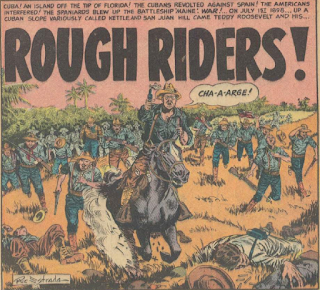
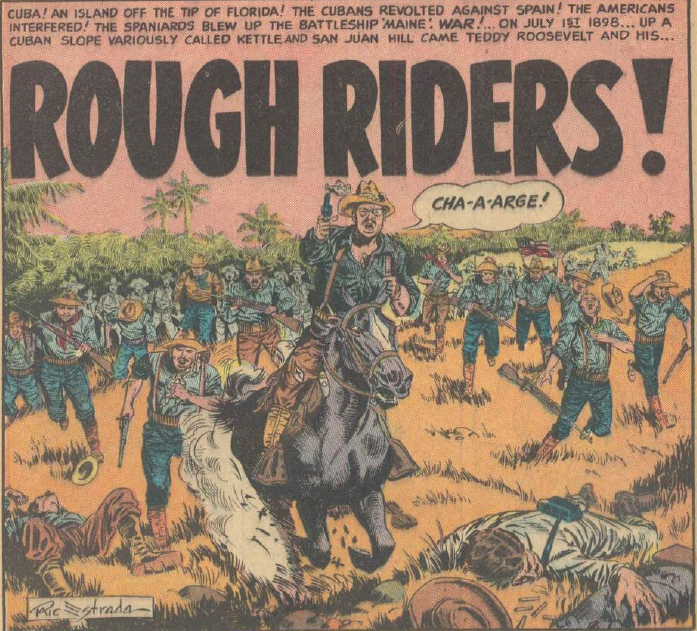
"Rough Riders!" ★★★
Story by Harvey Kurtzman
Art by Ric Estrada

"Lufbery!" ★★ 1/2
Story by Harvey Kurtzman
Art by George Evans

"Sailor!" ★★★ 1/2
Story by Harvey Kurtzman
Art by Jack Davis

Ever hear of the Army “Bird-Dogs”? No? Exactly! These aircraft pilots were largely responsible for cruising through the sky and radioing the enemy’s position to their comrades down below in order to send the enemy packing with some heavy artillery blasts. The drawling good ol’ boy who flies the plane in our tale goes about his duty without so much as breaking a sweat, laconically surveying the Chinese convoy making its way down the North South Road and radioing in their coordinates. The convoy is broken up with a few well-placed blasts, but the pilot realizes it’s time to split when three Chinese soldiers begin to mount their anti-aircraft machine gun. Ol’ Cletus makes it back to home base a wiser man after having noticed the hole in the cockpit window from the bullet that nearly took his life. Light on its feet all around, “Bird-Dogs” manages to keep its eight pages moving along briskly thanks to the breezy layout of Severin and Elder. Jack’s comment below regarding the story’s removed perspective is accurate; the grim fallout left in the wake of the blasts is literally depicted from a god’s-eye-view, leaving the broken bodies of men and horses looking like ants.

I can see my horse from here.
("Bird-Dogs!")

But do you know who had it worse than the oft-uncelebrated bird-dog? The “Rough Riders”! Particularly any of the countless Americans who fell at the tearing bullets of the Spanish army during our country’s entry into the dispute with Cuba in 1898. Led by no less than human grizzly bear Teddy Roosevelt, the Riders, men from all walks of life and education, find the torturous environs of Cuba to be too daunting even on their steely nerves. If the ripping artillery of the enemy wasn’t enough, the Americans must also contend with the island’s unfriendly fauna as well. After recounting the brutal ways in which his brothers in arms have taken bullets to the throat and cannon balls to the face, one Rider discovers that his end is to be the worst of all when the fatally wounded soldier falls prey to the pincers of flesh-hungry land crabs. Were it not for its exotic and completely left-field climax, “Rough Riders” would likely have gravitated towards the Hamper of Forgetfulness along with all the other old laundry of the war comics. Ric Estrada doesn’t look to be the best fit for EC—he’s still better than Fred Peters, thank God—but his style and talent feels in keeping with the “other pre-coder” vibe that this story gives off.

Der lion, jou see, she is me good look sharm!
("Lufbery!")
American ace Raoul Lufbery is having a ripping old time flying with the Lafayette Escadrille during WWI, but you would too if you had 17 official victories against the Germans under your belt and Lord knows how many unofficial ones. A cunning opponent in any aerial dogfight, Lufbery still keeps a clear head about his chances of escaping his plane should it catch ablaze during battle: “…First I’d do eferyt’ing to get de fire oudt! Den if I saw it vas no use, I’d jump! Maybe you’d fall in a tree! Anyhow, you couldn’t be no woise off!” We know what you’re thinking: What the hell kind of accent is that? We also know the other thing you’re thinking: What the hell is Lufbery doing with a lion sitting next to him? But most importantly we know the third thing you’re thinking: How the hell are those words going to come back and kick Lufbery in the Red Barons? Glad you asked! After taking off in another man’s aircraft to shoot down a crippled German albatross, Lufbery finds that he must abandon ship when his guns jam, his thumb gets blown off, and the plane’s gasoline tank explodes. Forever a man of his word, Lufbery takes his chances and jumps out… missing his hypothetical tree and crashing fatally into an old peasant’s rose garden. George Evans’ you-are-there artwork remains a consistent delight, and the blackly humorous turnabout that this tale of valor takes proves amusing.

During “Operation Killer” in the Korean War, an MD comes out from an air strike none the worse for wear but the same cannot be said for his fellow troops. The doc quickly goes about his business, carefully medicating and dressing gory wounds like severed jugulars and traumatized eyes with all the care and patience of the dutiful. It seems the old adage about lightning proves true for explosions, as another one knocks the doc off his feet but leaves him mostly unscathed. This time out it’s a Chinese soldier who ends up wounded, but just as before the doc keeps to his Oath and fixes the patient’s gangrenous tissue right up. Later two important discoveries are made: first that the doc’s leg was actually badly wounded following the second blast, and second that he’s actually not with the Marines but actually a Navy doctor attached to the outfit.

Aerial? No thanks.
Arterial? Hell yes!
("Sailor!")

Just as “Bird-Dogs” before it set out to honor the contributions of a neglected division of the military, so too does “Sailor” seek to shine a light on the down-and-dirty sacrifices that men of the Navy made right alongside their muddy brothers in the Army. I’ve said before that when it comes to the war titles I’ve had my fill of aerial dogfight stories, but the one thing I can probably never get enough of is war medic stories. I love all the gritty anatomical details and how they’re ultimately about rebuilding and restructuring in times of destruction and chaos. “Sailor” is another addition to this great tradition. --Jose

Corporal Enfantino responds to the Chubby Bunny challenge.
("Bird-Dogs!")
Peter: The army pilot of "Bird-Dogs!" has one of those annoying accents that forces the reader to re-read just about every sentence to see if the message came through clearly, but this vignette is enlightening and exciting: lots of little panels filled with green stuff, yet the art is dazzling. "Rough Riders!" is a weird one, to be sure. It begins as another one of Harvey's lectures, but then almost discards that plot and segues into a lecture on military death before throwing in a Crypt-Keeper-worthy finale (". . . to be eaten alive by land crabs . . .") just for the hell of it. It's a strange combo, for sure, but the whole thing finds a way to stay cohesive. Perhaps even more startling than impending death by crab is the four-panel sequence detailing the death of a Rider (below). "Lufbery!" features gorgeous, photo-realistic art from George Evans (an artist we don't see enough of around these parts) and a bio of an ace I knew nothing about. The tone and look sure remind me of Kanigher and Kubert on Enemy Ace. As good as the first three tales are (and they are very good), the obvious four-star story here is "Sailor!," grueling in a way only pre-code comics could get away with. Sad that the Code took most of the realism out of the genre and, for the most part, left us with watered-down tripe like Gunner and Sarge and Hunter's Hellcats.

Jack: I agree with you that "Sailor!" is the best story in the issue, as Davis portrays the gritty life of a Navy doc in Korea. Next comes "Lufbery!," a heroic depiction of a WWI flier who leaps from his burning plane without a parachute. "Rough Riders!" is not very engaging, even though Kurtzman wisely focuses on one man's impending death; Estrada's art is just average. Finally, I usually like the Severin/Elder stories more than I liked "Bird-Dogs!" It's marred by the Huckleberry Hound accent of the main character and the story is told in such a laid-back fashion as to be dull. The subtle panels showing the destruction on the ground are so low key that they almost don't register.

Lieutenant Seabrook cuts to the heart of the matter.
("Sailor!")


Williamson
Weird Fantasy #18

"Counter-Clockwise" ★★ 1/2
Story by Bill Gaines and Al Feldstein
Art by John Severin and Will Elder

"Zero Hour" ★★★
Story by Ray Bradbury
Adapted by Al Feldstein
Art by Jack Kamen

"Homesick!" ★★★ 1/2
Story by Al Feldstein
Art by Al Williamson and Roy Krenkel

"Judgment Day!"  ★★★★
Story by Al Feldstein
Art by Joe Orlando


Ron was lucky, growing up the son of rocket ship pilot Sam Travis and, one evening, he tells his pop that he wants to join the rocket fleet. As he's breaking the news to his stunned father, a spaceship lands in front of them and a strange, grotesque creature exits and approaches the duo. Sam blasts the monstrosity with his atom blaster and the perceived danger is averted. When the elder Travis reports the occurrence to the authorities, the government takes the rocket away for study. Ron is accepted into the rocket fleet and graduates at the top of his class; his reward being named the captain of the very alien ship he and his father discovered. His mission is to find the planet the rocket originated from; a five-year mission that has its perils. Six months into the voyage, Ron discovers what he thinks is the planet of origin and, despite orders only to observe, he lands the ship but manages to damage one of the fins in the process. While working on the damage, Ron discovers that the planet turns "Counter-Clockwise" to the direction of Earth and time is turning backwards. More distressing, his body grows bumpy sores and he loses stamina. Finally, after years of repair, the ship is ready for flight and Ron heads back to Earth. He lands in a field where a man and his son approach; the man aims his atom blaster and fires. As Ron lays dying, he realizes that he has gone back ten years in the past! Wholly predictable and the science is a bit far-fetched . . . I think (would your watch really run backwards if the planet turned counter-clockwise?) . . . but the plot is enough fun to avert your thoughts now and then. The art is . . . interesting; I'd have thought this one would have gone to Wally rather than the war guys but maybe Wood's plate was full. The protagonists don't suffer much but that creature is anything but scary.

Precocious seven-year-old Mink plays a new game called “Invasion” with the local kids. The tots are collecting household items, conversing with invisible pals, and spouting dialog like “Beam 4-9-7-A-B-X.” Mink’s mom gets worried that maybe there’s more to her daughter than just a very active imagination. Ray Bradbury spins more magic with children (no writer could blend childhood and dark fantasy like Bradbury), the only drawback being the Jack Kamen art. While Kamen has his fans, I remain unimpressed with the standard “talking head” narrative. The artist’s payoff panel (the unveiling of the invaders) looks more suited to a ghost story than science fiction but there's no denying that it's quite effective.  “Zero Hour” proved to be very lucrative for Ray Bradbury. In addition to the WF classic, the story was also adapted several times for radio (by Suspense, Escape, X Minus One, and Dimension X) and, in 1992, for Ray Bradbury Theatre, a syndicated TV show that lasted 65 episodes (over 6 seasons), all revolving around Bradbury’s short stories.

David Todd is in love with friend Larry Ardsley's wife, Lynn, and the thought that Larry gets to make love to Lynn every night is driving the man crazy. Luckily, Lynn feels the same way about David and, equally lucky, David and Larry are about to head to Mars on an expedition. David explains to Lynn how he intends to murder Larry and blame it on Mars. The boys land on the red planet and David wastes no time, blasting Larry the second they're out on the Martian landscape. Col. Todd reports back to Earth, letting them know that his partner has died of a strange disease he picked up when the men were exploring and that he'll be heading for the hub space station immediately. When David gets to the station, he finds it deserted, but a message over the loudspeaker, from General Minorly back on Earth, informs him that, because scientists can't explain Larry's sudden death and for the safety of Earth, David is confined to the space station for the rest of his life. I love a twist I never see coming and "Homesick!" paid off in spades. Al Williamson's art looks almost too good for funny books, with its posed characters and lovely detail. Certainly, the science fiction books were the most appropriate showcase for Williamson's work, but he also found time to contribute to some of the other EC titles as well. Like many of the EC vets, Williamson found work at Warren in the 1960s, producing such classics as "Sand Doom" (Creepy #5) and "The Lighthouse" (Eerie #3).

Tarlton has arrived at Cybrinia, "the planet of mechanical life," where robots have been programmed to create and propagate a civilization much like that of man back on Earth. Trouble is, Tarlton discovers that the main "species," the orange robots, have taken control of the planet and relegated the blue robots to the slums of Cybrinia. After a tour of both colonies, Tarlton explains to his orange robot guide that Cybrinia is not ready to become part of the "great Galactic Republic" because, unlike Earth, which has come a long way since the 1950s, this planet allows segregation and promotes prejudice. Leaving his host with some words of wisdom, Tarlton boards his ship and blasts off. Once in space, he removes his helmet and "the beads of perspiration on his dark skin twinkle like little stars . . ." Probably the most controversial tale EC ever published (outside of the infamous "Foul Play"), "Judgment Day!" must have been a bold kick in the nuts for 1953 and remains pretty doggone powerful (and, unfortunately, timely). Its critics might deem it overly preachy and, as Monday Morning Quarterbacks, we can find that climax a tad predictable, but I think the story still has lots of bite. Bill Gaines's fights with the censors over "Judgment Day!" are legendary and the whole sad but true story can be found here. --Peter

Jack: It's hard to read such a famous story without looking at everything that happens through the lens of knowing the ending. The gimmick of having Tarlton keep his helmet on the whole time to hide his face in preparation for the last-panel revelation is awkward but necessary. "Homesick!" is best appreciated for the stunning work by Williamson; the story itself starts out as almost a noir/sf crossover with a woman and her lover planning to kill her husband, but by the end it's all a bit dry and scientific in the telling. Kamen's Kids populate "Zero Hour," which is an example of a story that works better without pictures. I know it well from a treasured cassette of an old radio show and thus was disappointed in how it was presented here. "Counter-Clockwise" is an above-average time paradox story that manages to end predictably even though it doesn't go where I thought it would go at the start.


At Last!
The Long-Awaited Return of the Hangman!
In the 106th Issue of Star Spangled DC War Stories
On Sale Next Week!