Monday, January 14, 2013

Batman in the 1970s Part 53: The 1977 Wrap-Up


by Jack Seabrook
& Peter Enfantino


1977: The Year in Review

1977 was a stable year for Batman and Detective, with all of the highlights occurring in the latter book.  Both series published nothing but 36 page issues all year and cover prices began at 30 cents but went up to 35 cents with the June issues. Batman was published twelve times and remained a monthly, while Detective began the year as a bi-monthly but switched to an eight times a year schedule and thus had a total of eight issues published. Each issue of both titles featured 17 pages of new material, in addition to house fillers such as "Direct Currents," "Publishorial," "The Daily Planet," and a few "DC Profile" features about writers and artists. The letters column in Detective remained "Batman's Hot Line," while the letters column in Batman began the year as "Letters to the Batman" but was renamed "Bat Signals" with the November issue. Letters columns were edited by Bob Rozakis. Julius Schwartz edited both titles all year.

In Batman, covers were by Jim Aparo (7), Mike Grell (4) or Ernie Chua and Vince Colletta. Inside stories were always full-length and starred Batman. Writers were David V. Reed (11) and Denny O'Neil (with Julius Schwartz and E. Nelson Bridwell). Pencils were by John Calnan (4), Grell (4), Romeo Tanghall (2), Chua or Irv Novick. Inks were by Tex Blaisdell (4), Bob Wiacek (3), Colletta (2), Frank Springer (2) or Chua. Guests included Catwoman, the Joker, Lex Luthor, the Penguin, the Riddler, Robin, Skull Dugger, Dr. Tzin-Tzin, and a large cross-section of the Rogue's Gallery in the "Where Were You on the Night Batman Was Killed?" four-issue story arc.

In Detective, covers were by Marshall Rogers and Terry Austin (4), Aparo (3) or Rich Buckler and Colletta. The first issue of 1977 featured an 11 page lead story starring Batman and a six page backup story starring Hawkman. The third issue of the year featured an 11 page lead story starring Batman and a six page backup story that told the origin of Dr. Phosphorus, the villain in that issue's lead story. The other six issues featured full length Batman stories.

The lead stories were written by Steve Englehart (6) or Rozakis (2). Pencils were by Rogers (5), Walt Simonson (2) or Calnan. Inks were by Austin (5), Al Milgrom (2) or Colletta. The backup stories were written by Englhart or Rozakis, with pencils by Simonson or Rogers and inks by Milgrom or Austin. Guests included the Atom, Black Canary, the Calculator, Deadshot, Dr. Phosphorus, Elongated Man, Green Arrow, Hawkman, Hugo Strange and the Penguin.

Batman also appeared in the following DC comics in 1977:

Batman Family (6 issues)
The Brave and the Bold (7 issues)
DC Special (1 issue)
DC Special Series (1 issue)
Justice League of America (12 issues)
Limited Collector's Edition (2 issues)
The Super-Friends (7 issues)
World's Finest Comics (5 issues)

1977 was also noteworthy for the return of Neal Adams as a frequent DC cover artist. While he also drew covers for other series, this post features examples of the covers he drew this year that included Batman.

Finally, DC Super-Stars 17 featured the first appearance of the Huntress, who was the daughter of Batman and Catwoman on Earth Two.


1977: THE BEST (AND WORST) OF THE YEAR


Peter's picks:

Best Script: Steve Englehart, "The Dead Yet Live" (Detective 471)
Best Art: Marshall Rogers, "I Am the Batman" (Detective 472)
Best All-Around Story: "The Dead Yet Live" (Detective 471)

Worst Script: David V. Reed, "Skull Dugger's Killjoy Capers" (Batman 290)
Worst Art: John Calnan & Tex Blaisdell, "Where Were You on the Night Batman was Killed?"
(Batman #291-294)
Worst All-Around Story: "Skull Dugger's Killjoy Capers" (Batman 290)
Special Achievement for Awfulness: The "Where Were You on the Night..." arc (Batman #291-294)

Jack's picks:

Best Script: Steve Englehart, "I Am the Batman" (Detective 472)
Best Art: Marshall Rogers, "I Am the Batman" (Detective 472)
Best All-Around Story: "I Am the Batman" (Detective 472)

Worst Script: David V. Reed, "The Testimony of Lex Luthor" (Batman 293)
Worst Art: John Calnan & Tex Blaisdell, "The Testimony of Lex Luthor"
(Batman #293)
Worst All-Around Story: "The Testimony of Lex Luthor" (Batman 293)

1977 Circulations

Batman 150,853
Detective Comics 125,743
Superman 223,222

The Amazing Spider-Man 258,156


Thursday, January 10, 2013

John Collier on TV Part Four-Alfred Hitchcock Presents: "None Are So Blind"

by Jack Seabrook

Having exhausted their supply of stories from Fancies and Goodnights, the producers of Alfred Hitchcock Presents turned to a more recent story for their fourth adaptation of a work by John Collier. "None Are So Blind" was written around December 1955 and was published in The New Yorker on March 31, 1956. A thorough search has failed to turn up any source where this story has been reprinted, so it looks like it made one appearance in print, was quickly purchased for TV adaptation, and was forgotten.


The story concerns Seymour Johnstone, proprietor of a small antique shop in New York City and more preoccupied with wondering when his rich Aunt Muriel will die than he is with running his shop. He happens upon an article in a magazine about life expectancy and is discouraged to learn that his aunt may not die as soon as he hopes. Out of the magazine falls an envelope, in which Seymour finds a driver's license issued in California to Antonio Bertani, whose physical description is similar to that of Seymour. Seymour decides to masquerade as Bertani in order to murder his aunt. He constructs an identity as a shady Italian in New Jersey, disguising himself with a gold tooth, different clothes, and facial dye.

Muriel Drummond, his aunt, invites him to spend the Easter weekend at her Connecticut home. On Good Friday, he announces that he will take the train to New Jersey to inspect an antique. From New Jersey, he drives back to Connecticut in Bertani's car and then joins his aunt for dinner. After dinner, he places a threatening note in her desk and shoots her dead. He sneaks upstairs, then races down to find his aunt's dead body. He raises a ruckus that the maids witness, runs outside, and makes sure that Bertani's car is stuck in the mud. He calls the police and they come to the house and interview him.


Seymour pretends to have been fearful when he set out to chase the murderer. He tries to charm the policemen, who leave to continue their investigation. They return the next evening, having traced the car to Bertani's residence in New Jersey. Descriptions of Bertani by his neighbors mention a gold tooth, but also "a nasty little cyst on the left side of his nose." The detective observes that Seymour also has a cyst on his face in exactly the same spot. The title of the story comes from Matthew Henry (1662-1714), who wrote "none are so blind as those that will not see" in a Bible commentary. Collier's use of the name Seymour for his main character is ironic, since he actually "sees less" than others.

Mildred Dunnock as Aunt Muriel
"None Are So Blind" is a weak story compared to the first three that were adapted for Alfred Hitchcock Presents. The ending is subtle but it is clear that Seymour was in the habit of putting the left side of his face out of his mind and did not realize that his attempts to disguise himself were doomed to failure because of the large defect on his face.


The visual nature of the twist ending to this story must have made it appealing to adapt for TV. The teleplay was written by James Cavanagh and the episode was broadcast on CBS on Sunday, October 28, 1956, two weeks after "De Mortuis" had been aired, making it the third episode of the show's second season to be adapted from a story by John Collier. Once the viewer is aware of the twist ending, the most interesting part of the show becomes the process of watching how director of photography Reggie Lanning and director Robert Stevens set up their shots and film Hurd Hatfield (as Seymour) to hide the left side of his face without making it obvious that that is what they are doing.

The plot of the show follows that of the story with some revisions. Seymour narrates the show in voiceover, which helps to tie it together. He spends a lot of time staring at his right profile in the mirror and self consciously rubbing the left side of his nose, though the reason for this is not revealed until the last shot. Clues are sprinkled liberally throughout the show, such as this line of Seymour's: "The only way I could possibly survive in this so-called civilization is not to see anything unpleasant, just to pretend it doesn't exist." Aunt Muriel comments on Seymour's habit of positioning himself so others only see what he believes is his best angle.

K.T. Stevens as Liza
Instead of finding the driver's license in an envelope that drops out of a magazine, Seymour finds it in a wallet he picks up from the floor. A new character is added to the story: that of Liza, Seymour's girlfriend. He chats with her in his antique shop and reveals to her his plan to assume Bertani's identity and murder his aunt for her money. The Bertani disguise is rather absurd, consisting of a wig, a mustache, and bushy eyebrows. When Seymour is about to murder his aunt, she laughs at him and mocks his plans to plant the letter in her desk drawer; Liza had also laughed at Seymour when he told her his scheme. The show's continuity is a bit sloppy; Seymour puts the letter into an empty drawer, yet when the detective opens the drawer it is stuffed full of junk and he has to rummage through it to find the letter. A curious moment occurs when Seymour runs up the stairs after murdering his aunt: he trips and drops a glove, then runs up the stairs partway and has to come back down to pick up the item. Presumably, this was an attempt to increase suspense, but it falls flat.

Hurd Hatfield as Seymour
In the final scene, when the detective confronts Seymour, the detective explains that he had been good friends with Aunt Muriel and she had told him that, when anything annoyed Seymour, he pretended it was not there. The detective suddenly realizes that Seymour's facial defect matches that of Bertani. He spins Seymour around and we see his full face for the first time, with a large birthmark next to his nose.


"None Are So Blind" is a mediocre story that cannot be saved by good performances and competent direction. James Cavanagh (1922-1971), the writer who adapted it for television, was the author of many TV scripts in the 1950s and 1960s. He wrote 15 episodes of Alfred Hitchcock Presents, including "'Mother, May I Go Out to Swim?'" and "Fog Closing In," for which he won an Emmy. Director Robert Stevens also won an Emmy for the episode "The Glass Eye," one of the 49 episodes of the Hitchcock series that he directed.

Rusty Lane as the detective
Starring as Seymour was Hurd Hatfield (1917-1998), who had become famous for his role in The Picture of Dorian Gray (1945). Though he continued to appear in movies and on TV until the early 1990s, his career never again reached the peak that he had hit with one of his first movie roles. He appeared in two episodes of Alfred Hitchcock Presents. Aunt Muriel was played by character actress Mildred Dunnock (1901-1991). Like Robert Emhardt, she was a founding member of the Actors Studio and had great success on Broadway in the original production of Death of a Salesman, where she played Willy Loman's wife Linda. She was on TV from 1948 to 1982, appearing in four episodes of the Hitchcock series and one episode of Thriller. She was also in Hitchcock's The Trouble With Harry (1955).


Seymour disguised as Bertani
"None Are So Blind" is available on DVD here and may be viewed online here.

Sources:


Collier, John. "None Are So Blind." The New Yorker 31 Mar. 1956: 29-34. DVD.
Grams, Martin, and Patrik Wikstrom. The Alfred Hitchcock Presents Companion. Churchville, MD: OTR Pub., 2001. Print.
IMDb. IMDb.com, n.d. Web. 04 Jan. 2013.
"John Collier: An Inventory of His Papers at the Harry Ransom Humanities Research Center." John Collier: An Inventory of His Papers at the Harry Ransom Humanities Research Center. N.p., n.d. Web. 04 Jan. 2013.
"The New Yorker." The New Yorker. N.p., n.d. Web. 06 Jan. 2013.
"None Are So Blind." Alfred Hitchcock Presents. CBS. 28 Oct. 1956. Television.

"Quote/Counterquote: None so Blind as Those That Will Not See." N.p., n.d. Web. 06 Jan. 2013.
Wikipedia. Wikimedia Foundation, n.d. Web. 04 Jan. 2013.


Monday, January 7, 2013

Batman in the 1970s Part 52: November and December 1977


by Peter Enfantino
& Jack Seabrook


Detective Comics 473 (November 1977)

"The Malay Penguin!"
Story by Steve Englehart
Art by Marshall Rogers and Terry Austin

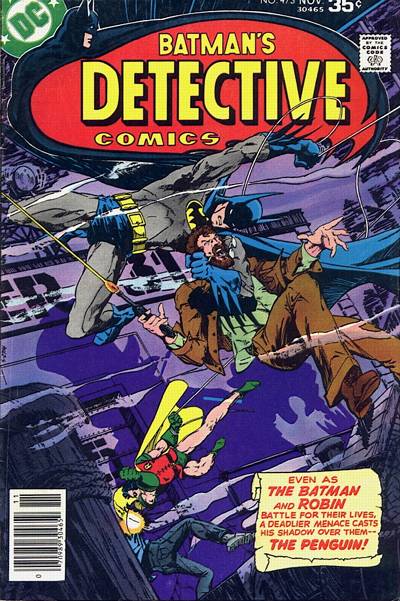
The Penguin is back in town and Batman is sure the feathered fiend's next target is the rare Malay Penguin, a piece of art on exhibit at the Reed Galleries in Gotham. But the bird is a slippery one and what may seem to be evident isn't always. Luckily for Gotham art lovers, The Batman is always one step ahead of his arch-enemies and deduces that The Penguin is actually planning a different heist: the hijacking of a jet carrying some very important businessmen. The Dark Knight and Robin intercede before the dirty bird can carry out his nefarious plan. Ironically, after he's been nabbed by the Dynamic Duo, The Penguin reveals to Robin that he had actually stolen The Malay Penguin weeks before and the statue in the gallery is a fake! Meanwhile, across town, Mob boss Rupert Thorne is seeing ghosts!

If you gotta have a Penguin, this is the way to present him.
PE: This one's a mixed bag for me but, in the end, it's enjoyable enough. I think The Penguin almost demands lightweight material and that's what we get here. When did Pengy start leaving clues for Bats (a la The Joker and The Riddler) and isn't that modus pretty much drying up? Having said that, the story advances at a pleasing, if somewhat confusing, pace and I like the Dark Knight vibe Englehart is trying to get this title back to after years of meandering. Here we get the first mention that Gotham's Finest is run by the mob (Commissioner Gordon being the only holdout, of course), a scenario that will be continually explored throughout the coming decades and used to good effect by Frank Miller, Tim Burton, and Christopher Nolan. And what's up with the ghost of Hugo Strange haunting Boss Thorne? Marshall Rogers's depiction of The Penguin would have to become the definitive version up to this point. Rogers definitely seems to be going for the 1930s look of The Batman, menacing and grim. Even the lettering cries out retro. Marshall doesn't fare as well with his civilian characters, however, with Bruce and Dick, especially, looking like doodles whipped up in 7th Grade art class.  Minor quibbles though when compared to the tripe discussed in the Batman title the same month.
Look out, Neal Adams, you may have competition!

Jack: I agree with you up to a point. The opening pages, with Batman and Robin fighting hoods on a foggy pier, definitely has an early Bob Kane feel to it, and Rogers does much better with people in costume than with people out of them. His depiction of a shirtless Robin is laughable, yet for every man he draws only adequately, there is a woman (Silver St. Cloud) whom he draws beautifully. I thought it was funny that the owner of the museum where the Malay Penguin is being exhibited spared almost no expense on security precautions but drew the line at security cameras because they were too expensive--and this was only 35 years ago! Austin has the same problem that many other Bat artists we've seen in this decade have with overdoing the Batcape for effect, and I will stick with Neal Adams as the best Bat artist, but this story is the third issue in a row of Detective to rate four stars out of a possible four in my book.


Batman 293 (November 1977)

"Where Were You on the Night Batman was Killed? The Testimony of Lex Luthor!"
Story by David V. Reed
Art by John Calnan and Tex Blaisdell

Lex Luthor is the third arch criminal to testify in support of his claim to have killed Batman. He staged a robbery at the Gotham Museum of Art to draw Batman's attention so that he could shoot a Maser beam from a satellite orbiting the planet. The beam erased Batman's consciousness and replaced it with that of Superman. Luthor then beat Batman to death, thus eliminating Superman, whose body was indestructible. Unfortunately for Luthor, Superman testifies next and explains that he and Batman were wise to the plan all along and that it failed miserably.

PE: If David V. Reed didn't write so doggone seriously, I'd think this whole arc was a joke. Well, it is a joke actually, just not of the funny variety. What possible motive could Superman have for flying to this mock trial and testifying to the "innocence" of Lex Luthor? Even if Supes wasn't the most boring hero in comics, would he stand by while the arch-enemies of his best buddy gathered and celebrated his "demise?" And what comic reader in 1977 could read this badly constructed, horribly written, and amateurishly illustrated nonsense and want to tune in to the concluding chapter? Calnan and Blaisdell's Man of Steel looks like a different character in every panel he's in.

Jack: That was what struck me from the first page--how awful Calnan and Blaisdell's Superman looks! I'm surprised that DC allowed this to get published, since I recall reading that they used to have Curt Swan re-draw Superman's face on the work of other artists to ensure a consistent look. On a more interesting note, the letters column changes its name to "Bat Signals" with this issue, after having been "Batman's Hotline" since at least January 1970, when we started this project. Also, a note on the "publishorial" page reports that the DC Direct Currents Hotline had been too successful and had to be shut down. If one can believe what is written here, kids across America were racing home from school every day to call the hotline for the latest DC news and the phone company was so flooded with calls that it asked DC to shut down the service. Part of me wants to believe that this is true, while the other part thinks it may just be hype.


Detective Comics 474 (December 1977)

"The Deadshot Ricochet"
Story by Steve Englehart
Art by Marshall Rogers and Terry Austin

Tossed in the pokey after his run-in with The Batman and Robin (last issue), The Penguin is boasting to con Floyd Lawton that he's not long for the prison. When asked what he's talking about, the bird offers up a trick monocle that produces a ray beam that can cut through walls. Lawton snatches the eyeglass and makes his getaway. Not just another hood, Lawton is, in fact, one of The Batman's first nemeses, the assassin Deadshot! Picking up some new spandex for the 1970s, Deadshot begins what he hadn't finished years ago: taking The Batman's head for his trophy cabinet. Though he's trained for years in prison, it takes much more than that to conquer The Dark Knight and Deadshot finds himself off to prison a short time after he's broken out. Meanwhile, other cans of worms have opened: Boss Thorne has a second encounter with the "ghost" of Hugo Strange; The Batman's deadliest foe is back; and Silver St. Cloud, Bruce Wayne's beau of the month, has discovered how her boyfriend stays so fit and trim.


PE: Sly Steve Englehart echoes my feelings when he writes "We won't be seeing The Penguin again for a while--and it's probably just as well!" Amen! The Batman's confrontation with Boss Thorne is why Steve Englehart is the best Batman writer so far this decade. Englehart gets the Dark Knight vibe, almost as though he'd been boning up on early 1940s 'tecs whereas other writers have had no clue, seemingly watching reruns of that TV show instead. This is a dangerous city where bad things can happen to good people.

There's also a bit of foundation laid for Silver's eventual discovery of Bruce's hobby with a nice bit of foreplay between the two lovers in a restaurant (and that haunting final "It was Bruce" after The Batman's battle with Deadshot). Silver's obviously suspicious of Bruce's involvement with The Dark Knight but perhaps doesn't want to appear foolish by coming out and asking her beau. Englehart continues to mine the pages of those old comics as evidenced by a reference to one of Bruce's old loves, Julie Madison (from Detective Comics #31!) and, of course, the return of Deadshot, a bad guy not seen since Batman #59 (July 1950). (According to Englehart in an interview that appeared in The Batcave Companion [TwoMorrows, 2009], it was Julius Schwartz's suggestion to reboot the long-forgotten criminal).

Throw in more ghostly apparitions and the cameo of a certain clown prince of crime and you've got yet another prize package fit for enjoying thirty-five years on. Deadshot's original costume, a tux and top hat, might have been a bit silly for a villain (not to mention a bit cumbersome when he has to turn tail and run for it) so an upgrade was obviously necessary. Unfortunately, though the get-up is very fetching, it's a tad too close to the design for Marvel's Deathlok, the Demolisher, to warrant any claims of originality.


Jack: For once, I was sorry to see Robin go, now that Englehart/Rogers/Austin have once again made him an interesting character. I do understand why he left, since I too would respond immediately to a summons from Wonder Girl. I agree that it's neat to see characters from Batman's distant past being worked back into the mythology; the lack of continuity had been one of our complaints a few years ago. I like the Silver St. Cloud character but I had to look twice when she referred to the "freakin' authorities"--that doesn't sound like the way she would speak. So far, the Englehart run of Detective is terrific--let's hope it lasts longer than the Goodwin run!

The original, dapper Deadshot from Batman #59
The new, "improved" Deadshot the Demolisher


Batman 294 (December 1977)

"Where Were You on the Night Batman was Killed? The Testimony of The Joker!"
Story by David V. Reed
Art by John Calnan and Tex Blaisdell

Batman's number one foe, the Joker, is the fourth criminal to testify that he killed Batman. While robbing a furrier one night he witnessed Batman defeat a petty thief. The next night, he went back to the furrier and faced off against Batman, killing him with an injection of laughing toxin and then wiping away his facial features with acid. After leaving the courtroom, Two-Face removes his disguise and is revealed to be Batman, who finds and captures the Joker. Batman explains to Commissioner Gordon that the trial was an elaborate ruse to figure out who had killed a harmless young man whose hobby was dressing up as Batman and acting out his escapades at the scenes of prior crimes.

PE: Rather than spend any more of your time telling you why this arc is insipid, juvenile, and a waste of paper, I'm inclined to put my tongue between my lips and describe it as thus:  <rude noise>, but I'll take the high road and avoid the childishness just this once. I wish I could ask the late Julius Schwartz why he thought stories like this, putting four super-villains on trial for the supposed murder of Batman, signaled the age of a new Batman (one that the readers had been clamoring for, evidently) as he exclaimed in an issue not too far in the past. As Roger Daltrey once said, "Meet the new boss. Same as the old boss." The inexplicable thing here is that, over at Detective, those changes are showing up in spades. Perhaps Julie simply wanted to keep his options open. I suspect we'll be seeing the version of The Joker I enjoy in February's 'tec. As for the startling revelation that Two-Face was actually The Batman all along: nah-nah-nah-nah-nah, told you so!


Jack: You are too hard on this arc! I enjoyed the last of the four stories and thought it was an interesting way to explain what was happening. I'll grant you that Calnan and Blaisdell's art is not memorable, and their Joker seems to be based on Irv Novick's Joker, which was never one of my favorite versions. However, it made sense that the Joker would accidentally kill Batman and then wipe out his features, and--in a sort of twisted, DC Comics way--the whole plan for the trial also made sense, as a way for Batman to flush out the young man's killer. I know, I know, he probably could have tracked him down by more traditional detective methods, but it was kind of fun to see all of those obscure Bat-villains, wasn't it?

PE: No.

Another Neal Adams illustration for the
Saturday morning cartoon lineup

Is it too late to write?


Monday, December 31, 2012

Batman in the 1970s Part 51: September and October 1977


by Jack Seabrook
& Peter Enfantino


Batman 291 (September 1977)

"Where Were You on the Night Batman was Killed? The Testimony of the Catwoman!"
Story by David V. Reed
Art by John Calnan and Tex Blaisdell

The underworld is abuzz with news that Batman is dead. Since so many criminals have taken credit for the murder and in so many places, a trial is held at a secluded estate in Gotham City. Ra's al Ghul is the judge, Two-Face is the prosecutor, and six Bat-villains comprise the jury. First up on the stand is Catwoman, who tells her tale of how Batman found her trying to go straight and she let him drown in an icy river. The jury doesn't buy her story.

PE: Another issue of Batman, another juvenile David V. Reed storyline, this one threatening to take up the next four issues and 68 pages. I'm not sure what's worse, a story concerning Batman chasing after art thieves or a long arc misusing the Rogue's Gallery yet again. Hard to tell, but the minute I saw Ra's al Ghul, one of Batman's most important and "serious" opponents, serving as judge on the trial, I was out of here. The only thing missing here was Bat-Mite and Krypto. Batman was actually missing as well. Why would all these dangerous (and in some cases, psychotic) criminals hang out together and serve as jurors on a mock trial? I smell another stinker of "Crime Olympics" proportion. The art, by newcomers John Calnan and Tex Blaisdell, is by the numbers, neither horrible nor exemplary. It just gets the job done. Blasidell cut his teeth on strips such as Little Orphan Annie.


Jack: As usual, I enjoyed this story. The art is almost Golden Age in its simplicity, which works well with this cast of characters. The Rogue's Gallery includes some interesting figure we've not seen in awhile, such as the Mad Hatter and Poison Ivy. Calnan and Blaisdell do a nice job of illustrating the very leggy Catwoman but their Ra's Al Ghul pales next to the Adams/Novick original.


Detective Comics 472 (September 1977)

"I Am The Batman!"
Story by Steve Englehart
Art by Marshall Rogers and Terry Austin

Having attained the true identity of The Batman, Professor Hugo Strange proceeds to milk the information for all it's worth. First, he cashes in many of Bruce Wayne's stocks then he hits on the greatest idea he's ever had: he'll sell Batman's identity to the highest bidder. Three figures, all hidden in shadows, opt in to the bid. Opening ante: one million dollars! Not wanting to play fair, Boss Rupert Thorne kidnaps Professor Strange and attempts to beat his secret out of him. Hugo is very resilient, resisting Thorne's interrogation and eventually succumbing to his torture. Meanwhile, Robin comes to the rescue of Bruce and Alfred, who are being kept in Strange's hideout.

PE: If not the blockbuster we witnessed last issue, this is another strong entry from messrs. Englehart, Rogers, and Austin. That cover is a bit misleading since there's no real appearance of a "new Batman," and becomes confusing since over at the Batman title, we're about to start a long arc on "Where were You on the Night Batman was Killed?" This story has nothing to do with that arc though. Monday Morning Quarterbacking lets us in on the fact that Hugo Strange is not dead (for those who don't mind a bit of a spoiler, it's revealed in Batman #356 (February 1983) that Strange used a form of yoga to slow his heart down and fool his captors into thinking he'd succumbed to their beatings). I wasn't sharp enough to see that The Penguin (or rather, The Penguin's umbrella) makes a cameo during the bidding scene, so thanks to Steve Englehart for pointing that out to me. I wonder who the other two bidders were. It's a testament to just how sharp Marshall Rogers's penciling is that he can make even Robin, the Boy Blunder, look cool and dangerous. Cool art or no, I'll never buy the old comic book trope that a man with a mask on can look just like the other man. In this case, Strange wears not only a Bruce Wayne disguise but a Batman cowl over that. In the letters page, Bob Rozakis reveals that Julius Schwartz has decided to separate the vibe of Batman and 'tec by accentuating the Golden Age atmosphere in this title. Thus, the appearance of the long-gone Hugo Strange. That's a good plan but let's see if it works with a campy villain like next issue's The Penguin.

Jack: I thought this was one of the best Batman comics I've ever read! Oddly enough, the Batman does not appear in it. We get Hugo Strange masquerading as the Batman and Bruce Wayne in a drugged state--but no Batman. It makes no difference to me, though, since the story and art mesh perfectly to make a truly exciting tale. Strange is a fascinating character, Magda and Silver are gorgeous, and Robin is as good as we've ever seen him. Even Boss Thorne strikes an air of menace. I can tell you who the other two bidders were--Boss Thorne and the Joker. If this issue is indicative of what we're in for in Detective, I can't wait for more! Too bad Batman is so weak in comparison right now.


Batman 292 (October 1977)

"Where Were You on the Night Batman was Killed?  The Testimony of The Riddler!"
Story by David V. Reed
Art by John Calnan and Tex Blaisdell

The Riddler takes his turn on the stand and explains how he led Batman on a merry chase through Gotham that ended with him blowing the Caped Crusader to bits in a quarry. Two Face proves that dynamite is not ignited by fire and the jury gives E. Nigma the heave-ho.

PE: Another dim-witted chapter in The Death of Batman. The only suspense, aside from whether I'll be able to stay conscious during all four installments, is what part the real Batman plays in all this? I'll bet money he's in the courtroom (odds-on favorite would have to be Two-Face) but what possible conclusion can close out this saga? Why would Bats sit tight while all these bad guys have a party and celebrate his "death?" And, most important question of all, how is it that every one of Bats' Rogue Gallery (with the possible exception of Mr. Freeze and The Penguin, the latter of which is being used in 'tec at the moment) is out of jail at the same time? Is Arkham bone dry? Great cover, though.


Jack: You're right that Jim Aparo's cover is the highlight of this dreadful issue. It's too bad that Aparo rarely ventured out of The Brave and the Bold and over to Batman and Detective--he was one of the best artists to draw Batman in the '70s. What puzzled me about this story was the Riddler's makeup skills, which seem to rival those of his pointy-eared nemesis--his transformation into Bruce Wayne seems to include a wholesale revision of his facial bones. Also, what is Lex Luthor doing in the Batman Rogue's Gallery?


Thursday, December 27, 2012

John Collier on TV Part Three-Alfred Hitchcock Presents: "De Mortuis"

by Jack Seabrook

Just two weeks after "Wet Saturday" came the next episode of Alfred Hitchcock Presents to be adapted from a John Collier story; "De Mortuis" was broadcast on October 14, 1956. The story upon which it was based, with the same title, had been published first in The New Yorker's issue dated July 18, 1942. The title, "De Mortuis," is taken from the Latin phrase, De mortuis nihil nisi bonum; roughly translated, it means "speak no ill of the dead." Ironically, no one in the story is actually dead, at least not physically.


As the story begins, Dr. Rankin has just finished cementing over a patch on his cellar floor. He hears his friends Buck and Bud enter the house upstairs, looking for him to go fishing. They find him in the cellar and he explains that his wife Irene is out visiting and he has repaired the cellar floor where water was coming up. As the three men chat, the visitors begin to suspect that Dr. Rankin has murdered his promiscuous wife and buried her body in the basement. He angrily denies it but they admit that her behavior must have provoked him--they considered telling him the truth about her prior to their marriage five years before but chose to remain quiet.

Cara Williams as Irene
To the doctor, Irene is "innocent. Like a child," but Bud calls her "the town floozy"; no one has said anything to her husband, but she has lately been seen with more men, even "truck drivers." Buck and Bud assure Dr. Rankin that everyone will be on his side and that they will pretend that they were never there in order to bolster his alibi. After they leave, the doctor sits alone in the cellar, dejected; Irene comes home and he invites her downstairs to show her his work, telling her: "I'm afraid I'll have to take it all up again."


"De Mortuis" is another example of Collier's subtlety, in which he inverts the story of "Back for Christmas," where an unhappy husband murders his wife and buries her body in the basement. This time, the husband is happy because he does not know his wife's true nature; when he finds out, he plans to do exactly that which was suspected of him by his overly imaginative friends. A simple explanation of the story's title is that Buck and Bud speak ill of Irene, whom they think is dead, and by doing so inadvertently cause her death. A more shaded explanation might suggest that each of the story's characters is already dead in some way: Dr. Rankin, whose eyes are dead to Irene's deception; Bud and Buck, whose emotions are dead to the sensitivity of their friend; Irene, whose heart is dead to the harm caused by her behavior.

"De Mortuis" was adapted for television by Francis Cockrell, who had also adapted "Back for Christmas" and whose wife Marion adapted "Wet Saturday." Unlike the two earlier episodes, which followed the stories closely, the televised version of "De Mortuis" takes a rather different approach to its source material. The show begins as Dr. Rankin struggles with a heavy bag of concrete and takes it down to his cellar to begin mixing, all set to ominous music. His two friends arrive and make themselves at home, reading his newspaper and drinking his coffee. The kitchen is a mess, and one of the men comments that "Irene isn't much of a housekeeper." They agree that Dr. Rankin will find out about her sometime but they doubt he will do anything, because he is "innocent . . . a nice guy." As he fills the hole below, unaware that they are in his home, they discuss his wife's adulterous behavior and we see two flashback sequences, one narrated  by each man.


Robert Emhardt as Prof. Rankin
In the first flashback, Bud tells Wally (not Buck) about an incident when he witnessed Irene being picked up in a diner in the middle of the day by a truck driver. In the second flashback, Wally tells Bud about a time when he was on a group camping trip and he thought Irene was flirting with him. These scenes establish Irene as an attractive woman who dallied with many men; it also demonstrates that Wally and Bud seem to enjoy her antics, gossiping and hanging on each other's every word. Once they discover Rankin (a professor now, rather than a doctor) in the cellar, the story briefly follows Collier's original, until it takes another detour as Rankin shows his friends cages with rats that are the subject of his experiments. When he tells them that one group of rodents has responded by becoming aggressive and attacking each other, Bud instantly jumps to the conclusion that Rankin has murdered his wife and buried her in the cellar.

Henry Jones as Wally
The story continues as the three men move their discussion upstairs and Rankin realizes what his friends think he has done. He yells at them, asking "what are you talking about?" and challenges them to "dig up the cement . . . call the sheriff!" After they leave, he returns to the cellar, where he sits alone and dejected. Irene arrives home and he summons her downstairs. Much as in the conclusions to "Back for Christmas" and Wet Saturday," the teleplay spells out what the story only implies; Rankin lifts a pickax and we see his wife's legs descending the stairs; she asks, "Well, what is it?" and the picture fades out with a musical sting.


Perhaps due to the changes in the story, "De Mortuis" is not as successful as the two Collier adaptations that had come before it. The show seems forced and drags in spots. Director Robert Stevens tells the story in a straightforward manner, with two noteworthy shots. There is a nice camera move near the end of the show where Bud and Wally step aside and the camera dollies in on Rankin's face, and there is a menacing low angle shot of Rankin framed in the cellar door as he challenges his friends.

Philip Coolidge as Bud
The casting is very good. As Professor Rankin, Robert Emhardt (1913-1994) is overweight and sweaty, able to seem both innocent and dangerous at the same time. Emhardt was a founding member of the Actors Studio and his career on TV and in film stretched from about 1950 to the early 1980s. In addition to seven episodes of the Hitchcock series, he was seen in a Twilight Zone and an episode of Kolchak: The Night Stalker.


Cara Williams (1925- ) is suitably voluptuous as Irene; she was nominated for an Oscar as best supporting actress for her role in the Defiant Ones (1958) and appeared four times on Alfred Hitchcock Presents--her role in Robert Bloch's "The Cure" was similar to her role in "De Mortuis."

Haim Wynant as the truck
driver lights Irene's fire
Bud, the tall, thin friend, is played by Philip Coolidge (1908-1967), who appeared in seven episodes of the Hitchcock series, as well as an episode of The Twilight Zone and Hitchcock's North By Northwest (1959). Wally, the shorter friend, is played by Henry Jones (1912-1999), an instantly recognizable character actor who had a 50-year career on television and in the movies. In addition to six episodes of the Hitchcock series, he appeared in episodes of seemingly every TV series, including The Twilight Zone, Thriller, Night Gallery and Kolchak: The Night Stalker. He also appeared in Hitchcock's 1958 classic, Vertigo.


Finally, making a brief appearance as the truck driver who picks up Irene is Haim Wynant (1927- ). He later changed his stage name to H.M. Wynant and is remembered for his role in The Twilight Zone episode, "The Howling Man."

Like "Back for Christmas" and "Wet Saturday," "De Mortuis" was adapted for radio and television both before and after it appeared on Alfred Hitchcock Presents. It was seen on the TV show Lights Out on September 1, 1946, but this episode seems to have been lost. It was adapted for the radio show Suspense and broadcast on February 10, 1949, starring Charles Laughton. This episode can be heard here. Back on television, it was broadcast as part of the Suspense series on June 12, 1951; this episode has also been lost. On radio again, it was broadcast on the Short Story series on May 26, 1952; this episode may be heard here. On television, it appeared as the February 17, 1955 episode of Star Tonight under the title "Concerning Death"--I have not been able to find a copy of this available for viewing, but since it was shown in 1955 it may be in an archive somewhere. Finally, decades after the Hitchcock show, "De Mortuis" was remade as "Never Speak Ill of the Dead" and broadcast as the May 24, 1981 episode of Tales of the Unexpected. It may be viewed here.


Sources:

Collier, John. "De Mortuis." Fancies and Goodnights. New York: Bantam, 1961. 9-15. Print.
"De Mortuis." Alfred Hitchcock Presents. CBS. 14 Oct. 1956. Television.
Grams, Martin, and Patrik Wikstrom. The Alfred Hitchcock Presents Companion. Churchville, MD: OTR Pub., 2001. Print.
IMDb. IMDb.com, n.d. Web. 23 Dec. 2012.
"My Old Radio - The Best OTR Ressource on the Web." My Old Radio - The Best OTR Ressource on the Web. N.p., n.d. Web. 23 Dec. 2012.
"The New Yorker." The New Yorker. N.p., n.d. Web. 23 Dec. 2012.
Wikipedia. Wikimedia Foundation, n.d. Web. 23 Dec. 2012.