Monday, July 16, 2012

Batman in the 1970s Part 27: November and December 1973


by Jack Seabrook & 
Peter Enfantino

Batman 253 (November 1973)

"Who Knows What Evil -- ?"
Story by Denny O'Neil
Art by Irv Novick & Dick Giordano

Batman foils a gang of counterfeiters unloading funny money at the Gotham Freight Yards and is helped by an unseen marksman with an echoing laugh. Bruce Wayne follows the money trail to Tumbleweed Crossing, Arizona, where unruly hippies have been wreaking weekly havoc. Bruce meets Lamont Cranston, a scientist who is staying at the same hotel, then Batman journeys out into the desert, where a shadowy figure shoots down the counterfeiters’ plane before they get away. The unseen marksman helps Batman dispatch the leader of the gang, then meets him back at the Gotham Freight Yards at midnight and reveals himself as The Shadow.

That's quite a cape, Batman!
PE: The Bat cape grows to even more idiotic lengths, this time as long as the car he's driving. Obviously, Bruce Wayne never read the biography of Isadora Duncan. The "big surprise" reveal of The Shadow, who's kept in the shadows until page 14, might have been a bit more... surprising... had the character not been featured so prominently on both cover and splash. The story itself is just another bad crime drama about counterfeit dough that could very easily have been authored by Frank Robbins. Why would Batman jump to the conclusion that his hidden ally is The Shadow based only on maniacal laughter? Why couldn't it be The Joker setting up Bats for a fall?


Jack: I think the marksmanship was what led Batman to deduce that The Shadow might be the laugher. Plus, he has a deeper voice than the Joker.

PE: Once again, when the bad guy is revealed, he turns out to be the only other supporting character introduced in the story. Haven't O'Neil or Robbins read Agatha Christie? If you want a reveal to be shocking, you need a few more characters. I'll go out on a limb and say the only reason this story exists is to give the debut issue of The Shadow, which was on sale the same time as Batman 253, a push. Denny O'Neil wrote ten of the twelve issues of the 1973-75 series. I'm assuming that O'Neil, Giordano, and Novick were privy to Jim Steranko's painting for The Living Shadow (Dell paperback) since the book wasn't published until 1974 and the two images are a little too similar. I find it highly doubtful that Big Jim would base his now-famous painting on the Novick/Giordano panel but then stranger things have happened.


Jack: I thought that the parts of this story involving The Shadow were cool enough to overcome the more banal bits with the hippies being paid to ride dune buggies through town and the hotel owner who ran the gang. I especially liked the ending, where Batman tells The Shadow that "you were my biggest inspiration." That's a nice touch and a bit of a comic/pulp history lesson by Professor O'Neil.


Detective Comics 437 (November 1973)

"Deathmask!"

Story by Archie Goodwin
Art by Jim Aparo

The Gotham Museum plays host to the exhibit "Art of the Xochipecs," featuring priceless artifacts of an ancient Central American tribe. Some of the visitors, such as the gang of hoods on the roof, are not on the guest list. Batman takes care of them very quickly but the real menace seems to be an appearance by the Xochipecs' god of death, Matuchima, a robed figure with a skull mask and a mean disposition. Batman's not buying that Matuchima is an ancient God risen from the tombs and he sets out to prove that point. 

PE: I expected more from Archie Goodwin's first Batman story. Unfortunately, it falls into the same traps as the stories of Frank Robbins and Denny O'Neil: uninteresting villains and disappointing reveals. Aparo's an artist whose work I'm not familiar with but I've heard and read glowing reports. He does an admirable job illustrating The Dark Knight but I find his work to be very similar to that of Novick and Giordano. Nothing bad about that though.

Jack: This issue marks Jim Aparo's first Batman story for Detective. He had been drawing DC horror comics and the Batman team-ups in The Brave and the Bold. I think he is the second best Batman artist we've seen since January 1970, after Neal Adams. I do see a resemblance to the Novick/Giordano style, but I think Aparo's art is better. I especially like the wordless sequences.


PE: A couple of firsts here: Archie Goodwin's debut as both writer and editor of Detective, and the first Bat-gig for Aparo outside of his regular chores on Brave and the Bold (which he'd already been holding down for the past two years). Aparo would become well-respected in fandom for his Batman work, behind only Adams and Marshall Rogers in 1970s/80s popularity. Aparo had a hand in two of the most popular Batman arcs in the 1980s, "Ten Nights of the Beast" (written by Jim Starlin) and the controversial "A Death in the Family" (chronicling the death by Joker of Jason Todd, the second Robin). Archie Goodwin had been the guiding force behind Jim Warren's comic line, Creepy, Eerie, and Blazing Combat, editing the line and writing the majority of the stories that appeared in all three. One only has to look at the gruesome collapse of the Warren books after Goodwin's departure in 1967 (and the advent of reprints to fill up vacant pages) to realize just how important this guy was. Unfortunately, his tenure here at Detective would last only seven issues.

Jack: I looked back at the story after reading your comments and I think it is easily much better than anything Frank Robbins was routinely writing, and also better than the O'Neil Shadow story running the same month in Batman. It will be interesting to see what Goodwin does with the character in 1974.

"The Himalayan Incident"
Story by Archie Goodwin
Art by Walt Simonson

Interpol agent Christine St. Clair travels to Katmandu to interview a wise old man named Haj the Ancient. The focus of the interview is St. Clair's search for a man named Paul Kirk, who may be moonlighting as an assassin named Manhunter. Christine leaves frustrated, since the interview seems to raise more questions than it answers. If she'd looked back over her shoulder as she walked away, she would have seen Haj the Ancient reveal himself as Manhunter.

PE: Perhaps the most celebrated back-up feature in DC history, Manhunter had a very complicated journey leading up to its debut in this issue. A Manhunter (with the alter ego of Paul Kirk) appeared in the pages of Adventure Comics in the 1940s but writer Goodwin insisted that this was a new character altogether. A decade away from superstardom with the Beta-Ray Bill storyline in Marvel's Thor, Simonson bursts out of these pages like the breath of fresh air delivered by a Steranko or an Adams. There was literally nothing like this strip anywhere to be found in the Batman books up to this time. The antithesis of Goodwin's Batman story this issue, Manhunter reads like the opening chapter of a very adult and very intricately woven novel.  I can see a lot of 12-year olds (myself included) giving up on this confusing and, for the most part action-free strip, but 39 years later this comic reader thinks it's the first Batman back-up I'm looking forward to reading.

Jack: I agree that this is exciting stuff, but I think we had a similar jolt during the brief period when Rich Buckler took over the art on the Robin backup. The level of quality didn't last long, though. I only have a vague recollection of this series but I'm looking forward to more.

PE: No letters page this issue as Archie delivers a very detailed and very revealing editorial instead. He maps out his intentions for Detective and explains why Jason Bard, The Atom, Hawkman, and The Elongated Man have been put on the shelf (different from the reasons Jack and I would give) and why Manhunter has been given the green light. Goodwin explains that sales are down for the Bat-books and so the time is ripe for experiments. Amen!

Jack: Goodwin notes that Julius Schwartz will stay busy with Shazam and Strange Sports Stories, two series I loved at the time. Had I been on Peter's school playground, that admission probably would have gotten me beaten up (you wouldn't have lasted a day!-PE). There were no December 1973 issues of Batman or Detective Comics, and these two November issues were the last with a 20 cent cover price. The next issue of both titles would start the run of 100-page super-spectaculars that pervaded the DC line in 1974.


Thursday, July 12, 2012

Shatner Meets Hitchcock Part One: Alfred Hitchcock Presents "The Glass Eye"

by Jack Seabrook

Early in his career as a television actor, William Shatner had a co-starring role in the Alfred Hitchcock Presents episode, “The Glass Eye,” which was the first episode of the series’ third season. Broadcast on Sunday, October 6, 1957, at 9:30 PM over the CBS network, “The Glass Eye” was adapted by Stirling Silliphant from a short story of the same name by John Keir Cross. The story was first published in Cross’s collection, The Other Passenger: Eighteen Strange Stories (1944).

This little tale of horror is told in the first person by an unnamed narrator who relates the story of a woman named Julia: “gaunt,” with a long nose and an “uncanny genius for saying the wrong thing”—a spinster at age 42. She lives in a “little flat in West Kensington”—a section of London—and on her mantelpiece is a glass eye on a bed of black velvet. Five years ago, she lived in a small room in a house between West Kensington and Fulham (another part of London); her room had “yellow wallpaper” and her life was lonely and desolate.

Jessica Tandy
Cross’s brief mention of yellow wallpaper recalls the well-known 1892 story by Charlotte Perkins Gilman titled "The Yellow Wallpaper," in which a woman confined to a room by her husband descends into psychosis. Julia, in “The Glass Eye,” never married, but is trapped in her loveless and lonely life as much as any Victorian woman. She begins to see a way out of her misery one day when she takes her sister’s crippled son to the Old Palace Music Hall in Fulham and sees “Max Collodi, The German Ventriloquist, with his amazing Dummy ‘George.’” Julia is captivated by the handsome Max; his act with the grotesque dummy is of little interest to her, but “all the empty years, the acres of desolation, had been leading up to this glorious climax.” She dreams of marrying him and goes to see his act every night for a week.


Max and George
The next week, Julia follows Max from music hall to music hall: “the foolish infatuation of an ageing woman of great ugliness for a Music Hall performer” causes her to quit her job and follow him as he tours England. She begins corresponding with him and sends a blurred snapshot of herself taken fourteen years earlier. He finally agrees to meet her at the Temperance Hotel in Blackpool—it is odd that a music hall performer would stay in a hotel where alcohol was banned, but perhaps this was because he wanted to be apart from other performers due to his secret.

Julia excitedly prepares for and attends the meeting, where Collodi sits facing her “behind a large mahogany table,” his dummy George “lolling grotesquely on a chair to his left.” Overcome by the desire to touch her idol, Julia approaches him and touches his cheek, causing him to fall over sideways from his chair. The dummy, George, screams and stands up on his chair, “his hideous painted face twisted with rage and fear and sorrow.” Julia laughs, screams, and kicks the figure on the floor; a glass eye pops out and rolls toward her. She picks it up and runs from the room, having learned the secret of Max and George—the “dummy” controlled the larger figure “by means of small pneumatic bulb controls.”

William Shatner and Rosemary Harris
As the story ends, the narrator tells us that the “terrible relic” (the glass eye) now sits on her mantelpiece. A year ago, he heard of a small traveling circus in Scotland with a clown named Maximilian, “a sad-faced, large-headed dwarf,” with a beautiful voice, who wears a “black patch over one of his eyes” when not performing.

“The Glass Eye” is a clever tale that asks the question, who is the gentleman and who, the dummy? Julia is described as ugly and she is an aging and lonely spinster. Max, the small man who pretends to be a dummy in order to survive, is intelligent, with a beautiful voice and enough talent to fool the public night after night. Yet when Julia discovers that the object of her affection is a fake, she is unable to see beyond the shallow appearance and into the heart of the man who possesses all of the qualities she truly desires. Why does Max wear an eye patch later on when traveling with the circus in Scotland? Perhaps it is in memory of the chance at love that he lost, when he almost took the bold step of revealing his true self to a woman and was jeered at in return.

George is revealed
To adapt the story for television, screenwriter Stirling Silliphant and director Robert Stevens had several challenges, the most significant of which was in convincing the audience that the figure supposed to be the ventriloquist was not obviously a dummy. This was done by having Tom Conway, who portrays Max, sit very still in his ventriloquist’s chair onstage, with one arm on his thigh and the other hidden behind George, the dummy. Watching the film carefully, one sees that he never moves any part of his body other than his lips and occasionally his head, supporting the notion that he is being controlled by the dummy. The scenes with Max and George are brilliantly conceived; Stevens uses a combination of long shots and medium shots to show the act without giving anything away. The key scene is at the end, in the hotel room, and again the man and dummy are posed together. It is only when the man falls to the floor and Julia crouches next to him that we see that it is clearly a dummy and not Tom Conway the actor.


The expressionistic camera angle shows Julia's inner turmoil.
Other changes made in the transition from story to small screen included strengthening the framing story, in which a man named Jim and a woman named Dorothy clean out Julia’s apartment after her death. Jim shows the woman (his wife?) the glass eye, and later he shows her theatrical programs and posters to illustrate the story he tells. William Shatner gives a great performance as Jim, holding the entire story together with his sensitive acting in the frame and with his narration that accompanies the flashbacks. Much of the narration is taken straight from the story, with phrases and remarks lifted intact.


Jessica Tandy, as Julia, also gives an outstanding performance, dramatizing what Jim’s narration describes. She often acts silently as his voice provides the details; as usual with this series, she is much more attractive than her character as described in the story, but she convincingly portrays a spinster who lives a life of loneliness. The most memorable shot in the episode is of George standing on the table in the hotel room, stamping his feet in anger and shame and yelling at Julia to get out. He then removes his grotesque dummy mask to reveal a small, aging man, with a look of sadness on his face that parallels that of Julia. In an incident absent from the story, he hops off the table and searches for the missing eye on the floor, as the camera fades from a close-up of the dummy’s head back to the framing narrative.

Hitch has a glass eye of his own!
The final shot of the film shows Max in the traveling circus, driving a horse-drawn cart. His head turns toward the camera and we see a black patch over his left eye. The effect is a good one when experienced as a simple twist ending, but without the narrator’s comments that are found in the story it leaves the viewer wondering why the small man wears the eye patch when it was the dummy that lost its eye.


Other pieces of the story left out in the TV version include literary devices such as a four-stanza poem written about Julia and a legend about a philosopher and a beggar; these serve to broaden the tale into one telling a universal truth, while the TV show is more narrowly focused on the story.

1st US edition
John Keir Cross, who wrote the original story, was a Scottish writer who lived from 1914-1967. In addition to the collection of stories where “The Glass Eye” was found, he wrote a science fiction novel called The Angry Planet. He is said to have been an insurance clerk, a hobo, and a traveling busker and ventriloquist, which (if true) gives added resonance to the story. He also wrote for BBC Radio.

Stirling Silliphant (1918-1996), who adapted the story for TV, was a prolific writer of television shows and movies. His credits include co-creating the series Route 66, creating the blind lawyer series Longstreet, and writing or co-writing films such as 5 Against the House (1955--from the Jack Finney novel), Village of the Damned (1960), The Towering Inferno (1974), The Poseidon Adventure (1972), and In the Heat of the Night (1967), for which he won an Oscar.

“The Glass Eye” was directed by Robert Stevens (1920-1989), who directed 44 episodes of Alfred Hitchcock Presents and five episodes of The Alfred Hitchcock Hour, as well as two episodes of The Twilight Zone. Previous episodes helmed by Stevens that I have analyzed include The Dangerous People and The Greatest Monster of Them All. On April 15, 1958, he was awarded the Emmy for Best Direction for a Television Series for "The Glass Eye"; this was the only Emmy won by a single episode of the Alfred Hitchcock Presents/Hour series in its ten-year run.

Jessica Tandy (1909-1994), who plays Julia, had a long career on stage and screen, appearing three times on Alfred Hitchcock Presents as well as in Hitchcock’s The Birds (1963). She won an Oscar for Driving Miss Daisy (1989).

Tom Conway (1904-1967), who portrays Max, was the older brother of George Sanders and shared his mellifluous speaking voice. Born in Russia to English parents, the family moved back to England when the 1917 revolution broke out. Conway had a long and wonderful career in film, playing The Falcon in ten films and appearing in three classic Val Lewton chillers: Cat People (1942), The Seventh Victim (1943) and I Walked With a Zombie (1943). He can be seen in three episodes of Alfred Hitchcock Presents.

Rosemary Harris (1927- ) has the small role of Jim’s companion in the framing sequence; she also went on to a long career on stage and screen, including three episodes of Alfred Hitchcock Presents. She appeared in three Spider-Man films as Peter Parker’s Aunt May.

Billy Barty
Patricia Hitchcock     (1928- ), Alfred’s daughter, has a small role as a hat clerk who sells a hat to Julia. Ms. Hitchcock appeared in ten episodes of Alfred Hitchcock Presents, including “The Cuckoo Clock.”

Billy Barty (1924-2000) stood three feet, nine inches tall and had a long career as an actor, from 1927 until his death in 2000. He formed The Little People of America, Inc., and also appeared in  “The Jar,” one of the best episodes of The Alfred Hitchcock Hour, as well as an episode of Thriller. A website is devoted to Mr. Barty.

Paul Playdon, who portrays the boy who Julia takes to the music hall, was a child actor who grew up to write for TV; he penned the teleplay for the Kolchak: The Night Stalker episode, “The Werewolf.”

Finally, William Shatner (1931- ) is Our Greatest Living Actor. Born in Montreal, Canada, he has starred in such series as Star Trek, T.J. Hooker, and Boston Legal. A true renaissance man, he has won Emmys for his TV work, written numerous books, and sung on record albums. His movie and TV performances are legendary and he is still performing regularly at age 81. He has an extensive website. I also recommend a visit to this website, which uses “The Glass Eye” as the basis for a study of Shatner’s use of a toupee.

“The Glass Eye” is available on DVD and can also been seen online.

Sources:

Cross, John Keir. "The Glass Eye." Timeless Stories for Today and Tomorrow. Ed. Ray Bradbury. New

York: Bantam, 1967. 84-99. Print.

"David Drake." Welcome -. N.p., n.d. Web. 8 July 2012. <http://david-drake.com/>.


"EBay." Electronics, Cars, Fashion, Collectibles, Coupons and More Online Shopping. N.p., n.d. Web. 10 July 2012. <http://www.ebay.com/>.

"Fantastic Fiction." Fantastic Fiction. N.p., n.d. Web. 8 July 2012. <http://www.fantasticfiction.co.uk/>.

"The Glass Eye." Alfred Hitchcock Presents. CBS. 1957 Oct. 6. Television.

Grams, Martin, and Patrik Wikstrom. The Alfred Hitchcock Presents Companion. Churchville, MD: OTR Pub., 2001. Print.

"A Home for Your Books." LibraryThing. N.p., n.d. Web. 8 July 2012. <http://www.librarything.com/>.

IMDb. IMDb.com, n.d. Web. 8 July 2012. <http://www.imdb.com/>.

"Internet Speculative Fiction DataBase." Internet Speculative Fiction DataBase. N.p., n.d. Web. 8 July 2012. <http://www.isfdb.org/>.

"Share Book Recommendations With Your Friends, Join Book Clubs, Answer Trivia." Goodreads. N.p., n.d. Web. 8 July 2012. <http://www.goodreads.com/>.

Wikipedia. Wikimedia Foundation, n.d. Web. 8 July 2012. <http://www.wikipedia.org/>.


Monday, July 9, 2012

Batman in the 1970s Part 26: August, September and October 1973


by Peter Enfantino &
Jack Seabrook


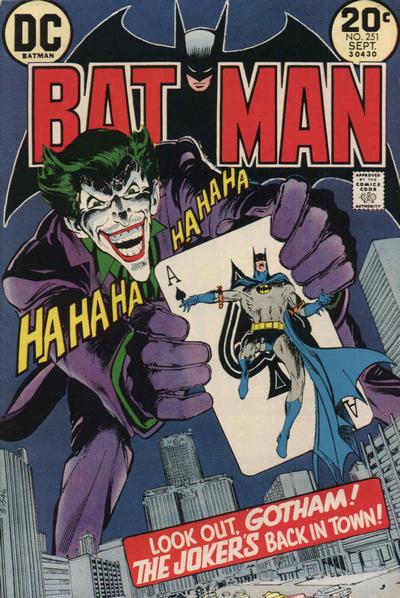
Batman 251 (September 1973)

“The Joker’s Five-Way Revenge!”
Story by Denny O’Neil
Art by Neal Adams

The Joker has escaped from the State Hospital for the Criminally Insane and is killing off his former gang members one by one. Batman tries but fails to protect gang member number two, who laughs himself to death. The Joker kills number three with an exploding cigar. Batman tries to help number four but the punk resists and is killed by the Joker. The Joker ambushes Batman but spares his life. Batman tracks the last former gang member to a closed aquarium at a beach that has been contaminated by an oil spill. The Joker sends the man into a shark tank, where Batman fights to save him. The story ends as Batman confronts The Joker on the beach, finally besting his old foe and dragging him back to the asylum.

PE: Simply, the greatest Batman comic story ever written. I won't hear arguments on this one. I've read that Frank Miller's Batman: Year One and Alan Moore's The Killing Joke were the two most influential sources for Tim Burton and Christopher Nolan when it came time to design their Batman films (we all know what was on Schumacher's mind) but if it wasn't for this story, there wouldn't be Batman: Year One or The Killing Joke or the Loeb/Sale The Long Halloween or Miller's The Dark Knight Returns or anything else edgy and Batman post-1973. I can imagine a world of graphic novels written by the clones of Frank Robbins about plots to steal the keys to the Batmobile or The Return of Aunt Harriet. <shiver> There are so many iconic visuals in this one that I wish we could run the entire story here but it's been reprinted several times and should be easy to track down. #1 shiver-inducing moment, if I had The Crown Prince of Crime's gun to my head and had to choose, would be the ghoulish laughter ringing out as The Joker dumps Bing Hooley and his wheelchair in a shark tank. Let's see Cesar Romero get away with this one!

Jack: It doesn’t get better than this. While O’Neil and Adams revived Two-Face back in Batman 234, this is the first appearance of The Joker since the “new look” Batman began at the dawn of the 70s. Adams sets the tone for what would follow in the following decades, as The Joker would cement his position as Batman’s number-one foe.

PE: To illustrate the power of this story, I have to tell a short story of my own. Back in 1973, I was a maniacal Marvel consumer. I bought all of Marvel's titles, comics and magazines, didn't matter which. I was enthralled by that little logo in the top left corner. For some reason, I picked up Batman #251, itself a milestone considering how much of a Bat-fan I became later on. I had never before bought a DC hero comic. I'd seen them, as a couple friends at school were big JLA and Superman fans. No thanks, thought I. I had also, of course, spent some of my formative toddler years watching William Dozier's Batman TV show. By the time I was 11 years old, which I was when #251 hit the stands, if you admitted on the playground that you still had a fondness for Adam and Burt, you were pretty much on your own for the rest of recess, if not the rest of your life. So, with the campy Bats still in my head, I avoided DC like the plague, but I did pick this one up. It may have been the wild Neal Adams cover or I may have thrown it onto my pile at 7-11 by mistake. For whatever reason, I bought it and read it and re-read it several times over the course of a weekend. I'd never read anything like it before. This Joker kills people! Looking back on it now, it was kismet that I picked up this one and not one of the issues leading up to it. Had I read one of those equally campy Frank Robbins stories, my Bat-fever would have never ignited.

Jack: After months and months of Bob Brown, Frank Robbins, and Irv Novick stories, I felt like I’d been crawling through the desert and finally found water when I read this issue! I wonder if Adams had a hand in the writing as well, since O’Neil’s stories did not often rise to this level.

PE: Actually, according to an interview with Adams in Michael Eury's indispensable The Batcave Companion (Twomorrows Publishing, 2009), Adams was very much put off by the homicidal nature of The Joker and had to be talked into the assignment by Denny. Though I can't comment on the general reaction to the story, I can peek at the letters page of Batman #254 and let you know that readers were almost unanimous in their praise for "5 Way Revenge." The lone holdout does not, however, earn a sneer from me as Michael Sloan presents an intelligent argument for the other side. Sloan offers that O'Neil's Joker is too insane and not in keeping with the classic version. Goodbye to "the classic version" and good riddance, I says. The popularity of the story no doubt convinced Schwartz that Bat-fans were hungry for the rogues' gallery and tired of mob bosses and jaywalkers. In the next ten issues we'll see the return of Cat-Woman, The Penguin, The Scarecrow, and Two-Face. This should be interesting!


Detective Comics 436 (September 1973)

“The Night Has a Thousand Fears!
Story by Frank Robbins
Art by Bob Brown & Frank Giacoia

In order to set up an alibi should he need one, Bruce Wayne begins spreading it around Gotham that he's afraid of the dark. That experiment backfires on him when he's exposed to a drug that causes him to have real night frights. That's not the only trouble Wayne gets into though as stern cop Shotgun Smith discovers several packets of narcotics in Bruce's luggage. As Shotgun heads for the courthouse for a warrant for Bruce Wayne's arrest, Batman investigates his pilot and stewardesses to find out who smuggled the dope into Gotham.

PE: This is the kind of crap that makes you wonder whether Julius Schwartz was serious about a "new look." Simply idiotic in every way. Why would Bruce Wayne spread it around town that he has a night phobia simply so he can change into Batman easier? Does he forget he's been changing into The Dark Knight for the better part of 20 years (in DC time) right under every Gotham-ite's nose without any problem at all?  Batman solves his fear of the dark with a pen-light! Wait, there's more! Batman's phobia must not include the dark night as he's swingin' around town and drivin' his fancy Batmobile without the shakes.

Jack: This is one of those “so bad it’s good” stories. First of all, what is going on with Bruce Wayne and the three stewardesses in the cockpit? Sandy, who turns out to be a dope smuggler, exclaims: “Waynesy can fly Sandy—Anytime—Anyplace!” Next we have the return of Shotgun Smith, last seen in Detective 428. It’s hard to believe that this character would next return—after a 20-year absence—in 1993, and become a recurring figure!

PE: My LOL-panel (I've tried to narrow it down despite the large number of choices) would have to be when Bats is spying on his private jet pilot, Rick, and he's hanging from a ceiling out of sight except for his long flowing cape hanging down!

Jack: Bob Brown’s art is running a close second to that of Frank Robbins for sheer awfulness. I’ve reproduced only a few choice panels here, but there are plenty more along these lines.

PE: You didn't really have to take a look at the credits to know who wrote this mind-numbing claptrap. The splash page has Frank Robbins' 1960s cliches all over it. The only thing missing is an equally frightened Boy Wonder.

Jack: This issue has a cover date of September but is listed in the indicia as August-September—the cover date presumably allowed dealers to leave it out for four months or so (since it appears to have gone on sale in late May).


“Sign of the Two Fingers!”
Story by Elliot Maggin
Art by Dick Giordano

A hardware magnate uses Sue Dibny and her new puppy to convince The Elongated Man to steal a new carbon thread from his competitor.

Jack: I love this series! Elongated Man stretches here, there and everywhere, usually for no good reason beyond the fact that it’s fun to draw and fun to look at.

PE: Yeah, it's goofy fun, certainly a lot more entertaining than the main event. Something I've always wondered about The Elongated Man and Mister Fantastic is whether we're supposed to accept that their heart and other vital organs stretch the same way as their bodies do. Okay, okay, it's a comic book. I'll just go back to "goofy fun!"


Batman 100 Page Super Spectacular (DC-20)
(September 1973)


Jack: This 100-page all-reprint issue included Golden Age Batman stories featuring Two-Face, along with other great reprints from the old days. Just seeing the cover of this comic brings it all back to me. This was the best bargain in town back in 1973--100 pages of wonderful old comics for fifty cents. Now where is that time machine again?

PE:  The best bargain ever in comics has to be the period in which DC loaded up several of its titles in a 100-page format. At the cost of a (then) whopping fifty cents (more than double the cost of a regular comic!), we got the 20 original pages of new story and art that would appear in the regular-sized titles plus 60 pages or so of  “super spectacular material… of yester-year" (according to Julius Schwartz). The 100-pagers were so cool (I mean, where else could a kid, in 1974 pre-Archive and Masterworks days, read stories that appeared ten, twenty, even thirty years before?), DC coaxed me into dumping change down for the likes of Justice League, Wonder Woman, Superman, and Brave and the Bold, titles I wouldn’t normally pick up if you paid me. I was a Marvel Zombie, bought all the titles including Night Nurse, but 100 pages for fifty cents was an offer I couldn’t refuse.


Batman 252 (October 1973)

"The Spook's Master Stroke!"
Story by Frank Robbins
Art by Irv Novick & Dick Giordano

Val Kaliban, alias The Spook, was put to death in the electric chair in 1963. Or was he? With a little help from Jason Bard, The Dark Knight tracks The Spook to his island hideaway and barely escapes being electrocuted himself before proving how the master of escape cheated death.

Jack: “Pfah!” This is what The Spook likes to start sentences with. What is “Pfah?” Is it a verbal tic? An expletive deleted? A throat-clearing noise? Does one pronounce the “P” or is it silent? And if it’s silent, why write it out?

PE: After the extreme high of Batman #251, we come back down to earth with this typically inane Frank Robbins mystery. Most everything that happens in the story really couldn't happen (how did Kaliban/The Spook get back into his own coffin when it's covered with eight feet of dirt? Does he have henchmen we're not privy to yet? A doorway into the coffin from one of those underground corridors? I can't tell you as it obviously wasn't important to Robbins to write a realistic story. Why does Jason Bard take a role in this story? Wouldn't he have to know that Alfred is butler to Wayne and therefore Bruce Wayne is... oh, never mind.

Jack: The essential Scooby-Doo-ishness of The Spook is hard to overcome, but the art is pretty slick. I just wish The Spook didn’t look like he was dancing a jig in so many panels.


"The King from Canarsie!"
Story by Elliot Maggin
Art by Dick Dillin & Dick Giordano

Danny Kaye? No, Davy King!
Not THAT Marvel
Family, Peter.
Beloved movie star and humanitarian Davy King is at Hudson U to get a college education after years in show business. Lucky for him, Robin is always nearby because someone is trying to kill him! It turns out it’s his agent, who is trying to scare him away from campus so he can get back to work.

Jack: The story is dedicated to Danny Kaye, which is helpful because he is so carefully disguised as Davy King that I never would have guessed who he was supposed to be. I have a real soft spot for Danny Kaye, especially in movies like The Court Jester and The Secret Life of Walter Mitty, but this story misses the mark.

PE: The awkward splash almost seems to depict Davy King with an erection after seeing Robin. Why would a comic book base one of its characters on Danny Kaye? Life imitates art, so they say, and I can see a league of eleven year-olds scratching their collective head and exclaiming "Who's Danny Kaye?" Aside from that, the story's just another rushed cliche. Most of the "accidents around campus" happen in one crammed panel, including a car going off a cliff which means that campus is awfully big, and the villain is the only other character we're introduced to. No mystery here.

Schwing!


Saw the announcement (above) for The Amazing World of Superman theme park, including admission fees, and wondered whatever happened to that. Turns out the city couldn't get a highway to run past the projected park site and everything went downhill from there. A pity since the proposal art (by none other than Neal Adams) made this look like a fun place to visit had it come to fruition. The way the economy's been in the last four decades though, chances are the place would have been built and then gone under fairly quickly. A fabulous website dedicated to the project (including those Adams drawings) can be found here.

Neal Adams' conceptual art for Supes' theme park


Monday, July 2, 2012

Batman in the 1970s Part 25: May, June and July 1973


by Jack Seabrook 
& Peter Enfantino 


Batman 249 (June 1973)

"The Citadel of Crime"
Story by Frank Robbins
Art by Irv Novick & Dick Giordano

Batman suspects that an abandoned castle on an island near Gotham is the cover for a big underworld gun supply depot. As Bruce Wayne, he sets up a floating cabaret on his yacht for his fellow wealthy citizens. A fireworks display fails to mask proof of the gun running, and Batman thwarts the operation and catches the millionaire behind it.

PE: YE-AH! So Batman has his own checking account at the Bank of Gotham? Really? Let's analyze that for a bit, go over the possible holes in that theory. He's written a check for a hundred grand which means he obviously has to deposit that money. This is before the days of direct deposit and he wouldn't have Alfred bring the money in (he might make that little hippy ward of his though) so, ostensibly, he walks into the bank with a sack of cash. It has to be currency or there'd be a paper trail otherwise. That's quite a lot of cash and that should raise questions with the government, never mind the bank manager. Does he pay taxes or does he file under Gotham's "Superhero Capital Gains Exemption"? If he's got at least a few hundred grand in that bank, all roads lead to the Feds and from there to Bruce Wayne. Oh, the story? Meh.


Jack: The Marla Manning subplot is painful. Why does Bruce Wayne have to develop a reputation as a cheap, callous millionaire just to get in with the members of an exclusive club? Don’t they all know him by now? P.S.: May 1973 is the first month so far in the 1970s without a Batman or a Detective being published.


"Case of the Kidnaped Crusader"
Story by Elliot Maggin
Art by Bob Brown & Frank McLaughlin


Consumer advocate Tom Carson disappears during a test drive with one of Dick Grayson’s fellow students. It takes Robin, the Teen Wonder, to solve the case.

PE: I am convinced that Frank Robbins recommended Elliot Maggin to Julius Schwartz to make his own writing look better. The only bright spot of this otherwise tedious strip is that it answers one of the Top Ten Fanboy questions: Do Teenage Superheroes get Acne?


Jack: McLaughlin’s inks give Brown’s pencils an angular look that they don’t usually have, but the story is forgettable. Carson was last seen on Detective 415, when Batman had to prove he (Carson, that is) was not guilty of a crime.


Detective Comics 435 (July 1973)

"The Spook Strikes Again!"
Story by Frank Robbins
Art by Irv Novick & Dick Giordano

Disguised as Big Turk Ramis, Batman lies in wait for The Spook but the scary bad guy isn't buying the disguise (could it be the big bat ears sticking out of Turk's skull?) and heads out the door. Before he can get very far, Batman unmasks The Spook, only to find it's prison-guard Jim Baines, who's been hypnotized by the real Spook. The ruse was all just to distract Batman long enough for the real Spook to help the real Turk bust out of the pokey. But the question is, how did the duo break out of a cell that was advertised as "escape-proof?" The answer is a false floor that leads down into the sewers below the prison. That's not the end of The Spook's secrets though as The Dark Knight stumbles onto a vast network of underground passages and hidey-hos. After a bit of trickery on Batman's part, The Spook is taken into custody but, once fingerprinted, it becomes evident that the mystery surrounding this villain has just begun.

PE: I love how Bats takes his Big Turk Ramis mask off and he has his Batman mask on! Now how in the world did he hide that pointy nose and those extremely... rigid ears? I'm dying to know. What's even more mystifying is that he actually asks The Spook "How'd you know it was me?!" Speaking of disguises, The Spook has an ultra-cool one but the realist in me asks if his face is set in shadows or if he has a flat black mask. Novick & Giordano do their best to make The Spook look exactly like a Saturday morning cartoon with his hood and huge blue eyes swimming in a sea of black shadows.

Jack: I like this two-parter! It veers close to Scooby-Doo territory, especially in the abandoned subway section scene, but the ambiguous ending worked. Novick and Giordano turned in a solid job on the art and the story was tricky enough to stay interesting. The Spook will return very soon in Batman!

PE: But this strip lives in Scooby-Doo land, Jack. The obvious reason why we enjoyed this adventure as opposed to most of Frank Robbins' scripts is that this has a touch of the macabre. The supernatural aspect, of course, is explained away but it's still an improvement over maniac truck drivers or art thieves. The real identity of The Spook could have been a big reveal, a la The Green Goblin, but since there's no continuity to speak of in the DC Universe as of this point in time, he's just a face to us. The final reveal though is certainly more intriguing than what I thought it would be: a disgruntled sewer worker or a disgraced librarian. The real lapse in reality here is not the fact that this shadowy villain retrofitted an entire underground world for his own devices but the fact that he'd stop the action long enough to tell Batman some of his "supernatural" secrets simply because our hero asks him! "So, you wanna know how I walk on walls? Hee hee, well, here's how I do it! With suction cups!"

Jack: Detective Comics began in March 1937 and was a monthly comic for 36 years (36 x 12=432 issues), but it finally switched to a bi-monthly as of this issue, #435. The indicia of issue 434, dated April 1973, says it is monthly. The indicia of issue 435 say it is bi-monthly, with a date inside of June-July 1973 and a cover date of July. Detective would remain a bi-monthly for about a year and a half, reverting to monthly with the April 1975 issue (446). Why did Detective finally go bi-monthly in early 1973? Our New Criticism study of the comic would suggest it was due to a decline in quality, but that’s unlikely. We do know that sales of DC comics declined across the board following the unsuccessful attempt to raise the cover price to 25 cents in 1971 and 1972. Perhaps cutting back publication of Detective was part of the fallout.

"Case of the Dead-On Target!"
Story and Art by Frank Robbins

Jason Bard investigates the mid-air murder of sky diver Rip Williams.

PE: I thought no way will Robbins do it but, yep, when Rip Williams hits the ground he makes a body-shaped hole just like in the Road Runner cartoons. Another dopey Jason Bard story capped off by an expository so long it threatens to bust out of its panel.

Jack: Frank Robbins must have been frustrated that no one was illustrating his Jason Bard stories properly so he decided to do it himself. And it’s not half bad! Of course, the idea that Bard would have to go up in the plane and re-enact the crime in order to solve the murder is patently ridiculous, and the characters looks like rejects from a Bee Gees concert, but for some reason I did not mind this story. Perhaps it’s the incredibly low bar set by prior Jason Bard case files.

At least she did not forget him...


Batman 250 (July 1973)

"The Deadly Numbers Game!"
Story by Frank Robbins
Art by Irv Novick & Dick Giordano

Odd thefts of unusual items plague the city of Gotham, but Amos Raven’s Historical Waxworks Museum is the beneficiary of the stolen items and attendance surges as a result. Batman figures out that there is a pattern to the crimes and he is able to stop the culprit just in time before he murders an innocent young woman. It turns out that the crook is an inquiring newspaper reporter who wanted to help the museum’s owner who had raised him from a child.


PE: Slow week in Gotham when a story on the six o'clock news about a hatchet has all of the city showing up to the wax museum the next day! I was like, this town ain't swingin' much, dad! If you study the dialogue in that panel below you'll uncover the "Frank Robbins is a hipster" fraud. "Like wild, man! Aren't those the hot oysterettes (hipster dialect) which were lifted last night (non-hipster dialect)?" Frank Robbins watched a lot of TV, I'm guessing.


Jack: One of the less plausible Frank Robbins plots, and that’s saying something! (It's saying you still haven't taken that vacation yet, Jack!-PE) I can buy the reporter committing all of the crimes, but why would he stoop to murder? We’re supposed to believe he is doing it out of the goodness of his heart in order to help his adopted father, whose old-fashioned museum can’t compete with the X-rated movie houses in the neighborhood! Only Fantastic Frank could come up with this one!

PE: Never mind the attempted beheading, what about the poor little six year-old at the police precinct reporting his stolen birthday cake? It's lucky Batman was there to witness this felony. I should have known Robbins would drop the ball when it came time to revealing where the stolen planet Uranus was located in the museum. I guess I'm just repeating myself when I say it can't get much worse than this.


"Return of the Flying Grayson!"
Story by Elliot Maggin
Art by Irv Novick & Frank McLaughlin

After some local kids buy a poster of the Flying Graysons, Dick is reminded of his childhood and the accident that took the life of his parents. His acrobatic skills come in handy later on, when he has to stop a truck driven by an art thief from killing the same kids!

Jack: It’s neat to be reminded of Robin’s origin, but that’s about all that’s worth mentioning in yet another backup story filler.


PE: Those kids sure are fast walkers. They watch the truck speed by them and then two panels later it's about to tip over on them. These stories only make me scratch my head over the timelines in comic books. How long has elapsed in the DC Universe since Grayson's parents were killed? Twelve years? If that's so, let's put Bruce Wayne at 30-ish when he rescued little Dick from a life as a street urchin. That would make him 40-45. That's where the aging process breaks down for me.

"The Batman Nobody Knows!
Story by Frank Robbins
Art by Dick Giordano

On a camping trip with three boys from the ghetto, Bruce Wayne gets to hear their descriptions of Batman’s unusual appearance and abilities. When the real Batman appears, the boys tell Wayne that he looks nothing like the Caped Crusader and should stop playing games!


Jack: This six-pager took me by surprise! It’s a charming little tale about childrens’ perceptions, nicely illustrated by Dick Giordano. The twist ending was clever as well. It’s a shame that the best story in this issue had to come last! Don’t worry, though, because next issue . . .

PE: YE-AH! I'm not sure if it was the length of the story but this is the best Frank Robbins has offered up yet in the 1970s. Now put it in the rear view and bring on...